The conversation around artificial intelligence in talent acquisition has reached a critical inflection point. As HR and TA leaders, we’re no longer asking whether AI will transform our function, but rather how we can harness its potential while preserving the irreplaceable human elements that make great recruitment truly exceptional.
Recent insights from PeopleScout’s exclusive client forum reveal a fundamental truth: the future of talent acquisition isn’t AI-driven or human-led. It’s both. And understanding this balance is essential for leaders preparing their teams for what comes next.
Beyond the Hype: Understanding AI’s Evolution in Talent Acquisition
AI in recruiting is more nuanced than many realize. We’re witnessing a significant shift from generative AI to agentic AI, and the distinction matters enormously for how we structure our teams and strategies.
Generative AI (Gen AI) automates predefined, repeatable tasks through fixed rules and workflows. It’s been valuable for creating job descriptions, drafting candidate communications, and handling routine administrative work. However, it operates within defined parameters, offers limited flexibility, and requires retraining as needs evolve.
Agentic AI represents the next frontier. Agentic AI systems are designed to act autonomously to achieve specific goals, executing multi-step processes without continuous human intervention. Across the talent acquisition lifecycle, we’re seeing agentic AI support campaign management, candidate matching, interview scheduling, and even vendor management. The technology is moving from simple task automation to sophisticated problem-solving that mirrors human reasoning.
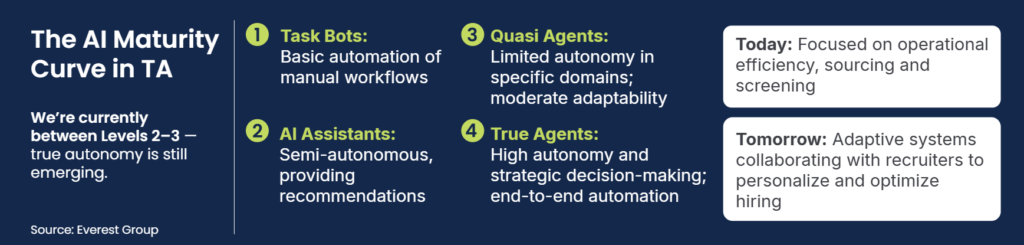
Yet here’s the reality check: we’re currently positioned between Levels 2 and 3 on the AI maturity curve. Most AI agents today resemble robotic process automation (RPA), rather than being truly agentic. True AI agents with high autonomy and strategic decision-making capabilities are still emerging. Understanding where we are on this journey helps set realistic expectations and strategic priorities.
👉 Learn more in our AI & Technology in Recruitment Resource Center
The Transformation of the Recruiter Role
This technological evolution is fundamentally reshaping what it means to be a recruiter. The administrative burden that once consumed 60-70% of a recruiter’s day is being systematically automated. Interview scheduling, ATS updates, offer letter generation, initial candidate outreach—these tasks are increasingly handled by AI systems that work faster and more consistently than any human could.
But rather than diminishing the recruiter’s importance, this shift is elevating it. The role is transforming from a transactional coordinator into a strategic talent advisor, and this evolution demands new competencies alongside enhanced application of timeless human skills.
What Humans Do Best
As AI handles the admin, recruiters can focus on what technology cannot replicate. Building authentic relationships remains fundamentally human work. The ability to assess cultural fit, understand nuanced candidate motivations, and read between the lines of a conversation requires empathy, intuition and emotional intelligence that no algorithm can match.
Strategic judgment becomes even more critical in an AI-augmented environment. Recruiters must translate data into market insights, embed employer value proposition messaging authentically into every interaction, and solve complex hiring challenges creatively. They serve as brand ambassadors who represent not just open positions, but organizational culture and values.
Context and ethics matter more than ever. When AI generates insights or recommendations, humans must critically evaluate them, understand their limitations, and apply judgment about when to follow the data and when to trust instinct. This interpretive layer is what prevents AI systems from perpetuating biases or making recommendations that look good on paper but fail in practice.
The New Skill Set
The strategic talent advisor role requires recruiters to develop new competencies that didn’t exist five years ago. Prompt engineering—the ability to interact effectively with AI systems to generate optimal results—is becoming as fundamental as Boolean search once was. Data literacy is no longer optional; recruiters must understand how to interpret AI-generated analytics, recognize patterns and challenge assumptions embedded in algorithmic outputs.
Perhaps most importantly, recruiters need to learn how to work alongside AI as a collaborative partner rather than viewing it as either a threat or a magic solution. This means understanding what AI does well, where it falls short and how to create workflows that leverage the strengths of both human and machine intelligence.
Using AI Responsibly
Adopting AI without guardrails is a recipe for problems that can damage both employer brand and hiring outcomes. Responsible AI implementation in talent acquisition must be built on four pillars: fairness and bias mitigation, explainability and transparency, data privacy and security, and ethical governance.
Fairness isn’t automatic because an algorithm is involved. In fact, AI systems can perpetuate and amplify existing biases if not carefully designed and monitored. TA leaders must demand transparency from tech vendors about how their AI systems make decisions and what safeguards exist against discriminatory outcomes.
For recruiters, it’s imperative that they understand why AI is ranking one candidate over another. “The algorithm says so” isn’t acceptable when making decisions that affect people’s livelihoods and careers. Transparency builds trust with both internal stakeholders and candidates.
Moving Forward: A Human-Centered Agentic AI Recruitment Strategy
The imperative is clear: develop an AI strategy that amplifies rather than replaces human decision-making. This means investing in both technology and people, ensuring your team has the skills to work effectively in an AI-augmented environment.
The future belongs to organizations that master this balance—that deploy AI agents for what they do well while doubling down on developing the uniquely human skills that create exceptional hiring outcomes. The recruiters who thrive won’t be those who resist AI or those who defer entirely to algorithms, but those who become strategic talent advisors capable of orchestrating both human and artificial intelligence toward shared goals.