The April 2026 jobs report points to a labor market that remains resilient, but increasingly cautious. U.S. employers added 115,000 jobs last month, outperforming expectations despite ongoing uncertainty tied to higher energy costs and geopolitical tensions in the Middle East. The unemployment rate held steady at 4.3%, while wage growth moderated slightly to 3.6% year over year. Hiring remains concentrated in sectors like healthcare, transportation and retail, while areas including information and financial services continued to lose jobs.
The Numbers
- 115,000: U.S. employers added 115,000 jobs in April.
- 4.3%: The unemployment rate remained unchanged.
- 3.6%: Wages increased 3.6% over the past year.
The Good
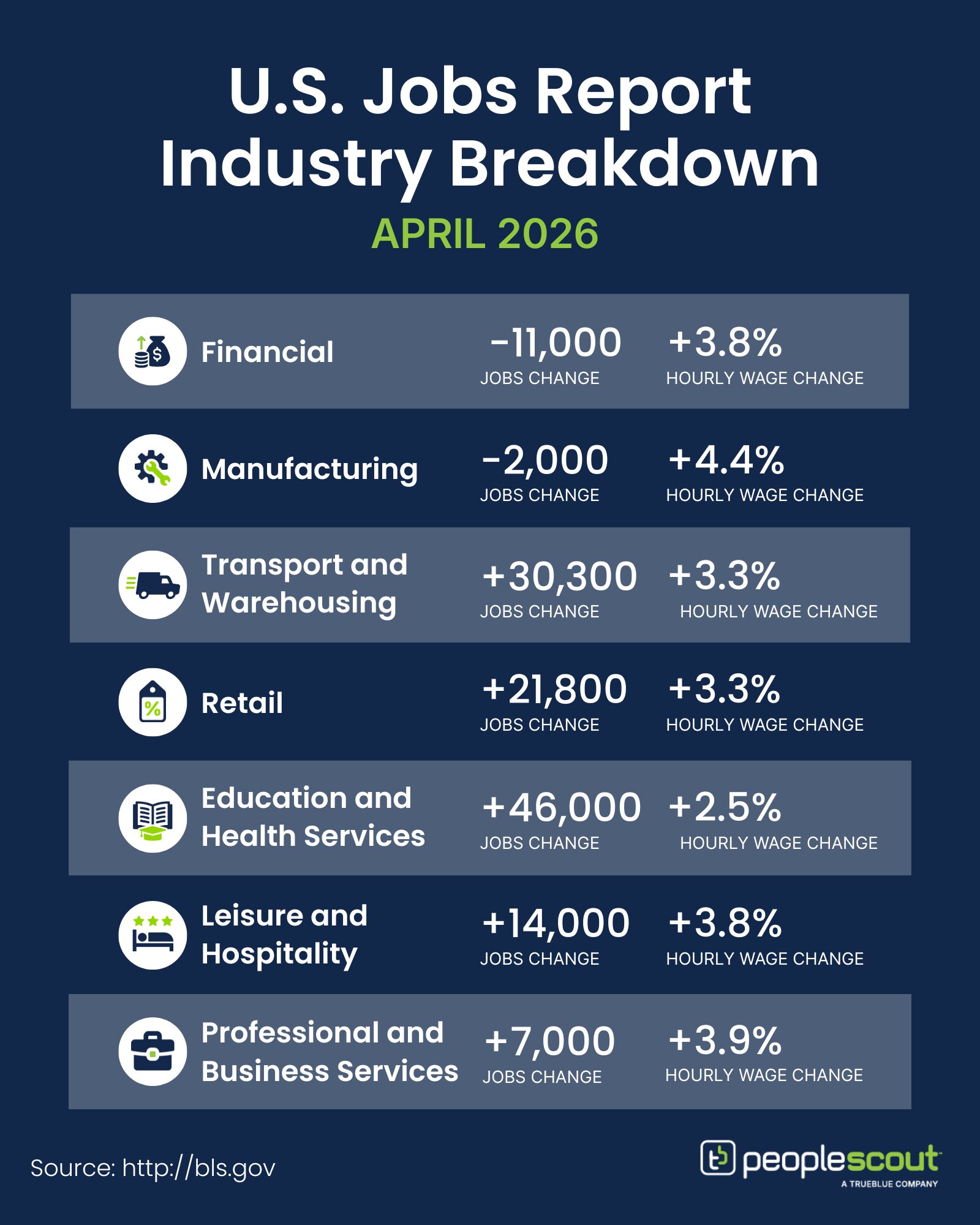
April’s report exceeded expectations and marks a second consecutive month of positive job growth, reinforcing the labor market’s resilience despite broader uncertainty. Healthcare led hiring again, adding more than 37,000 jobs, while Transportation and Warehousing (+30,000) and Retail (+22,000) also posted gains. Layoffs also remain limited, even as hiring slows. For talent leaders, this continues to support a competitive environment for critical skills and experienced talent. Wage growth also continues to cool gradually, which may provide some relief for organizations balancing hiring needs with cost management objectives.
The Bad
Despite the stronger-than-expected headline, the broader labor market remains sluggish by historical standards. Labor force participation declined again in April, while the number of workers employed part-time for economic reasons increased significantly. Sector performance also remains uneven. Information services lost 13,000 jobs, while financial activities declined by 11,000. Employers in technology and corporate functions continue to evaluate efficiency, automation and long-term workforce structure. While AI has not triggered widespread displacement, talent leaders are increasingly reassessing which roles drive the greatest strategic value and where productivity gains may reduce future hiring demand. At the same time, elevated gas prices and persistent inflation continue to pressure both businesses and consumers, which could weigh on hiring activity in the months ahead.
The Unknown
Geopolitical uncertainty remains a key variable. While the labor market has so far remained relatively insulated from the economic effects of the Iran conflict, sustained increases in fuel and transportation costs could eventually impact consumer spending, business confidence and hiring activity. Many employers appear to be taking a wait-and-see approach while evaluating how broader economic conditions unfold over the coming months. For talent leaders, this environment reinforces the importance of agility. Hiring strategies built around flexibility, workforce planning and critical-skill prioritization may prove more effective than broad-based expansion strategies in the current market.
Conclusion
The April 2026 jobs report reinforces a labor market that continues to slow gradually without significantly weakening. Hiring remains positive, unemployment is relatively stable and layoffs are still limited—but growth is increasingly concentrated in select sectors, while employers remain cautious about long-term workforce expansion. Rather than scaling hiring aggressively, many employers are prioritizing operational efficiency, targeted workforce investments and retention of high-value talent. Success in the months ahead may depend on balancing short-term cost pressures with long-term workforce readiness—ensuring organizations remain adaptable while continuing to secure the talent most critical to future growth.