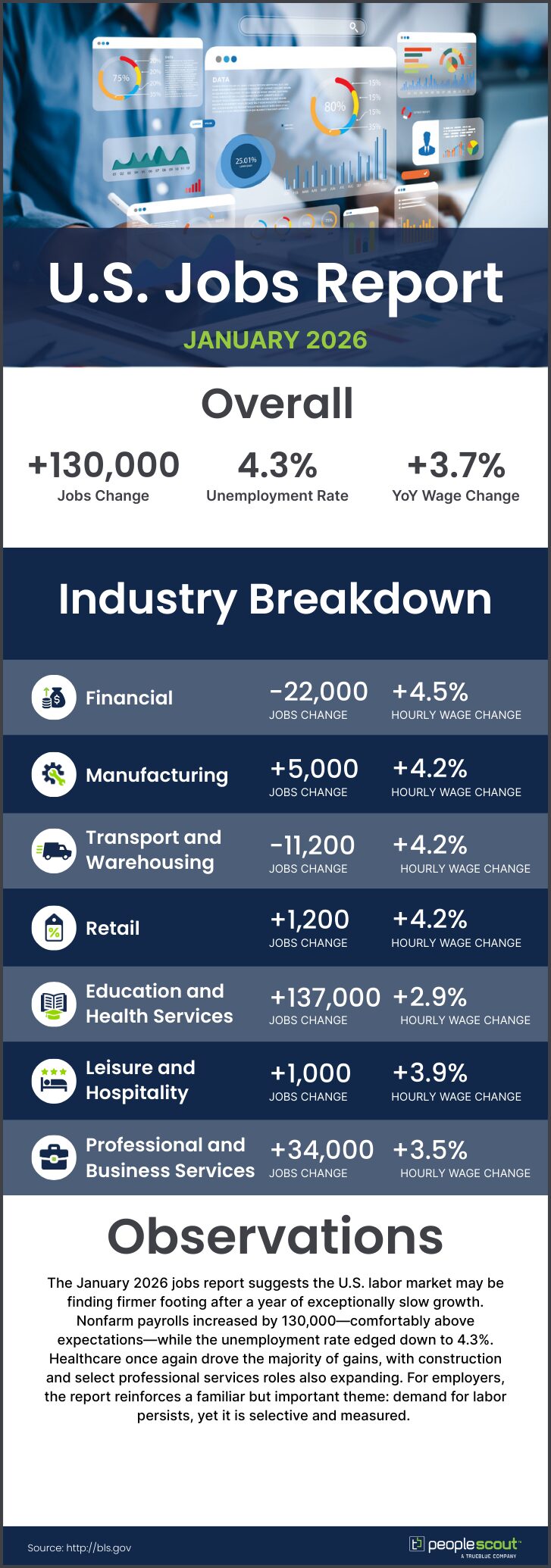
The January 2026 jobs report suggests the U.S. labor market may be finding firmer footing after a year of exceptionally slow growth. Nonfarm payrolls increased by 130,000—comfortably above expectations—while the unemployment rate edged down to 4.3%. Healthcare once again drove the majority of gains, with construction and select professional services roles also expanding. For employers, the report reinforces a familiar but important theme: demand for labor persists, yet it is selective and measured.
The Numbers
- 130,000: U.S. employers added 130,000 jobs in January.
- 4.3%: The unemployment rate dropped to 4.3%.
- 3.7%: Wages rose 3.7% over the past year.
The Good
January’s stronger-than-anticipated payroll growth tentatively suggests that hiring momentum is stabilizing. Private employers added 172,000 jobs, indicating organizations are still willing to invest in talent where demand supports it. The unemployment rate dipped slightly and remains within a range that is historically consistent with a healthy labor market. Healthcare continued to demonstrate remarkable durability, adding more than 80,000 jobs and accounting for a substantial share of total hiring. The construction industry also posted another solid month (+33,000). For talent leaders, these signals point to continued competition for critical skill sets rather than a broad-based pullback.
The Bad
Beneath the headline, the report confirms that overall labor market growth remains limited. Outside of a few industries, many sectors were flat. The most consequential development came from last month’s revisions to 2025 data, which showed the economy added just 181,000 total jobs, down sharply from the previously reported 584,000. This reframes last year as one of the weakest periods for job creation outside of a recession and indicates a far tighter, more competitive environment than earlier numbers implied. Other factors reinforce the picture of caution: job openings have trended down, long-term unemployment remains elevated compared with a year ago and hiring activity continues to trail historical norms.
The Unknown
The January improvement raises an important question: is this the beginning of a gradual reacceleration or simply variability within a slow-growth cycle? Seasonal factors, benchmark adjustments and shifting participation trends make early-year readings particularly complex. Economic dynamics, geopolitical risk and rapid advances in AI-driven productivity continue to shape how employers think about workforce investment. At the same time, the Federal Reserve has indicated it can afford to be patient as it evaluates incoming data, leaving borrowing conditions relatively stable for now.
Conclusion
January’s report provides cautious optimism. Hiring proved stronger than expected, unemployment remains contained and several core industries continue to expand. Yet the sweeping downward revisions to 2025 serve as a reminder that the labor market has been operating with far less momentum than many believed.