Why Companies Outsource Recruitment
The Recruitment Process Outsourcing (RPO) industry is currently valued at $7 billion to $8 billion annually with analysts forecasting continued growth at a rate of 9% to 20% per year over the next four years. These values include companies of all sizes with 58% of the market made up of large organizations and 32% of the market comprised of SMEs (small and medium enterprises). In this article we will work to provide an answer to the question: why do companies outsource recruitment?
Establishing Parameters for Comparison
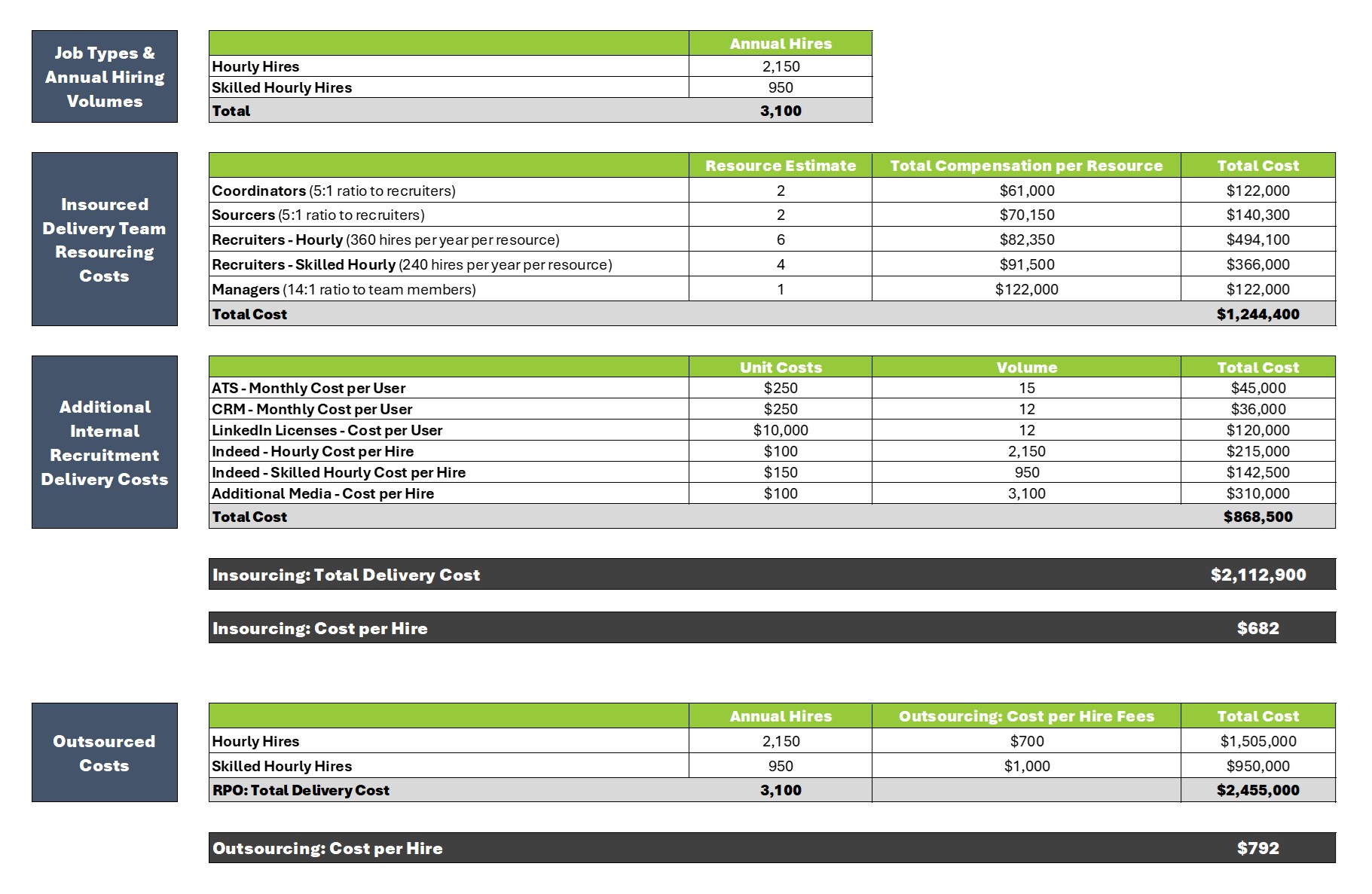
To compare insourcing costs to those of outsourcing we will first need to establish what the delivery costs of an insourced model are. Afterwards, these costs can then be compared to the typical fees seen from leading outsourced providers. However, this portion of the analysis is only part of the story. Afterwards, we will examine the financial benefits gained from outsourcing. These are primarily driven by improvement in Time to Fill that then translates to reductions in Overtime and Contingent Labor spend as well as increased revenue generation.
Internal Delivery Costs Versus Outsourcing Fees
Example hiring scenario with anticipated delivery costs factored in for comparison
Factoring the Positive Financial Impacts Anticipated with Outsourcing
A key driver in deciding to partner with an outsourced recruitment provider is the ROI that results from improved recruitment performance. For most clients, this includes reductions in Time to Fill, ranging anywhere from five to fifteen days. Often, the ROI delivered is more than the cost of an outsourced model. In the table below, we have used realistic yet conservative performance improvements and applied standard accounting principles to them, arriving at final figures for the anticipated financial impact of our illustrative hiring scenario.
Overtime (OT) and Contingent Labor (CL) Cost Savings Analysis Based on Improved Time to Fill
Time to Fill represents the duration from requisition open to a new hire starting. It also represents an amount of work that needs to be covered through overtime (OT) or contingent labor (CL) support. In the table below we look at the cost of work that is either covered by OT or CL and have estimated that 75% of unfilled work can be covered.

Revenue Generation Analysis Based on Improved Time to Fill
A portion of work that results from unfilled roles needs to be attribute to lost revenue. For hourly positions, this will be the remainder of unfilled work not covered by OT or CL. Here we have estimated that 25% of unfilled work can be attributed to lost revenue.

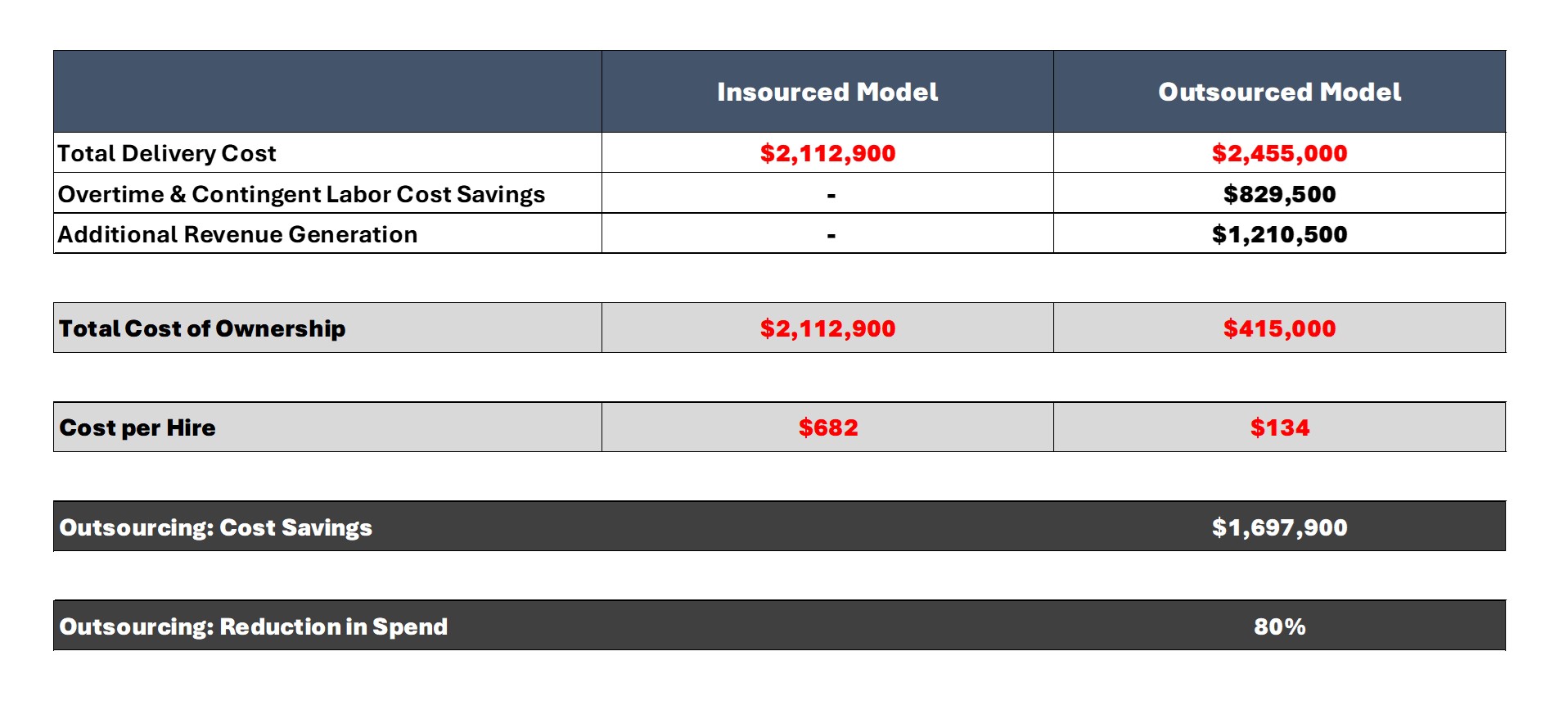
Insourcing Versus Outsourcing: Comparing Total Cost of Ownership
The table below includes our calculations up to this point. While it is not all encompassing as further analysis could be done to review the financial impacts associated with turnover and on-the-job performance; it does provide a window into the answer of why companies are outsourcing recruitment. Gains realized through improvements in Time to Fill, lead to reductions in Overtime and Contingent Labor spending as well as increased revenue generation, that far outweighs the incrementally higher delivery cost of an outsourced model.
Here red text represents negative spend while black text represents positive cost savings or revenue generation.