Something unexpected is happening in hiring.
Organizations globally are investing more than ever in AI-powered recruitment tools. Automated screening, intelligent matching, ATS upgrades—the technology budget for talent acquisition has grown significantly over the last three years. The efficiency gains are real. AI handles higher volumes of applications, reduces time-to-hire and brings consistency to screening at a scale.
And yet, according to our recent research, the candidate experience is getting worse.
PeopleScout’s latest research report, Inside the Candidate Experience 2026, is our most comprehensive global study of hiring from the candidate’s perspective. We surveyed more than 1,000 job seekers across 10 markets, audited employer hiring processes across more than 20 industries using our Candidate Experience Index and compared the results against our 2023 research. The findings challenge some of the core assumptions driving investment in hiring technology right now.
The Numbers: A Disappointing Trend Emerges
Our proprietary Candidate Experience Index scores the recruitment process across five stages—from how findable an organization is, to what happens after a candidate applies. In 2023, the post-application Engagement stage scored 24 out of 100. In 2026, it dropped to just 9.
Every other stage declined too: Awareness fell from 90 to 77, Application from 55 to 38, Activation from 39 to 23, Consideration from 53 to 40. Not a single stage improved. This happened during a period of record investment in hiring technology.
The candidate survey reflects this. Just 11% of candidates globally rate their most recent application experience as excellent. In 2023, fewer than two in ten rated it as excellent. Three years later, the floor has not moved.
So, What’s Going On?
What has changed since 2023 is not the experience, it’s the tools.
Three years ago, AI in hiring was largely an employer capability. Candidates experienced its effects without having equivalent access. Today, that has changed. More than half of job seekers globally (52%) said they used AI in their job search to write applications, research companies, optimize résumés and CVs and prepare for interviews.
Both employers and job seekers are using AI during the recruitment process. But no one is talking about it. Both sides can now move faster. Yet, they communicate less.
Generally, candidates are not using AI to game the system. Only 3% say their primary motivation was getting past screening tools. The dominant reasons are saving time (38%) and improving language (40%). When you set those motivations alongside a 64% ghosting rate—the proportion of candidates ghosted in more than half their applications—a picture emerges. Candidates have been trained, by consistent and repeated employer behavior, to treat applications as low-investment transactions. If most applications disappear into silence, why invest three hours in preparing each one? Leveraging AI to complete them quickly is the rational response.
Candidates have been trained, by consistent and repeated employer behavior, to treat applications as low-investment transactions. If most applications disappear into silence, why invest three hours in preparing each one? Leveraging AI to complete them quickly is the rational response.
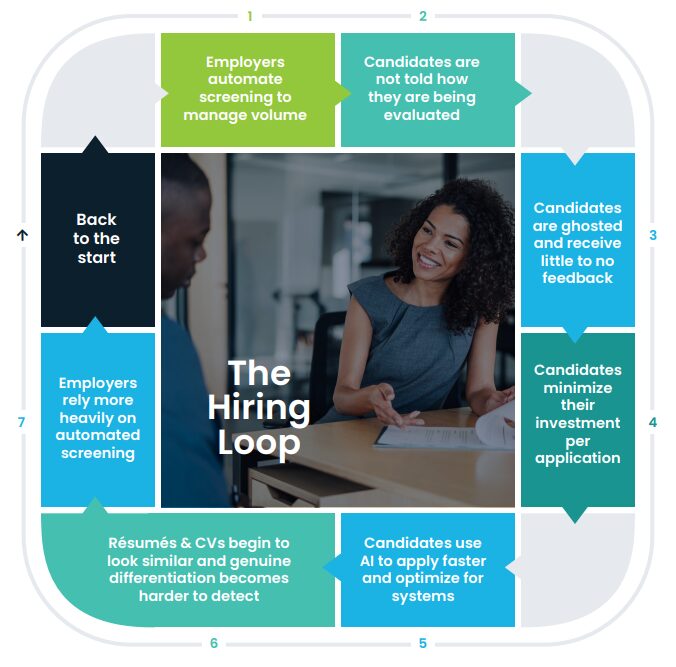
The loop this creates is self-reinforcing. Employers implement AI screening to manage rising volumes. Candidates adapt by investing less and applying faster. Applications start to look the same. Genuine differentiation becomes harder to detect. Employers rely more heavily on automated screening. Repeat.
The Revenue Impacts of a Poor Candidate Experience
Here is what makes this more than a candidate experience problem: 36% of candidates with a negative experience say they would stop purchasing from that company. And 37% say they would tell others not to apply. For consumer-facing employers, the candidate pool and the customer base are the same people. These aren’t recruitment metrics—they’re revenue metrics.
The efficiency savings from AI-powered screening are real. But they should sit alongside another number: the revenue exposure created when the candidate experience drives customers away. Most organizations are measuring one. Very few are measuring both.
The efficiency savings from AI-powered screening are real. But they should sit alongside another number: the revenue exposure created when the candidate experience drives customers away.
AI Works Best on a Solid Foundation
The most striking finding in this research is also the most actionable. The organizations producing the best candidate experiences in our study are not the most technologically sophisticated. They are the most communicative. They tell candidates how AI fits into their process. They follow up beyond the auto-responder email.
India is the most AI-advanced market in our study and provides the clearest proof of concept, with 84% of candidates using AI in their job search. It is also the most communicative country—64% of Indian candidates received some communication about AI use from at least one employer. India has the lowest ghosting rate in the Asia-Pacific region (56%), the highest positive experience rate (48%), and the strongest candidate confidence in human review of any APAC market.
The same pattern holds in Germany, which proved to be the most transparent market in EMEA, with the lowest ghosting rate in the region (38%) and the highest positive experience rate (47%).
In these countries, employers are communicating openly, ghosting rates are lower and trust amongst candidates is stronger. The correlation is not coincidental. It is a blueprint.
AI works best when it is built on a foundation of clear communication and transparent processes. Without that foundation, the investment in screening technology and other AI-powered automations produces diminishing returns—because jobseekers are investing less in their applications, and lower effort means a lack of candidate differentiation to inform hiring decisions.
The data is consistent across every region, every market and every demographic group we surveyed: candidates want to be treated as people, not processed as applications. They want their time to be respected. They want to understand what is happening throughout the hiring process and why. They want honest feedback when things don’t work out. None of these require new technology. All of them require a decision that communication is non-negotiable.
Successful organizations will build the candidate experience that makes every subsequent hiring campaign more effective, more efficient and more human.
To get the full research and more actionable insights, download the Inside the Candidate Experience 2026 report.