August’s jobs report offers a more encouraging read on a labor market that had been losing momentum over the summer. U.S. employers added 162,000 jobs, nearly triple forecasts, while June and July were revised up by a combined 55,000. The unemployment rate held at 4.1%, even as more workers entered the labor force, while wages grew 3.1% year over year.
The numbers
- 162,000: U.S. employers added 162,000 jobs in August.
- 4.1%: The unemployment rate held steady at 4.1%.
- 3.1%: Wages increased 3.1% over the past year.
The good
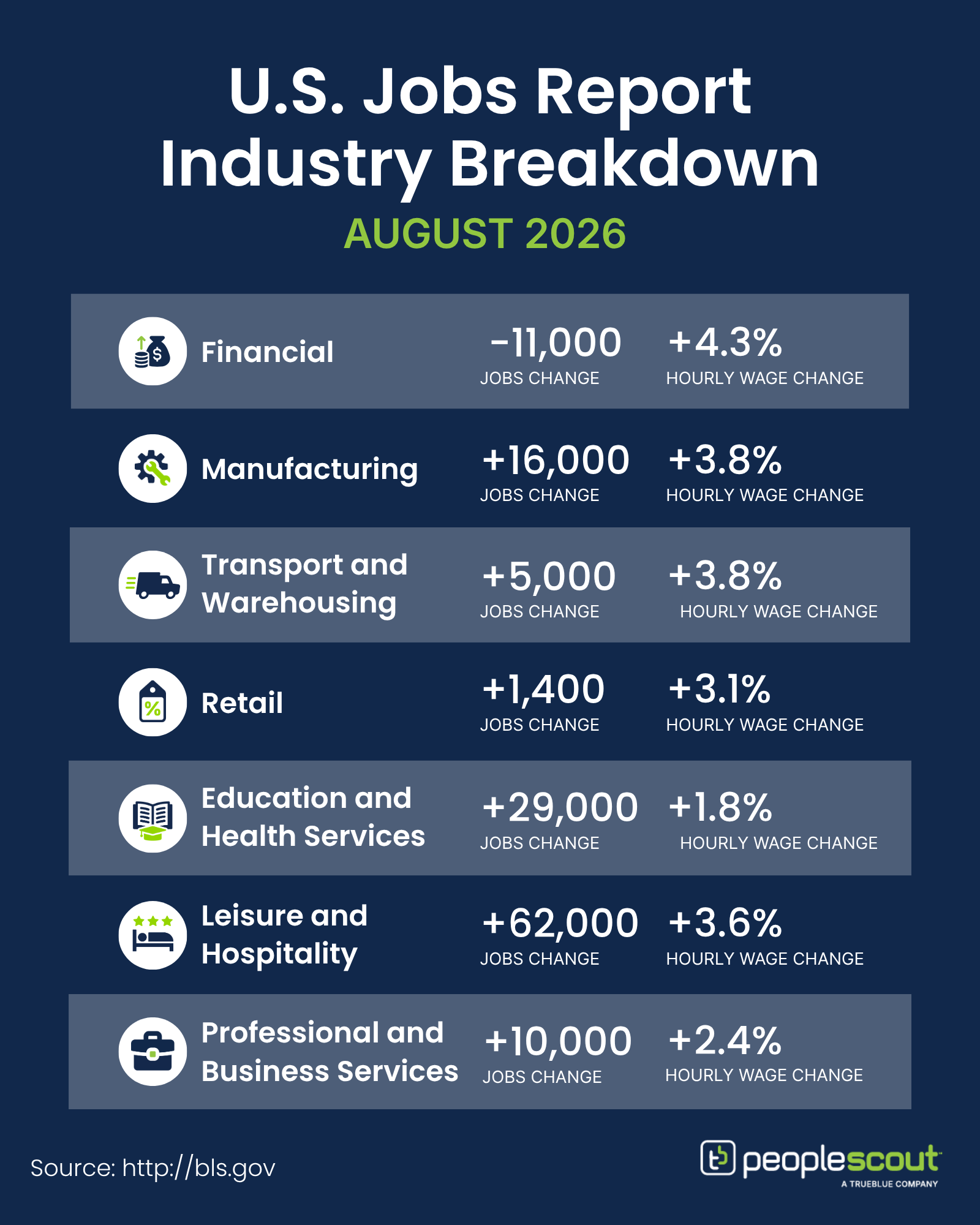
August offered a more encouraging signal for the labor market, with employers adding 162,000 jobs—nearly triple expectations—while the unemployment rate held steady at 4.1%. Upward revisions to June and July added another 55,000 jobs, suggesting the summer slowdown may not have been as pronounced as initially reported. Labor force participation also increased to 61.6%, while the broader measure of unemployment fell to 7.7%, its lowest level since June 2025. Hiring was also more broad-based than in recent months. Leisure and Hospitality led with 62,000 new jobs, including 59,000 in restaurants and bars. Notable gains were also seen in Education and Health Services (29,000), Manufacturing (16,000), and Professional and Business Services (10,000). Layoffs also remain historically low, reinforcing a picture of a labor market that is stable rather than contracting.
For talent leaders, the combination of stronger hiring, low layoffs and a growing labor force suggests employers have some room to move forward on hiring where business demand is clear. Competition for frontline and other in-demand talent is likely to remain elevated, making retention and speed-to-hire important even as broader hiring conditions remain measured.
The bad
Not every sector shared in the month’s momentum. More than 60% of the month’s job gains came from Leisure and Hospitality and local government education, while healthcare—one of the most consistent sources of job growth over the past year—added just 13,000 jobs, well below its prior 12-month average of 32,000. Wage growth continued to cool, with average hourly earnings up 3.1% year over year—the slowest pace since the pandemic-era slowdown and below the current rate of inflation. Meanwhile, job openings and hiring activity have remained relatively flat, suggesting workers may have fewer opportunities to move even as layoffs remain low.
For talent leaders, the unevenness across sectors reinforces the need to resist a one-size-fits-all approach. While some organizations may be positioned to pursue growth, others will remain focused on targeted hiring, productivity and cost management. Understanding where talent demand is building will be more important than reacting to the headline job number.
The unknown
Inflation and Fed policy remain the biggest swing factor. Annual inflation has climbed from 2.4% in February to roughly 3.4% in July, and the stronger jobs report has increased expectations that the Fed could raise rates at its September meeting. Upcoming inflation data will help determine whether the central bank views the strength of the labor market as compatible with its efforts to bring inflation back toward its 2% target. Labor supply is another variable to watch. An aging workforce and slower growth in immigration continue to constrain the pool of available workers, even as demand for labor varies significantly by industry and role.
For talent leaders, the uncertainty reinforces the value of agility. Maintaining flexible workforce plans and being prepared to adjust hiring priorities as economic conditions evolve may be more valuable than committing too early to either expansion or contraction.
Conclusion
The August jobs report provides a more resilient picture of the labor market than the summer’s weakest data suggested, but it is not a clear signal that broad hiring momentum has returned. Stronger-than-expected job growth, upward revisions and low layoffs point to stability, while uneven sector performance, cooling wages and relatively flat hiring activity suggest employers remain selective.
For talent leaders, the takeaway is less about accelerating or slowing hiring across the board and more about knowing where to act. Organizations that can identify the roles and capabilities most critical to business performance—and move quickly when demand emerges—will be better positioned to take advantage of a labor market that appears steadier, but remains highly selective.