September delivered a softer headline, but the underlying labor market remains more stable than the payroll number alone suggests. U.S. employers added 29,000 jobs, below expectations, while revisions reduced July and August payrolls by a combined 60,000. Unemployment edged up to 4.2%, labor force participation was little changed at 61.8%, and annual wage growth slowed to 3.0%.
The numbers
- 29,000: U.S. employers added 29,000 jobs in September.
- 4.2%: The unemployment rate rose to 4.2% from 4.1%.
- 3.0%: Wages increased 3.0% over the past year.
The good
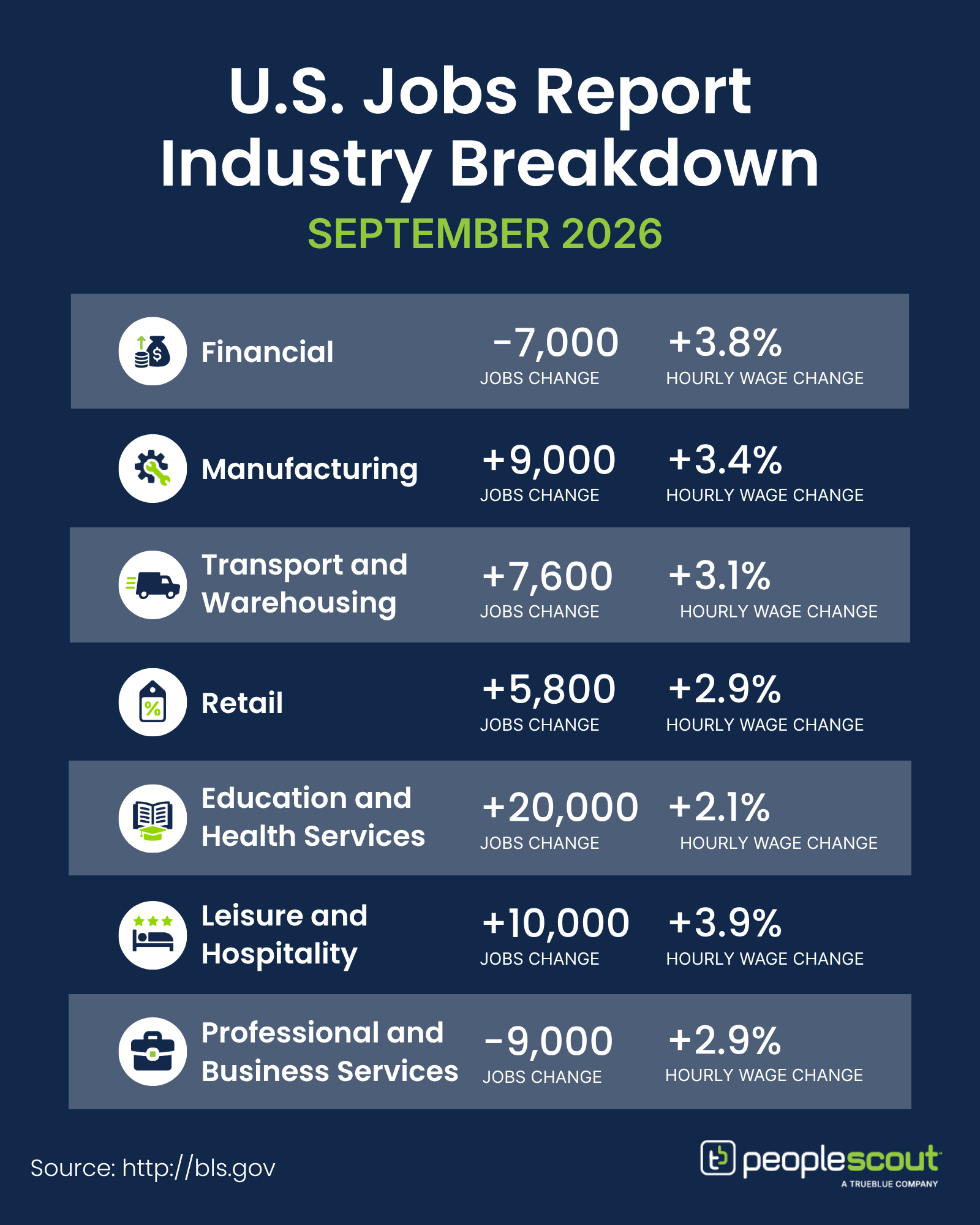
Employers may be hiring more selectively, but they aren’t broadly cutting their workforces. Healthcare added 16,700 jobs, Construction added 11,000, and Leisure and Hospitality gained 10,000. Manufacturing is now up 72,000 jobs since December 2025, providing another sign of gradual improvement in a sector that has faced prolonged hiring pressure. But perhaps more telling is what’s happening outside the payroll number. Initial jobless claims fell to 197,000, employer layoff announcements reached their lowest September level since 2022, and the employment rate among workers ages 25 to 54 rebounded after dipping over the summer. Recent claims data remain near historic lows, reinforcing the picture of employers largely holding onto the people they already have. For talent leaders, that creates an important distinction: slower hiring doesn’t necessarily mean easier hiring. When workers are staying put, employers recruiting skilled trades, clinical, production and other critical talent may still find experienced candidates difficult to dislodge.
The bad
The 29,000 jobs added in September fell well short of economists’ expectations, but numbers may have been affected by seasonal-adjustment quirks related to the timing of Labor Day, so the one month shouldn’t be read in isolation. But the pace of job creation is losing momentum, and the slowdown isn’t confined to September. Revisions also removed 60,000 jobs from July and August, turning July into a 10,000-job decline and bringing the three-month average to roughly 51,000. The slowdown is also uneven; some sectors saw growth, while Information lost 10,000 jobs, Professional and Business Services lost 9,000, and Financial Activities lost 7,000. For talent leaders, the takeaway isn’t simply that hiring is declining. Demand is becoming more selective. Employers appear to be scrutinizing where additional headcount creates the most value while continuing to invest in areas where skills remain scarce. That puts greater emphasis on workforce planning: understanding which capabilities should be built internally, where external hiring remains essential, and where more flexible talent models make sense.
The unknown
The bigger question is whether today’s slower hiring becomes the new normal—or gives way to another shift in demand. Inflation and interest rates remain important variables. Energy costs have added new price pressure, while recent inflation and employment data have reduced market expectations for another Federal Reserve rate increase in October. A further increase later this year remains possible, making the October 14 Consumer Price Index report another important signal for employers. Labor supply is changing too. Retirements and slower labor-force growth mean the economy may not need to create as many jobs each month as it once did to keep unemployment relatively stable. That makes today’s modest payroll gains harder to interpret using pre-pandemic benchmarks alone. For talent leaders, flexibility may matter more than forecasting the next turn perfectly. Organizations that identify critical skills early, maintain access to flexible recruiting capacity and distinguish between short-term demand changes and longer-term capability needs will be better positioned to adjust as conditions evolve.
Conclusion
September’s report reinforces an increasingly important distinction: a slower labor market isn’t necessarily a loose labor market. Employers are adding fewer jobs, but they also aren’t shedding workers at scale. Unemployment remains relatively contained, layoffs are low, and hiring demand continues in sectors where critical skills were already difficult to find. For talent leaders, that means the months ahead may be less about responding to broad labor-market trends and more about understanding the dynamics of their specific talent segments. Balancing cost discipline with the ability to secure, retain and quickly scale critical skills will remain central to workforce strategy.