There is a data point that surfaced in our new global research report, Inside the Candidate Experience 2026, that highlights an effect of a poor candidate experience that most talent acquisition leaders have not considered yet. It is not a candidate satisfaction score. It is not a Net Promoter Score. It connects the way organizations treat job applicants directly to the revenue those applicants generate—or stop generating—as customers.
Thirty-six percent of candidates who had a negative hiring experience say they would stop purchasing from that company.
For a retailer running seasonal hiring at scale, that is a meaningful portion of its customer base. For a financial services firm, a hospitality group, a healthcare provider—or any consumer-facing organization where the talent pipeline and the customer base overlap—the candidate experience is a commercial metric hiding in an HR dataset.
The Scale of the Problem
Our study surveyed more than 1,000 job seekers across 10 global markets. Across every market, every region, every industry, the pattern was consistent: most job seekers heard nothing back from most organizations they applied to.
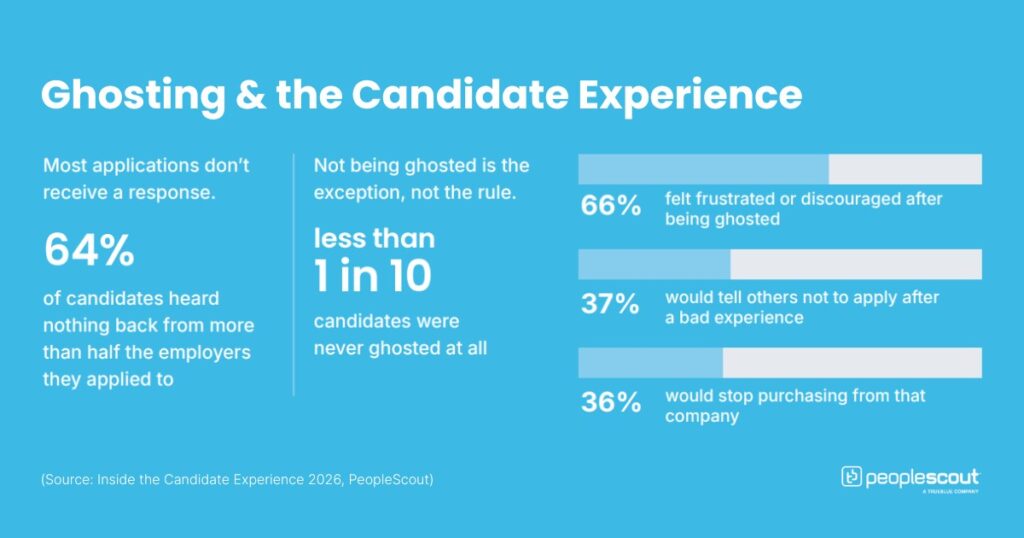
Sixty-four percent of candidates globally were ghosted in more than half of their applications. Less than 8% say they were never ghosted at all, making not being ghosted the exception, not the rule. The frustration has become visible enough that sites like Did They Ghost You? now exist specifically for candidates to report and name the companies that went silent on them—a public ledger of hiring silence that any job seeker can search before they apply.
After being ghosted:
- 66% of job seekers felt frustrated or discouraged after being ghosted.
- 43% said they felt less inclined to ever apply to that organization again.
Among candidates with a negative experience:
- 37% say they would tell others not to apply to that company.
- 36% say they would stop purchasing from it.
- 23% say they would actively encourage others to do the same.
The Regional Picture
Ghosting rates are remarkably consistent globally—between 63% and 67% across EMEA, APAC and North America. What differs is the candidate response.
North American candidates are the most emotionally dissatisfied after being ghosted—82% felt frustrated or discouraged, the highest of any region by more than 20 percentage points.
APAC candidates are the most likely to permanently disengage—47% were less inclined to ever apply again.
EMEA candidates are the most commercially reactive—sharing their experiences most broadly and showing the highest purchasing avoidance rates of any region, with some markets exceeding 40%.
Every region has a ghosting problem. The cost of that problem is distributed differently, and the commercial implications vary by sector and market in ways that determine how organizations should prioritize the fix.
The Hourly Worker Vulnerability
One finding deserves specific attention from leaders running high-volume hiring for consumer-facing businesses.
Hourly and shift workers—who make up the largest segment of the candidates in our study—are the most likely to be ghosted and the least likely to have a positive experience (39%). They are also, by definition, the group most likely to be customers of the organizations hiring them. Most high-volume hourly hiring happens in retail, hospitality, and consumer services—precisely the industries where the candidate-customer overlap is most concentrated. When 35% say they would tell others not to apply and 35% would stop purchasing after a bad experience, this is not an abstract employer brand risk. It is revenue risk at a significant scale.
The Cost Organizations Are Not Calculating
The efficiency savings from AI investment are real. But they need to be weighed against the revenue exposure created by the communication failures that are happening in parallel—the ghosting, the silence, the candidates who leave and don’t come back. Most organizations are only looking at one side of it.
Most talent acquisition teams measure time saved and cost per hire. Very few are measuring what happens downstream: the proportion of applicants who become detractors, the purchasing intent lost, the network effect of candidates who tell others not to apply. These are not soft metrics. They are revenue metrics with a direct line back to the hiring process.
AI tools, automated workflows and ATS upgrades can deliver real value when they support a process that candidates trust. But when communication is lacking, the efficiencies AI creates can be offset by lost revenue and reputational damage.
What Candidates Want
When we asked job seekers to rate what matters most to them in a hiring process, the answers were clear—and describe a standard most hiring processes are currently failing to meet.
The top three priorities globally are: employer respects my time (4.36 out of 5), a transparent process (4.28) and fair assessment regardless of background (4.27). All three are Engagement-stage commitments—the very stage where employers score just 9 out of 100 in our Candidate Experience Index.
The regional picture adds further texture:
- APAC candidates place fair assessment at the top of their priorities (4.41), by far the highest of any region—consistent with a market in which candidates are highly suspicious that employers are using AI to evaluate their applications, the highest rate globally. Where candidates believe automated systems are making decisions about them without explanation, anxiety about whether they are being evaluated fairly runs deepest.
- EMEA candidates prioritize transparency and clear feedback, reflecting a region where employer silence has become the norm and candidates have learned not to expect follow-up.
- North American candidates lead on wanting their time respected (4.41)—the highest of any region—consistent with the highest frustration rate from ghosting anywhere in the study.
The things candidates prioritize and expect do not require a technology overhaul. A minimum engagement standard — automated acknowledgment within hours, a personalized message within 48 hours, specific feedback at every rejection—provides candidates with the consistent communication and human connection they’re seeking.
When Organizations Get It Right
The business case for fixing the follow-up is no longer just about candidate satisfaction. It is about protecting revenue that comes from job seekers who are also customers.
Without laying a strong communication groundwork first, AI-assisted process efficiencies produce diminishing returns—candidates invest less time and energy in their applications, candidate quality declines and the efficiency gains at the top of the funnel are offset by brand reputation damage further down the pipeline. The cost of not communicating is visible in the data, and it shows up beyond the HR dashboard—on the bottom line.
To get the full research and more actionable insights, download the Inside the Candidate Experience 2026 report.