The July 2026 jobs report signals a shift in the U.S. labor market. After several months of modest job growth, employers cut 23,000 jobs in July, falling short of expectations for continued gains. The unemployment rate edged down to 4.1%, but the decline came alongside a further drop in labor force participation, which fell to 61.4%. Wage growth also cooled to 3.2% year over year, its slowest pace in recent months. Combined with significant downward revisions to May and June payrolls, the latest data suggests the labor market is cooling more than recent reports had indicated — though pockets of continued demand and historically low layoffs point to a more nuanced picture.
The Numbers
- -23,000: U.S. employers cut 23,000 jobs in July.
- 4.1%: The unemployment rate ticked down to 4.1%.
- 3.2%: Wages increased 3.2% over the past year.
The Good
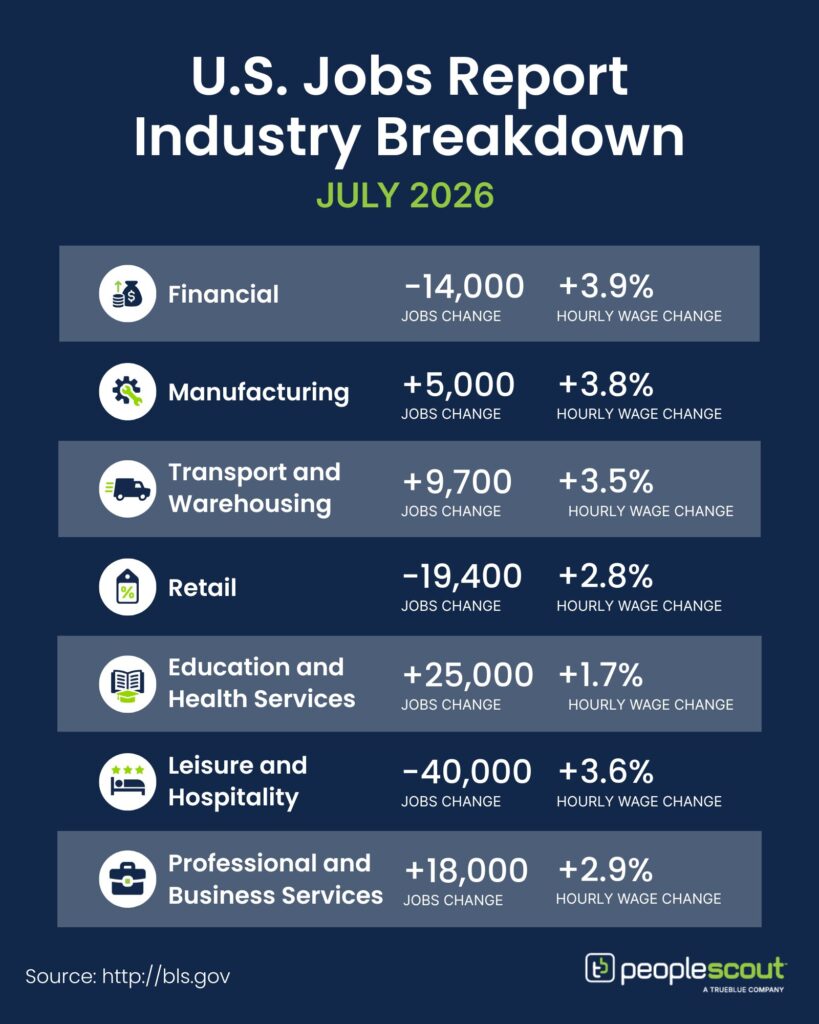
Despite the weak headline, several sectors continued to add jobs and layoffs remained historically low. Education and Health Services led with 25,000 new jobs, supported by continued gains in healthcare and social assistance Professional and Business Services added 18,000 jobs, while manufacturing (+5,000) and construction (+22,000) also posted gains, offering early signs of stabilization in goods-producing industries. At the same time, outplacement data show announced layoffs falling to a two-year low in July, while job openings and quit rates appear to have stabilized, even if they have not yet turned meaningfully upward.
For talent leaders, continued hiring in healthcare and professional services — combined with historically low layoff volumes — suggests competition for experienced talent in critical roles may persist even as overall hiring cools. Retaining key talent remains just as important as bringing new talent into the organization.
The Bad
The July data provides a clearer signal that hiring momentum is weakening. Government payrolls fell by 53,000 jobs, driven largely by a 50,000-job decline in local government education. Leisure and Hospitality lost another 40,000 jobs following a 61,000-job decline in June, while retail (-19,400) and Financial Activities (-14,000) also contracted. Wage growth slowed to 3.2%, and labor force participation fell again to 61.4% as several hundred thousand people exited the labor force.
For talent leaders, these declines reinforce the need for a selective approach to workforce investment. Rather than responding with broad-based hiring freezes or continued expansion, organizations may benefit from focusing hiring on the roles and capabilities most critical to business performance — while managing costs and preserving flexibility elsewhere.
The Unknown
Several factors will shape the labor market outlook through the remainder of the year. Elevated costs tied to disrupted oil shipments and renewed tariff actions continue to work through the economy, and it remains unclear how significantly they will affect hiring and consumer spending. The Federal Reserve held rates steady at its most recent meeting and will have another jobs report, along with additional inflation data, to consider before its September decision.
The labor supply picture also remains uncertain. Participation among prime-working-age adults partially rebounded in July following a sharp decline in June, while a slower pace of immigration continues to constrain the growth of the available workforce. That dynamic could create tighter labor supply in some industries even as overall hiring slows.
For talent leaders, the uncertainty reinforces the value of agility. Successful organizations will be those that can adjust hiring priorities, workforce plans and talent investments as conditions change.
Conclusion
The July jobs report points to a labor market that is cooling more than previously understood, but the picture is not uniformly negative. For talent leaders, the takeaway is less about choosing between “hire” and “freeze” and more about being intentional about where to invest. Protecting critical talent, focusing hiring on high-value roles and maintaining the flexibility to adjust workforce plans will be increasingly important as employers navigate a labor market that remains difficult to predict.