The June 2026 jobs report points to a labor market that continues to expand, though at a slower pace than earlier this year. U.S. employers added 57,000 jobs, reflecting more measured hiring after stronger gains in recent months, even with payroll estimates for both April and May revised downward by a combined 74,000. The unemployment rate edged down to 4.2%, although the decline occurred alongside a lower labor force participation rate, suggesting the improvement reflects more than hiring activity alone. Annual wage growth held at a healthy 3.5%. June’s report reinforces the picture of a labor market that is gradually moderating rather than weakening.
The Numbers
- 57,000: U.S. employers added 57,000 jobs in June.
- 4.2%: The unemployment rate declined to 4.2%.
- 3.5%: Wages increased 3.5% over the past year.
The Good
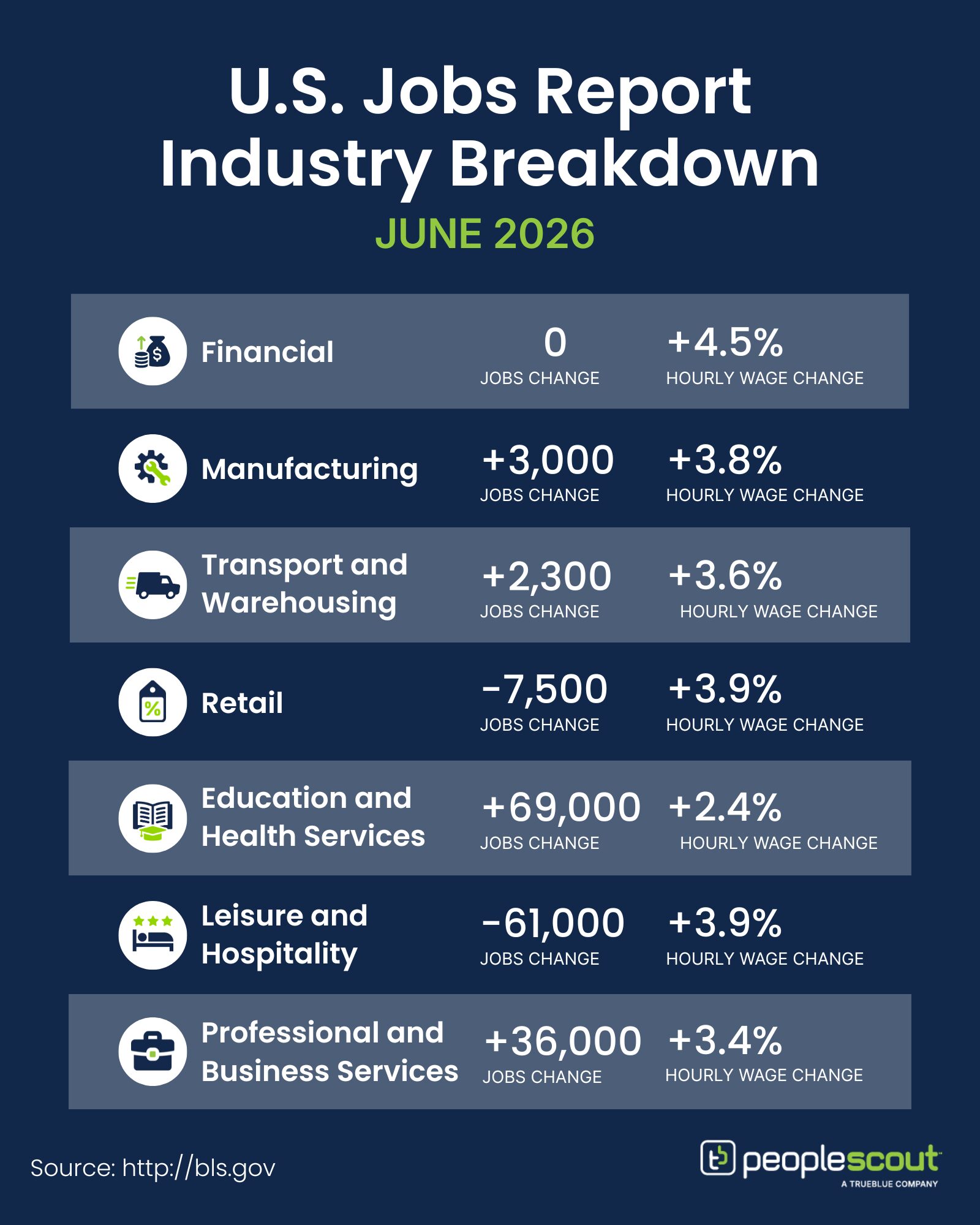
Several sectors continued to demonstrate resilience despite slower overall hiring. Education and Health Services led job growth with 69,000 jobs, although healthcare hiring continued at a slower pace than its recent average. Professional and Business Services added 36,000 jobs, signaling continued demand for specialized talent and business support functions. Transportation and Warehousing also posted modest gains. At the same time, unemployment edged lower and wage growth remained steady, suggesting employers are continuing to invest in talent where business needs remain strong. For talent leaders, competition for healthcare professionals, skilled specialists and critical business functions is likely to remain elevated, reinforcing the value of proactive talent pipelines and targeted recruitment strategies.
The Bad
Overall hiring slowed considerably in June, with payroll growth falling well below the pace seen earlier this spring. Job losses were concentrated in Leisure and Hospitality, which shed 61,000 positions, while Retail also declined. Manufacturing hiring remained positive but modest, and Financial Activities was flat. These mixed results suggest that many organizations are hiring selectively while carefully managing labor costs and evaluating demand. Rather than broad-based expansion, employers appear to be prioritizing investments in the functions and skills most closely aligned with business objectives.
The Unknown
While labor market fundamentals remain relatively healthy, employers continue to navigate persistent cost pressures, evolving consumer demand and an uncertain economic outlook. At the same time, continued investment in automation and AI is influencing how organizations think about workforce planning and productivity, even as demand for specialized skills remains strong. For talent leaders, maintaining flexibility will remain essential. Organizations that continuously monitor labor market conditions, adapt hiring plans and invest in critical capabilities will be better positioned to respond as conditions evolve.
Conclusion
Hiring continues across key sectors, unemployment remains low and wage growth is steady, but payroll gains have moderated and industry performance is increasingly uneven. The slower pace of hiring, combined with downward revisions to prior months, suggests organizations are becoming more deliberate in where and how they add talent rather than stepping away from hiring altogether. For talent leaders, success will continue to depend on strategic workforce planning, targeted hiring investments and the agility to adjust recruitment strategies as market conditions change.