The May 2026 jobs report suggests a labor market that remains steady and resilient despite ongoing economic uncertainty. U.S. employers added 172,000 jobs last month, exceeding expectations and building on stronger-than-reported gains in March and April. The unemployment rate remained unchanged at 4.3%, while annual wage growth slowed to 3.4%, its lowest level since 2021. Hiring broadened across more industries than in recent months, though growth remains concentrated in a handful of sectors. At the same time, wage growth continues to trail inflation, creating additional pressure for both employers and workers.
The Numbers
- 172,000: U.S. employers added 172,000 jobs in May.
- 4.3%: The unemployment rate remained unchanged.
- 3.4%: Wages increased 3.4% over the past year.
The Good
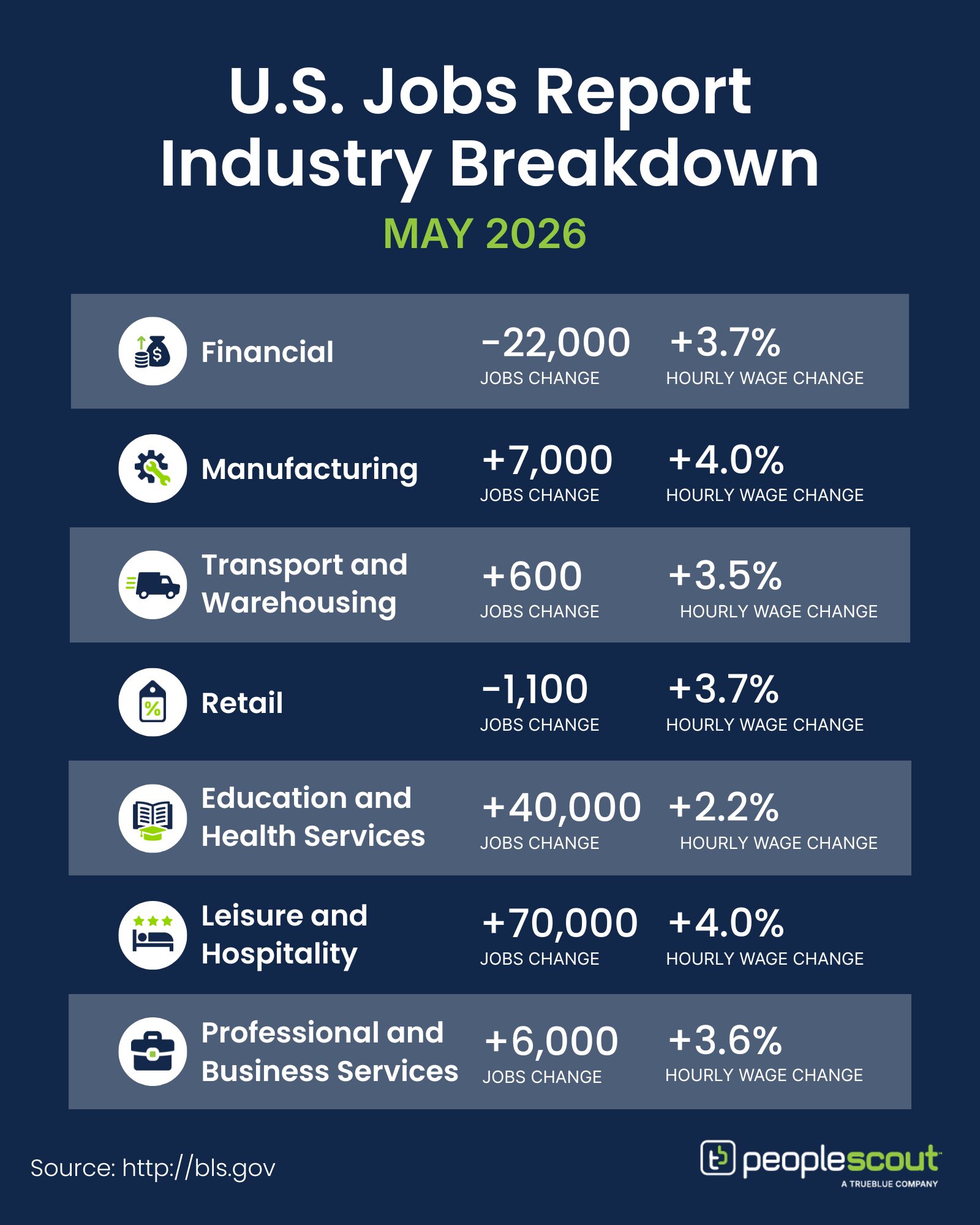
May’s report was stronger than expected and provides further evidence that the labor market has regained momentum following a sluggish 2025. Hiring was led by Leisure and Hospitality, which added 70,000 jobs, while Healthcare contributed another 35,000 positions. Job growth also became more broadly distributed across industries, and upward revisions to March and April payroll data added another 93,000 jobs, reinforcing the picture of a labor market that remains healthier than many anticipated. For talent leaders, continued job growth and limited layoffs suggest competition for critical talent is likely to persist, particularly in frontline, healthcare and customer-facing roles.
The Bad
While the headline numbers were encouraging, underlying challenges remain. Wage growth slowed to 3.4% year over year and continues to lag inflation, which may affect employee sentiment and retention as workers feel increasing pressure from rising living costs. Sector performance also remains uneven. Financial Activities lost 22,000 jobs in May and Transportation and Warehousing remains below its recent peak despite modest gains. Many employers continue to maintain headcount while carefully evaluating productivity, efficiency and long-term workforce investments. For employers, workforce planning decisions are increasingly focused on targeted hiring rather than broad expansion.
The Unknown
Several economic variables continue to cloud the outlook for the second half of the year. Higher energy and transportation costs are beginning to ripple through the broader economy, contributing to inflationary pressures that may affect both consumer spending and business investment decisions. At the same time, policymakers remain focused on inflation trends, creating uncertainty around the future path of interest rates. While hiring momentum has improved, many organizations are likely to continue balancing growth ambitions against cost management priorities. For talent leaders, flexibility remains critical. Organizations that can adapt hiring strategies quickly, prioritize critical skills and maintain visibility into workforce needs will be better positioned as economic conditions continue to evolve.
Conclusion
The May 2026 jobs report points to a labor market that remains stable and surprisingly resilient. Hiring exceeded expectations, unemployment held steady and job growth broadened across more sectors. However, wage growth continues to moderate, inflation remains a concern and hiring activity is still uneven across industries. Rather than signaling a return to aggressive workforce expansion, the report suggests employers remain focused on measured growth, operational efficiency and targeted talent investments. For talent leaders, success in the months ahead will likely depend on maintaining workforce agility—balancing near-term business needs with long-term talent readiness while continuing to compete for the skills most critical to future growth.