In regulated industries, a hiring mistake can create compliance risk, not just extra cost. Screening for regulated roles requires checking every candidate’s qualifications, but when recruiters review each résumé or CV by hand, screening slows down at a point where speed matters most. Candidates with the exact credentials these roles require are already scarce, and…
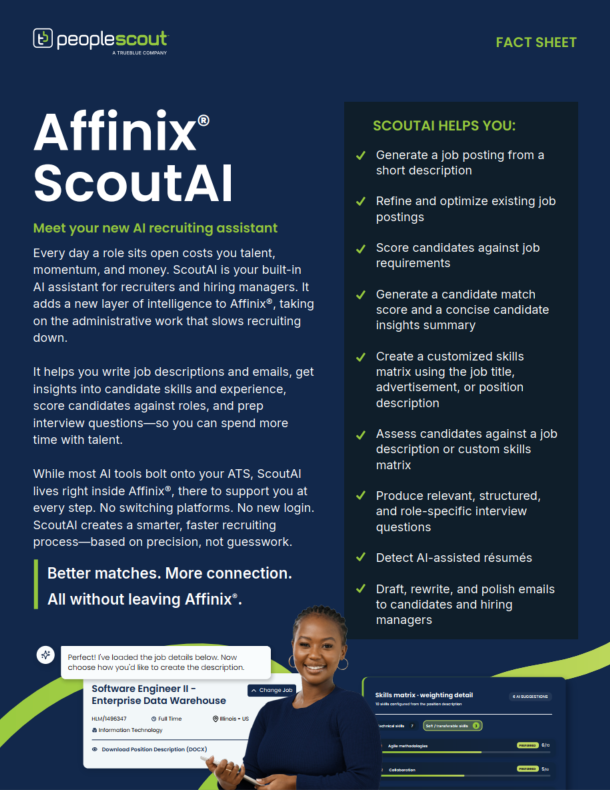
ScoutAI is your AI assistant for recruiters and hiring managers. It adds a new layer of intelligence to Affinix®, taking on the administrative work that slows recruiting down. Access the power of AI to write job descriptions, get insights into candidate skills and experience, score candidates against roles, prep interview questions, and more.
Created by leading research firm Everest Group, this research will help you explore what lies ahead as talent acquisition technology evolves into Systems of Execution.
AI is fundamentally reshaping what it means to be a recruiter. Understanding how to balance tech and the human touch is essential for leaders preparing their teams for what comes next.
The talent acquisition technology market is full of talk about agentic AI—autonomous systems that make independent decisions, adapt in real time, and carry out multi-step work without human intervention. Agentic AI has the potential to transform recruitment end to end, but the concept has spread so quickly that many tech capabilities are being mislabeled as “agents.”
The truth is that agentic AI in recruitment is still in its infancy, with most of what’s being billed as AI agents more closely resembling robotic process automation (RPA), rather than being truly agentic. While the potential is genuinely transformative, the technology remains fairly unproven in real-world talent acquisition environments today.
Regardless of whether an AI-supported tool is an agent, an assistant, or automation with a new label, when AI is involved in hiring, humans should still make the decisions. That does not change as technology evolves, and it is a guiding principle for talent acquisition leaders to maintain while the vocabulary keeps shifting. So, in this article, we’ll explore what agentic AI is, what it isn’t, and what that means for the technology decisions you’re making today.
Defining agentic AI: What makes it different
To understand why agentic AI represents such a significant leap, it helps to clarify what distinguishes it from the generative AI tools you may already use.
Generative AI (Gen AI) operates within clearly defined parameters. It automates predefined, repeatable tasks by following fixed rules and workflows. Need a job description written? Gen AI can draft one based on patterns it has learned. Want to send personalized outreach emails? Gen AI can generate variations at scale. These applications have proven valuable as sophisticated pattern-matching and content generation tools. They do what they’re programmed to do when they’re told to do it.
Agentic AI, by contrast, is designed to operate with genuine autonomy toward defined goals within the organization’s AI governance. In theory, these systems can make independent decisions without constant human intervention, adapt their approach in real time based on changing circumstances, engage in self-learning to improve their performance, and collaborate across multi-step processes that require coordination between different functions.
The vision is compelling. Imagine an AI agent that doesn’t just help you write a job description, but independently analyzes your hiring needs, sources candidates across multiple platforms, evaluates their fit using various data points, initiates outreach with personalized messaging, schedules interviews based on candidate and hiring manager availability, and continuously refines its approach based on which strategies yield the best hiring outcomes.
That’s the promise of agentic AI.
The maturity gap: Where we really are
Understanding where we are on this journey is essential for making smart investment decisions and setting realistic expectations with stakeholders.
Notably, research from Everest Group, Systems of Execution: The Next Evolution in Talent Acquisition Technology, describes AI agents as layer three in a four-layer model of where recruitment technology is headed. Most organizations remain at a “Foundational” stage of maturity, early in their journey and experimenting with automation pilots in limited areas. Very few organizations, if any, have reached the “Orchestrated” phase where true agents collaborate across sourcing, screening, and engagement. Today, that level remains aspirational for most recruitment programs.
Is your talent tech stack future-ready?
Discover where your organization stands on the path to orchestrated hiring.
Question 1 of 7
Your Results Are Ready
Complete the form to access your report instantly.
First name is required
Last name is required
Valid email is required
Company is required
0/200
By submitting your information, you consent to receive communications from TrueBlue and its subsidiaries regarding our services, including marketing communications relating to TrueBlue’s services. TrueBlue will process your information pursuant to our Privacy Notice.
Your Maturity Stage Is
What You Do Well
Where To Focus Next
You Don’t Have to Figure This Out Alone
This assessment tells you where you are. But moving from where you are to where you want to be requires a plan tailored to your situation.
That’s what we’re here for.
Schedule a Technology Diagnostic with PeopleScout to:
• Assess your specific situation (not generic)
• Identify your biggest opportunities
• Get a realistic timeline and investment expectations
What makes human oversight real rather than nominal
When AI makes a mistake in generating a job description, a human can catch and fix it before it goes live. When an autonomous agent decides whether to move a candidate forward or eliminate them from consideration before a human can review it, the consequences are more serious.
It also matters whether oversight is meaningful or merely procedural. Having a recruiter review 100 automated decisions at the end of a day—when they only have time to properly assess half of them—does little to mitigate risk. Oversight becomes meaningful when four conditions are met:
The person has the information they need to form a judgment, including why the system reached the conclusion it did.
Their current workload allows the time and capacity to exercise that judgment.
They have clear authority to overrule the system and know when to use it.
The decision, including any override, is recorded well enough that it can be explained later.
None of these are technology specifications. They’re about how the work is organized, who owns which decisions, and who is responsible for the outcome.
The regulatory landscape is rapidly evolving to address these exact concerns, consistently emphasizing human oversight of decisions that materially affect people. Requirements differ by market and continue to evolve, so organizations should refer to their own legal counsel on what applies to them. The direction of travel, though, has been steady, and it does not favor removing people from hiring decisions. Meaningful human oversight isn’t just good practice—it’s becoming a legal requirement.
How we approach agentic AI
For PeopleScout, our goal is never to add the latest tech for the sake of adding the latest tech. It’s to add technology that makes hiring measurably better for the people involved. Designing AI-supported processes to maintain human judgment is what makes talent technology valuable at scale.
That principle guides how we’ve built AI capabilities into our proprietary technology. Affinix® supports recruiter judgment through AI-enabled sourcing, screening, and scheduling, leaving the decision-making to your team. Embedded right into Affinix ATS, ScoutAI is an AI assistant that helps recruiters and hiring managers write job descriptions, get insights into candidate skills and experience, score candidates against role requirements, and prep interview questions that they can then refine. That is a deliberate choice about where responsibility sits, and it’s one we’ll maintain as our AI capabilities grow.
We develop and test new capabilities continuously, in partnership with clients and in live hiring environments, so that what reaches your team has been proven to help rather than simply shipped. Affinix is ISO 27001:2022 certified and GDPR compliant, so those capabilities operate within an enterprise security and privacy framework.
Making smart decisions today
Agentic AI in recruitment will continue to evolve. The question for talent leaders is not whether to embrace that evolution, but where its autonomy creates value and where human judgment remains essential.
The most effective organizations will be thoughtful about that distinction. They’ll use AI to create capacity, accelerate processes, and surface better insights, while keeping people accountable for hiring decisions. As the technology matures, that balance—not the label attached to the tool—will determine how successfully organizations put AI to work in hiring.
How a government healthcare employer turned a full day of résumé review into an hour
Affinix® and ScoutAI helped this healthcare organization cut résumé review time by over 80%, gave hiring managers visibility they never had, and reduced job board spend by 25%.
25%reduction in job board spend
80%+drop in time spent reviewing résumés
Situation
This government healthcare organization hires the people who keep public health programs running, from clinical staff to program managers. Much of that hiring is grant funded, so roles must be filled quickly to make the most of the funding window. Plus, recruiters must screen for specific credentials, degrees, and experience, which is crucial for compliance in healthcare hiring.
The team was working in an aging recruitment system that gave them almost no reporting. Recruiters struggled to see where to focus their efforts. Hiring managers had no visibility at all, so they depended on recruiters for status updates. And leaders had no reliable picture of where their advertising money was going, or which sources produced their best candidates.
Solution
To give recruiters, hiring managers and leaders greater visibility into the hiring process and help the team make faster, more informed decisions, the organization moved to Affinix®, PeopleScout’s proprietary talent technology suite, which is now available directly to employer recruitment teams.
Screening that starts with the best-qualified candidates
ScoutAI, an AI assistant built into Affinix, scores each résumé against a skills matrix which is weighted to the credentials and experience the role requires. Recruiters then focus on screening the candidates who match at 80% and above.
Before implementing Affinix, recruiters had to review hundreds of résumés to find the qualified few, which often took an entire day before a single conversation with a candidate could happen. Now, with the help of ScoutAI, they begin with the strongest matches and apply their own judgment to what AI can’t assess, like soft skills and technical depth. Recruiters now spend an hour per role on average reviewing résumés, reducing time spent on this task by over 80%.
Previously, the team drafted job descriptions in a separate AI tool, then moved the copy back into their old recruitment system. The AI Job Ad Generator feature does that from anywhere in Affinix. Now, recruiters write, refine, and publish job postings without switching systems. Plus, with Affinix’s built-in job board integrations, postings update automatically.
Reporting the whole team can act on
Affinix Analytics gives the organization the visibility its old system never could. Hiring managers can now see how many candidates have been screened, which have been rejected, and where candidates are in the process. Working from the same information takes the pressure off recruiters to keep managers updated. Leaders can also review activity by recruiter and by role, and the pipeline view gives them a clear read on the health of every requisition.
Source tracking gives the organization insight into what they spend on each job board and where their best candidates come from. They use that data to shift spend toward the sources that perform, which has cut job board spend by 25% in the first year.
Results
80%+ reduction in time spent reviewing résumés. Now recruiters focus on the best-matched candidates first—those with the correct credentials and experience.
25% reduction in job board spend. Source data showed which channels delivered qualified candidates, so budgets can be weighted toward top-performing ones.
Shared requisition visibility. For the first time, hiring managers and leaders can see status, screening progress, and pipeline health without having to ask a recruiter.
Strong recruiter adoption. The team lead describes Affinix as “phenomenal” and reports that recruiters genuinely enjoy using it.
Grant-funded healthcare hiring leaves little room for delay. By giving recruiters better information faster and giving hiring managers a clearer picture of the process, Affinix and ScoutAI freed this team to spend more time on the part of hiring only people can do, judging fit and building relationships.