AI & the Candidate Experience: Key Findings from Our New Research

Something unexpected is happening in hiring.

Organizations globally are investing more than ever in AI-powered recruitment tools. Automated screening, intelligent matching, ATS upgrades—the technology budget for talent acquisition has grown significantly over the last three years. The efficiency gains are real. AI handles higher volumes of applications, reduces time-to-hire and brings consistency to screening at a scale.

And yet, according to our recent research, the candidate experience is getting worse.

PeopleScout’s latest research report, Inside the Candidate Experience 2026, is our most comprehensive global study of hiring from the candidate’s perspective. We surveyed more than 1,000 job seekers across 10 markets, audited employer hiring processes across more than 20 industries using our Candidate Experience Index and compared the results against our 2023 research. The findings challenge some of the core assumptions driving investment in hiring technology right now.

The Numbers: A Disappointing Trend Emerges 

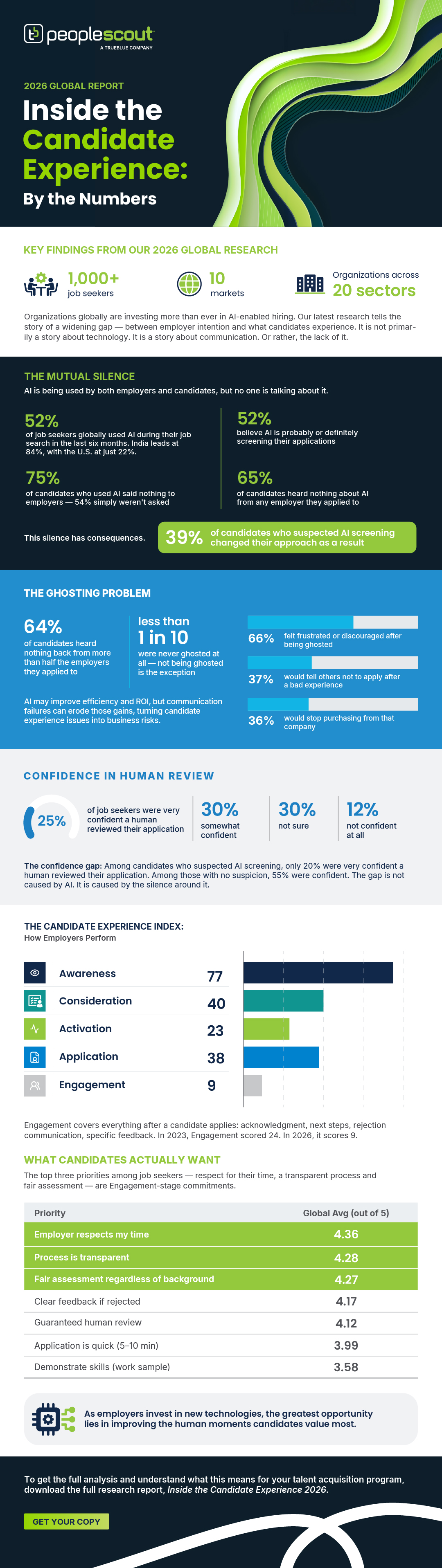
Our proprietary Candidate Experience Index scores the recruitment process across five stages—from how findable an organization is, to what happens after a candidate applies. In 2023, the post-application Engagement stage scored 24 out of 100. In 2026, it dropped to just 9.  

Every other stage declined too: Awareness fell from 90 to 77, Application from 55 to 38, Activation from 39 to 23, Consideration from 53 to 40. Not a single stage improved. This happened during a period of record investment in hiring technology. 

The candidate survey reflects this. Just 11% of candidates globally rate their most recent application experience as excellent. In 2023, fewer than two in ten rated it as excellent. Three years later, the floor has not moved. 

So, What’s Going On? 

What has changed since 2023 is not the experience, it’s the tools.  

Three years ago, AI in hiring was largely an employer capability. Candidates experienced its effects without having equivalent access. Today, that has changed. More than half of job seekers globally (52%) said they used AI in their job search to write applications, research companies, optimize résumés and CVs and prepare for interviews. 

Both employers and job seekers are using AI during the recruitment process. But no one is talking about it. Both sides can now move faster. Yet, they communicate less.

Generally, candidates are not using AI to game the system. Only 3% say their primary motivation was getting past screening tools. The dominant reasons are saving time (38%) and improving language (40%). When you set those motivations alongside a 64% ghosting rate—the proportion of candidates ghosted in more than half their applications—a picture emerges. Candidates have been trained, by consistent and repeated employer behavior, to treat applications as low-investment transactions. If most applications disappear into silence, why invest three hours in preparing each one? Leveraging AI to complete them quickly is the rational response. 

Candidates have been trained, by consistent and repeated employer behavior, to treat applications as low-investment transactions. If most applications disappear into silence, why invest three hours in preparing each one? Leveraging AI to complete them quickly is the rational response.

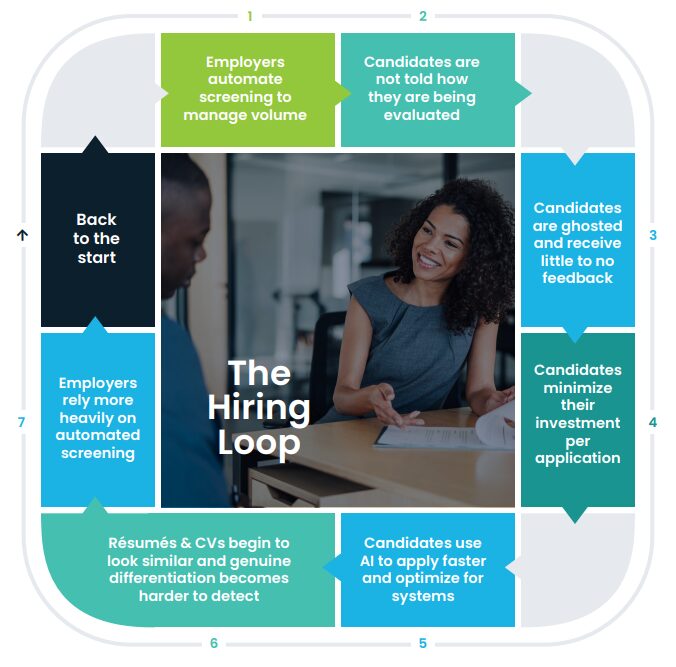
The loop this creates is self-reinforcing. Employers implement AI screening to manage rising volumes. Candidates adapt by investing less and applying faster. Applications start to look the same. Genuine differentiation becomes harder to detect. Employers rely more heavily on automated screening. Repeat.

The Revenue Impacts of a Poor Candidate Experience 

Here is what makes this more than a candidate experience problem: 36% of candidates with a negative experience say they would stop purchasing from that company. And 37% say they would tell others not to apply. For consumer-facing employers, the candidate pool and the customer base are the same people. These aren’t recruitment metrics—they’re revenue metrics. 

The efficiency savings from AI-powered screening are real. But they should sit alongside another number: the revenue exposure created when the candidate experience drives customers away. Most organizations are measuring one. Very few are measuring both. 

The efficiency savings from AI-powered screening are real. But they should sit alongside another number: the revenue exposure created when the candidate experience drives customers away.

AI Works Best on a Solid Foundation 

The most striking finding in this research is also the most actionable. The organizations producing the best candidate experiences in our study are not the most technologically sophisticated. They are the most communicative. They tell candidates how AI fits into their process. They follow up beyond the auto-responder email.  

India is the most AI-advanced market in our study and provides the clearest proof of concept, with 84% of candidates using AI in their job search. It is also the most communicative country—64% of Indian candidates received some communication about AI use from at least one employer. India has the lowest ghosting rate in the Asia-Pacific region (56%), the highest positive experience rate (48%), and the strongest candidate confidence in human review of any APAC market. 

The same pattern holds in Germany, which proved to be the most transparent market in EMEA, with the lowest ghosting rate in the region (38%) and the highest positive experience rate (47%). 

In these countries, employers are communicating openly, ghosting rates are lower and trust amongst candidates is stronger. The correlation is not coincidental. It is a blueprint. 

AI works best when it is built on a foundation of clear communication and transparent processes. Without that foundation, the investment in screening technology and other AI-powered automations produces diminishing returns—because jobseekers are investing less in their applications, and lower effort means a lack of candidate differentiation to inform hiring decisions.  

The data is consistent across every region, every market and every demographic group we surveyed: candidates want to be treated as people, not processed as applications. They want their time to be respected. They want to understand what is happening throughout the hiring process and why. They want honest feedback when things don’t work out. None of these require new technology. All of them require a decision that communication is non-negotiable. 

Successful organizations will build the candidate experience that makes every subsequent hiring campaign more effective, more efficient and more human. 

To get the full research and more actionable insights, download the Inside the Candidate Experience 2026 report. 
The Real Price of Ghosting: Why Fixing the Follow-Up is a Revenue Decision 

There is a data point that surfaced in our new global research report, Inside the Candidate Experience 2026, that highlights an effect of a poor candidate experience that most talent acquisition leaders have not considered yet. It is not a candidate satisfaction score. It is not a Net Promoter Score. It connects the way organizations treat job applicants directly to the revenue those applicants generate—or stop generating—as customers. 

Thirty-six percent of candidates who had a negative hiring experience say they would stop purchasing from that company. 

For a retailer running seasonal hiring at scale, that is a meaningful portion of its customer base. For a financial services firm, a hospitality group, a healthcare provider—or any consumer-facing organization where the talent pipeline and the customer base overlap—the candidate experience is a commercial metric hiding in an HR dataset. 

The Scale of the Problem 

Our study surveyed more than 1,000 job seekers across 10 global markets. Across every market, every region, every industry, the pattern was consistent: most job seekers heard nothing back from most organizations they applied to. 

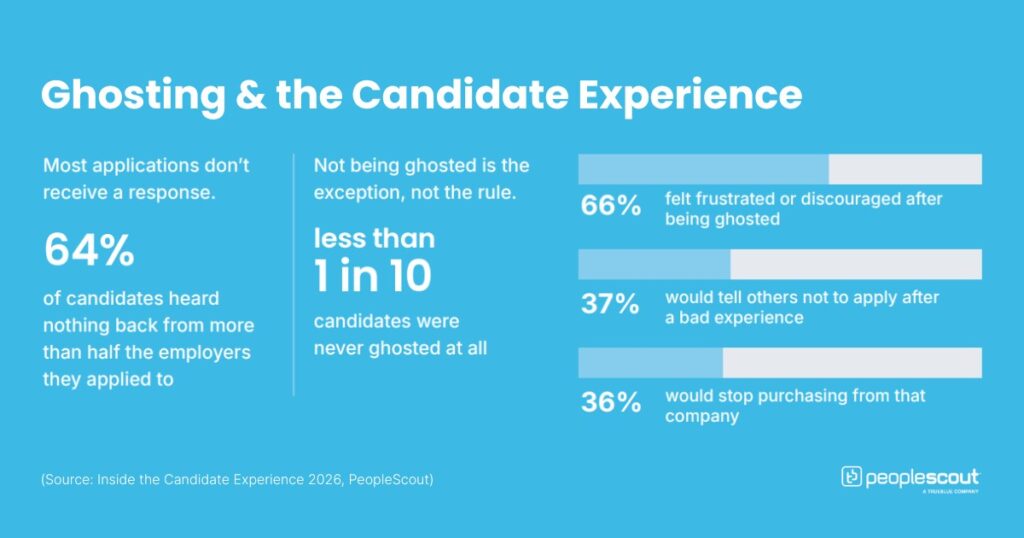
Sixty-four percent of candidates globally were ghosted in more than half of their applications. Less than 8% say they were never ghosted at all, making not being ghosted the exception, not the rule. The frustration has become visible enough that sites like Did They Ghost You? now exist specifically for candidates to report and name the companies that went silent on them—a public ledger of hiring silence that any job seeker can search before they apply.

After being ghosted:  

  • 66% of job seekers felt frustrated or discouraged after being ghosted.  
  • 43% said they felt less inclined to ever apply to that organization again.  

Among candidates with a negative experience:  

  • 37% say they would tell others not to apply to that company.  
  • 36% say they would stop purchasing from it. 
  • 23% say they would actively encourage others to do the same. 

The Regional Picture 

Ghosting rates are remarkably consistent globally—between 63% and 67% across EMEA, APAC and North America. What differs is the candidate response. 

North American candidates are the most emotionally dissatisfied after being ghosted—82% felt frustrated or discouraged, the highest of any region by more than 20 percentage points.  

APAC candidates are the most likely to permanently disengage—47% were less inclined to ever apply again.  

EMEA candidates are the most commercially reactive—sharing their experiences most broadly and showing the highest purchasing avoidance rates of any region, with some markets exceeding 40%. 

Every region has a ghosting problem. The cost of that problem is distributed differently, and the commercial implications vary by sector and market in ways that determine how organizations should prioritize the fix. 

The Hourly Worker Vulnerability 

One finding deserves specific attention from leaders running high-volume hiring for consumer-facing businesses. 

Hourly and shift workers—who make up the largest segment of the candidates in our study—are the most likely to be ghosted and the least likely to have a positive experience (39%). They are also, by definition, the group most likely to be customers of the organizations hiring them. Most high-volume hourly hiring happens in retail, hospitality, and consumer services—precisely the industries where the candidate-customer overlap is most concentrated. When 35% say they would tell others not to apply and 35% would stop purchasing after a bad experience, this is not an abstract employer brand risk. It is revenue risk at a significant scale. 

The Cost Organizations Are Not Calculating 

The efficiency savings from AI investment are real. But they need to be weighed against the revenue exposure created by the communication failures that are happening in parallel—the ghosting, the silence, the candidates who leave and don’t come back. Most organizations are only looking at one side of it. 

Most talent acquisition teams measure time saved and cost per hire. Very few are measuring what happens downstream: the proportion of applicants who become detractors, the purchasing intent lost, the network effect of candidates who tell others not to apply. These are not soft metrics. They are revenue metrics with a direct line back to the hiring process. 

AI tools, automated workflows and ATS upgrades can deliver real value when they support a process that candidates trust. But when communication is lacking, the efficiencies AI creates can be offset by lost revenue and reputational damage. 

What Candidates Want 

When we asked job seekers to rate what matters most to them in a hiring process, the answers were clear—and describe a standard most hiring processes are currently failing to meet. 

The top three priorities globally are: employer respects my time (4.36 out of 5), a transparent process (4.28) and fair assessment regardless of background (4.27). All three are Engagement-stage commitments—the very stage where employers score just 9 out of 100 in our Candidate Experience Index. 

The regional picture adds further texture:  

  • APAC candidates place fair assessment at the top of their priorities (4.41), by far the highest of any region—consistent with a market in which candidates are highly suspicious that employers are using AI to evaluate their applications, the highest rate globally. Where candidates believe automated systems are making decisions about them without explanation, anxiety about whether they are being evaluated fairly runs deepest.  
  • EMEA candidates prioritize transparency and clear feedback, reflecting a region where employer silence has become the norm and candidates have learned not to expect follow-up.  
  • North American candidates lead on wanting their time respected (4.41)—the highest of any region—consistent with the highest frustration rate from ghosting anywhere in the study. 

The things candidates prioritize and expect do not require a technology overhaul. A minimum engagement standard — automated acknowledgment within hours, a personalized message within 48 hours, specific feedback at every rejection—provides candidates with the consistent communication and human connection they’re seeking. 

When Organizations Get It Right  

The business case for fixing the follow-up is no longer just about candidate satisfaction. It is about protecting revenue that comes from job seekers who are also customers. 

Without laying a strong communication groundwork first, AI-assisted process efficiencies produce diminishing returns—candidates invest less time and energy in their applications, candidate quality declines and the efficiency gains at the top of the funnel are offset by brand reputation damage further down the pipeline. The cost of not communicating is visible in the data, and it shows up beyond the HR dashboard—on the bottom line. 

To get the full research and more actionable insights, download the Inside the Candidate Experience 2026 report. 
The Sector Split: What Separates the Best Candidate Experiences from the Rest 

A poor candidate experience isn’t a single problem with a single fix. It’s a different challenge in every industry, and the sectors getting it right prove that meaningful improvement is well within reach—often without a major technology investment. 

Our research report, Inside the Candidate Experience 2026, analyzes survey data from more than 1,000 job seekers across 10 markets globally alongside data from PeopleScout’s Candidate Experience Index across more than 20 industries. In this article, we take a deep dive into the sector-level data to see what specific practices are driving the difference between industries that are getting it right and those that aren’t. 

Healthcare and Engineering: The Quiet Overperformers 

Two sectors produce notably better-than-average experiences: engineering and healthcare. The engineering sector has the highest number of candidates rating their experience as positive at 55%, with healthcare close behind at 52%. Healthcare also holds the lowest negative experience rate of any major sector, at just 7%—less than half the rate seen in retail or technology. 

The healthcare data is particularly striking given the context. It is a sector with high hiring volumes and meaningful AI suspicion (49% of candidates believed they were screened by AI), yet the sector produced some of the best candidate sentiment in the dataset. The likely explanation is the structure of the process itself: healthcare hiring tends to involve direct human contact at early stages. Even if candidates think AI is involved in the process, they are confident their applications were evaluated by a person, not simply filtered by a system, and the data reflects that. 

Engineering’s outperformance tells a similar story from a different angle. Technical assessment in this sector tends to be explicit and well-explained, meaning candidates understand what they are being evaluated on and why. That clarity—even where AI is involved in earlier stages—significantly improves how the overall experience is perceived. 

Both sectors offer a lesson for other industries: the experience is better when candidates understand the process. Transparency throughout the journey matters. 

IT/Tech: High Adoption, High Expectations, and a Paradox Worth Examining 

Technology sector candidate data paints the most complex picture. These job seekers have the highest AI adoption of any sector (81%) and the highest AI screening suspicion (74%)—both by a wide margin—while still posting a respectable 46% positive experience rate. But IT/Tech also has the highest percentage of candidates saying that AI makes hiring feel less human (66%).  

The paradox is instructive. Technology candidates are likely more informed about AI—including its use in hiring—than almost any other group. They are more likely to suspect it is being used, more likely to feel its dehumanizing effect, and more attuned to gaps between what a process claims to be and what it delivers.  

Technology companies are managing the basics reasonably well, but the AI transparency conversation is where the experience breaks down. This gap will likely widen as candidate expectations in the sector continue to rise. 

Government and Education: The Widest Gap Between Expectation and Reality 

Hiring within the government and education sectors represents the most significant experience challenge in the dataset—and one with implications that go beyond employer brand. 

Candidates in the government and education sectors place the highest priority on fair assessment of any major sector (4.43 out of 5), yet these sectors have the lowest positive experience rate (35%), the highest ghosting rate (74%), and the highest rate of employers not mentioning AI (77%).  

For public sector talent acquisition leaders, this is both a candidate experience opportunity and a reputational one. Organizations that champion fairness and transparency in their public-facing mission have a natural head start in applying that same standard to how they treat applicants—and closing this gap may be one of the most visible trust-building moves available to them. 

Retail: The Highest Volume, Highest Risk Sector 

Retail accounts for the largest share of respondents in this study and carries some of the most consequential experience findings in the dataset. A 72% ghosting rate. Just 35% of candidates say they had a positive experience. Employer silence about AI at 75%—among the highest of any major sector. Only 23% of candidates are very confident a human reviewed their application. 

Retail also has the most direct overlap between its talent pipeline and its customer base. The candidates being ghosted in retail hiring are, in many cases, regular customers of the same companies. A third of retail candidates who have had a negative recruitment experience say they would stop purchasing or actively discourage others from applying. This has some major commercial consequences in a sector where customer acquisition costs are significant, and word-of-mouth travels fast. 

High-volume retail hiring is precisely where automated workflows and AI screening deliver genuine efficiency benefits. It is also precisely where the communication gap is most costly—because the scale of the brand exposure is highest. For any talent leader running volume retail programs, the candidate experience opportunity in this sector is among the largest and most commercially significant in the dataset. 

Banking and Financial Services: Better at AI Communication, Still Falling Short 

The banking and financial services sector performed best when it comes to communicating with candidates about AI—but don’t get too excited. Nearly two in three banking candidates (64%) still heard nothing about AI from employers, which says more about how low the bar is than how well the sector is doing, with silence running as high as 77% across the other major sectors. 

The good news is that relative edge still shows up in the experience data: 48% of the sector’s candidates rated their experience as positive, the second highest among major sectors. This suggests even partial, inconsistent communication can move the needle on candidate sentiment—which says something about how easy this problem should be to fix, and how little most sectors are doing about it. 

Banking’s modest edge likely reflects regulatory pressure to be explicit about automated decision-making, coupled with the industry’s standard of more structured, formal communication in general. But the sector still shows that even a partial improvement in communication is replicable elsewhere. 

The Takeaway 

The practices that move needle when it comes to candidate experience—transparency, frequent communication, a process candidates can understand—aren’t sector-specific. Any organization, in any industry, can adopt them. The sector data simply shows what’s possible when they do, and what it costs when they don’t. This change doesn’t require new technology or a bigger budget. It simply takes a decision to implement fundamental best practices that close the gap between candidate expectation and reality, to stand out from the competition. 

To explore the full data and benchmark your organization’s candidate experience, download the Inside the Candidate Experience 2026 report.