What is Employer Branding? And Why It’s Talent Acquisition’s Secret Weapon

Attracting and retaining top talent goes beyond offering a good salary. Candidates are looking for more than just a job; they’re seeking a purpose, a positive culture, and a company that aligns with their values. This is where employer branding comes in. But what is employer branding, exactly? 

Simply put, the employer branding definition is your company’s reputation as an employer—the unique identity you present to both your current employees and prospective hires. It’s an individual’s perceptions and lived experiences of what it’s like to work for your organization. Think of it as your company’s promise to its employees—what it’s like to work for you, the values you uphold and the employee experience you provide. 

👉 Get Your Essential Guide to Employer Branding. 

What are the Benefits of Employer Branding? 

Understanding what employer branding is is just the first step. The real question is, why should you invest in it? The benefits of a strong employer branding strategy are multifaceted and directly impact your organization’s bottom line: 

  • Attract Top Talent: A strong employer brand makes your company more appealing to highly skilled individuals. When candidates perceive your organization as a desirable place to work, you naturally attract a larger and more qualified talent pool. This significantly reduces time-to-hire and the cost of recruitment. 
  • Reduce Recruitment Costs: With a positive reputation, you’ll spend less on advertising and external recruitment agencies. Candidates will be actively seeking you out, rather than the other way around. This improved candidate experience leads to more efficient hiring. 
  • Boost Employee Engagement and Productivity: A strong employer brand fosters a sense of belonging and pride among your existing workforce. Engaged employees are more productive, innovative, and committed to the company’s goals. This contributes to a healthier and more dynamic workplace culture. 
  • Improve Employee Retention: Employer branding isn’t just about attracting new hires; it’s also about keeping your current ones happy. A positive employer brand reinforces employee loyalty and satisfaction, reducing turnover rates. When employees feel valued and proud of where they work, they’re less likely to look elsewhere. 
  • Enhance Business Reputation: Your reputation as an employer directly impacts your overall business reputation. Companies known for their excellent employer brand are often perceived as more trustworthy and successful in the market, attracting not only talent but also customers and investors. 
what is employer branding

What is an Employer Value Proposition (EVP)? 

Integral to understanding what an employer brand is is grasping the concept of an Employer Value Proposition (EVP). Your EVP is the heart of your employer brand. 

The employee value proposition (EVP) is a clear articulation of why your target talent should work for your company over competitors. It captures the essence of your uniqueness as an employer, the “give and get” between you and your employees. 

Once defined, this proposition is a powerful tool and the foundation of any employer brand management strategy. We think of the EVP as a guiding “north star” for all employer brand activities. 

A well-defined EVP and employer brand encompasses: 

  • Compensation & Benefits: Base salary, bonuses, health insurance coverage, retirement plans and paid time off. 
  • Career Pathways & Development: Opportunities for learning, growth, promotions and skill development. 
  • Work Environment: Company culture, team dynamics, work-life balance, flexibility and physical workspace. 
  • Company Culture: Values, mission, leadership style, recognition programs and a sense of community. 
  • Impact & Purpose: The meaningfulness of the work, the company’s societal contributions and how individual roles contribute to the bigger picture. 

Your EVP defines what makes your company a unique and desirable place to work. It’s what you promise to your employees, and effectively communicating this promise is the cornerstone of a strong employer branding strategy. 

how to improve employer branding

Key Components of a Winning Employer Brand Strategy 

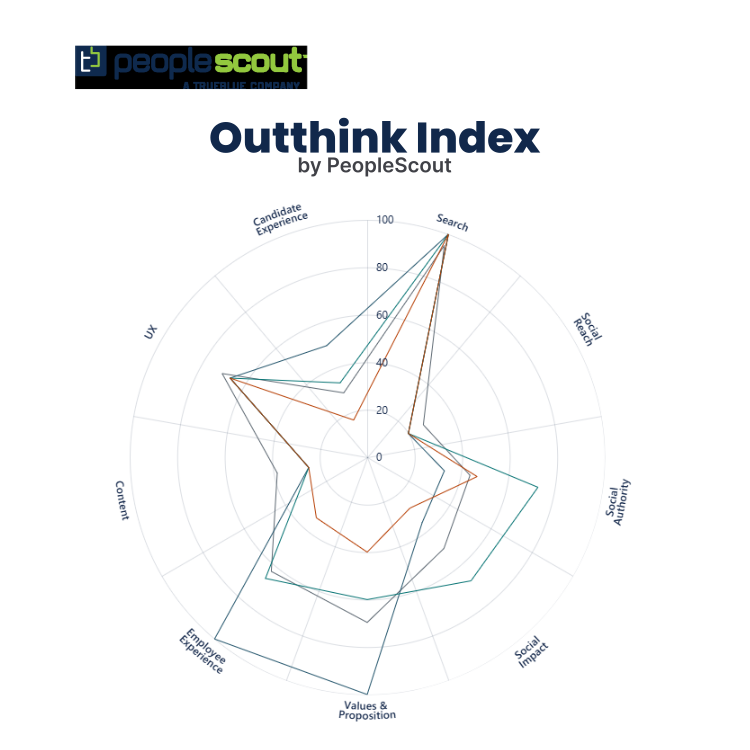
In addition to defining your EVP, developing a robust employer branding strategy involves several crucial elements. The Outthink Index by PeopleScout evaluates employer brand across nine segments:  

Employee Experience 

Modern employees seek comprehensive support beyond salary, including professional growth, well-being, and alignment with personal values. Your employer brand should showcase flexible work policies, benefits, diversity initiatives, career development opportunities and work-life balance on their career pages and candidate touchpoints. 

Content Strategy 

Content serves as the primary vehicle for telling your employer brand story through various formats like social media, videos, testimonials and digital experiences. Effective content should provide authentic insights, demonstrate company values in action, create emotional connections with candidates and establish credibility while differentiating from competitors. 

Social Media Presence 

With the majority of job seekers using social media in their search, these platforms are critical for a strong employer brand. The Outthink Index evaluates social media strategy through three dimensions: Reach (consistent posting and employee advocacy), Authority (thought leadership and industry expertise), and Impact (meaningful metrics like engagement rates and candidate conversion). 

Search Optimization 

SEO is crucial for employer branding since hundreds of millions of job searches occur monthly through search engines. Organizations must optimize job postings and career sites with strategic keywords, ensure mobile-friendliness, integrate with relevant job boards, and create easy-to-navigate career sites to appear in top search results. 

User Experience 

User experience (UX) encompasses every digital touchpoint in a candidate’s journey from discovery to application completion, serving as a virtual window into workplace environment. Critical UX elements include mobile-first design, intuitive navigation, fast loading times, accessible content, and seamless integration across platforms to prevent losing potential applicants. 

Candidate Experience 

The candidate experience serves as the most authentic advertisement for your employer brand, with every interaction showcasing organizational values and culture. Key elements include clear job descriptions, transparent processes, regular communication, constructive feedback, and streamlined interviews, especially since candidates could share negative experiences online. 

employer brand strategy

How to Improve Employer Branding 

So, you understand what employer branding is and why it’s importance. Now it’s time to ask how to improve employer brand? Here are actionable steps: 

  • Benchmark Your Employer Brand: Use the Outthink Index to see how your current employer brand stacks up against other organizations in your industry. The Outthink Index is an interactive tool that lets you compare your employer brand across critical touchpoints—from social presence to candidate experience and employee engagement. It’s the perfect starting point to identify opportunities to enhance your employer brand. Contact us to receive your custom Outthink Index report. 
  • Conduct an Audit: Start by gathering feedback from your current employees. Use surveys, focus groups, and exit interviews to understand their perceptions of working at your company. What are their pain points? What do they love? This internal perspective is invaluable for shaping your employer brand messaging. 
  • Craft Your Story: Authenticity is key. Share compelling stories about your company culture, employee successes, and the impact your organization makes. Utilize various channels like your career site, social media, employee testimonials and blog posts to showcase your employer brand messaging. 
  • Engage on Social Media: Use platforms like LinkedIn, Instagram, and even TikTok to showcase your company culture. Share behind-the-scenes glimpses, employee spotlights and company events. Respond to comments and engage with your audience. 
  • Leverage Employee Advocacy: Your current employees are your best brand ambassadors. Encourage them to share their experiences and become advocates for your company. Employee generated content (EGC) is incredibly powerful and believable because genuine testimonials are far more impactful than corporate messaging. 
  • Optimize Your Online Presence: Your career website is often the first point of contact for potential hires. Ensure it’s informative, engaging and reflective of your employer brand. Maintain an active and positive presence on professional networking sites and social media platforms. 
  • Measure and Adapt: Employer branding is an ongoing process. Regularly assess the effectiveness of your strategy through surveys, feedback and key recruitment metrics. Be prepared to adapt and evolve your approach based on insights and changing market trends. 

Employer Brand & RPO: A Strategic Partnership 

When seeking to build or enhance your employer brand, considering a partnership with a Recruitment Process Outsourcing (RPO) provider that specializes in employer branding can be a highly advantageous move. An RPO is more than just a staffing agency; it’s a strategic partnership where an external provider manages all or part of your recruitment functions. 

An RPO with extensive employer brand expertise integrates employer brand strategy directly into the hiring workflow, ensuring consistency and effectiveness from the very first candidate touchpoint. This holistic approach ensures that your employer brand isn’t just a marketing exercise but is woven into every aspect of your talent acquisition process. 

👉 Learn more about PeopleScout Talent Advisory solutions. 

RPO + Employer Brand Agency: PeopleScout Offers the Best of Both 

While an employer branding agency can offer valuable creative and strategic guidance, an RPO partner with inherent employer branding capabilities provides a deeper, more integrated solution. PeopleScout offers the best of both with one of the largest in-house talent advisory teams in the industry.  

  • Holistic Integration: As both employer brand agency and RPO, we deliver an employer brand strategy or campaign and then implement it throughout the recruitment process daily. This means your employer brand isn’t just designed; it’s actively lived and reinforced through every candidate interaction, from initial outreach to onboarding. Our recruitment delivery teams ensure your EVP is reflected in job descriptions, interview processes and candidate communications. 
  • Real-Time Data & Iteration: We are constantly engaged in the recruitment market, gaining real-time access to data on candidate perceptions, response rates and market trends. This allows us to gather immediate feedback and make iterative adjustments to your employer branding strategy, ensuring it remains effective and responsive to the talent market. Other agencies might provide periodic reports, but we offer continuous optimization. 
  • Efficiency & Cost-Effectiveness: By offering both RPO and talent advisory solutions, PeopleScout can offer significant cost savings compared to building an internal team or managing multiple external vendors (like an agency for branding and another for recruitment execution). The integration of employer branding within our core service streamlines the entire process. 
  • Scalability & Agility: Our RPO solutions offer flexibility to scale recruitment efforts up or down quickly, adapting to your changing hiring needs. This includes scaling employer branding activities in parallel. Leveraging a separate employer brand agency might require new contracts or project scopes for increased demand, whereas we can embed it in our operational flow. 
  • Accountability for Recruitment Outcomes: Ultimately, an RPO is accountable for filling your open roles. With our extensive expertise in employer branding, we directly link brand strength to recruitment success metrics (e.g., time-to-hire, quality of hire, cost-per-hire). An employer branding agency’s accountability typically ends with the delivery of brand assets or a campaign.

By choosing an RPO with robust employer branding capabilities, you gain a strategic partner that not only understands what employer branding is but actively embeds it into every step of your talent acquisition lifecycle, leading to superior hiring outcomes and a more compelling presence in the talent market. 

The Future of Work and Employer Branding 

As the world of work continues to evolve, so too does the importance of employer branding. Companies that invest in clearly defining and promoting their employer brand will be the ones that thrive. By answering the question “What is an employer brand?” and committing to a thoughtful, authentic strategy, your organization can build a magnetic reputation that attracts, engages, and retains the talent essential for future success. 

How to Improve Employer Brand: Digital-First Strategies for Modern Recruitment 

Understanding how to improve employer brand has become a critical business imperative. Skills shortages persist across industries, and employers face unprecedented competition for the best workers. To succeed in attracting top candidates and retaining talent, organizations must move beyond traditional recruitment strategies and focus on building a compelling employer brand that resonates with their target workforce. 

👉 What is Employer Branding?

Your employer brand represents the public perception of what it’s like to work for your organization—it’s what job seekers, employees, and the broader market think about when your company’s name is mentioned. A strong employer brand enables organizations to attract the right talent, improve retention rates, and significantly reduce recruitment costs. However, knowing how to improve an employer brand requires a strategic, multi-faceted approach that addresses every touchpoint in the candidate experience. 

How to Improve Employer Brand: 5 Essential Strategies That Work 

1. Conduct Regular Employer Brand Audits

Conducting a comprehensive employer brand audit is fundamental to understanding your current market position and identifying gaps between your intended brand message and actual candidate perceptions. This strategic assessment reveals how your organization is genuinely perceived by both current employees and potential candidates, uncovering discrepancies between internal culture and external reputation that could be hindering recruitment efforts.  

Conduct a competitive analysis to benchmark your employer brand against industry leaders and direct competitors, while also performing a comprehensive digital footprint assessment across all online platforms where your brand appears. While you might know intuitively that your brand needs improvement, but without comparative data, it’s difficult to:  

  • Identify specific areas requiring attention 
  • Prioritize investments for maximum impact
  • Demonstrate ROI to key stakeholders  
  • Track progress over time  
  • Understand how you stack up against competitors  

This is why PeopleScout developed the Outthink Index—a proprietary benchmarking tool designed to provide comprehensive analysis across nine critical components of employer branding. Built by our in-house talent advisory experts and leveraging data from hundreds of employer brands, the Outthink Index provides organizations with precise visibility into how their brand measures up against competitors, highlights specific enhancement opportunities, and ultimately strengthens their capacity to attract and retain exceptional talent. 

👉 Contact us to receive your custom Outthink Index report.  

2. Put Authenticity at the Center of Your Content Strategy

A comprehensive employer brand content strategy requires positioning your organization as both an industry leader and an attractive career destination. This involves creating valuable content that establishes your company as an authority through insights on emerging trends, discussions about future skills requirements, and examples of how you’re solving critical industry challenges. Equally important is developing content focused on career advice, professional development, and employee growth opportunities, which demonstrates your commitment to team members’ success while effectively attracting passive candidates. 

The most powerful employer brand advocacy comes directly from your employees themselves. In today’s climate of corporate skepticism, employee voices carry exceptional credibility—according to the Edelman Trust Barometer, 58% of people trust what employees say about their workplace, making them more valuable than traditional advertising. Employee-generated content through blog posts, social media, and video testimonials provides authentic insights that resonate far more effectively than corporate messaging, highlighting the immense value of building robust employee advocacy programs. 

  • Formalize an Employee Advocacy Program: Identify employee ambassadors and provide them with training, content ideas and official recognition for their efforts.
  • “Day in the Life” Features: Showcase real employees performing their roles in different departments and highlight various career paths within the organization. This provides an honest look at your company culture. 
  • Social Media Takeovers: Allow team members to take over your company’s Instagram Stories or LinkedIn page for a day. This offers a personal and relatable perspective on your workplace. 
  • Highlight Success Stories: Share authentic narratives of career progression, learning opportunities and meaningful projects. This demonstrates growth and impact within your organization. 
  • LinkedIn Engagement: Support employees in building their professional brands on LinkedIn, which naturally promotes your organization as an employer of choice. 
  • Interactive Content: Consider investing in virtual reality experiences for remote office tours or job previews to create an immersive candidate experience that will set you apart. 

3. Invest in Digital Presence Optimization

Effective employer branding requires active oversight of your digital reputation across all online touchpoints, not just your company website. This means consistently monitoring and managing your presence on review sites, social media platforms and other digital channels where potential candidates might encounter your brand. A proactive approach to online reputation management ensures your employer brand maintains a positive and authentic presence wherever job seekers might research your company. 

Today’s job seekers, particularly Gen Z and millennials, demand seamless digital experiences throughout their entire candidate journey. Your employer brand strategy must prioritize mobile-optimized, digital-first approaches that meet candidates where they spend their time—on social platforms and mobile devices. Creating intuitive, accessible digital touchpoints ensures you can effectively engage with the modern workforce and provide the smooth, tech-forward experience that today’s candidates expect from potential employers. 

  • Proactive Review Strategy: Encourage satisfied employees and successful interns to share honest reviews on Glassdoor and other review sites. Share positive reviews on your career page and social media to amplify good experiences. 
  • Social Media Monitoring: Track social media mentions using tools like Hootsuite, Sprout Social or Google Alerts. 
  • Develop a Response Protocol: Create a process for responding to negative reviews or social media incidents quickly and professionally across all platforms. Consider engaging a reputation management service for severe issues. 
  • Connect Digital Platforms to Your ATS: Implement one-click apply options where possible to boost your conversion. 
  • Create a Frictionless Experience: Use responsive and accessible design for all recruitment-related content and ensure your career pages load quickly on mobile devices. Test your application process regularly on different devices and browsers. 
  • Embrace New Tools: Consider AI-powered chatbots for initial candidate screening and FAQ responses. 

4. Implement Employer Brand Measurement Frameworks

Without measurable data, it’s impossible to know whether your employer brand initiatives are resonating with target audiences or driving meaningful business outcomes. Key metrics to monitor include:  

  • Application-to-hire ratios by source
  • Employee Net Promoter Score (eNPS) 
  • Glassdoor ratings and review sentiment 
  • Social media engagement rates on employer brand content 
  • Time-to-hire for key positions 
  • Employee retention rates by hiring source 

Implementing a comprehensive employer brand measurement system requires establishing baseline metrics, setting regular monitoring schedules and utilizing both quantitative and qualitative data collection methods. This systematic approach enables data-driven decision making and helps justify continued investment in employer brand initiatives while demonstrating clear ROI to leadership. 

  • Leverage Surveys: Start by conducting employee surveys, exit interviews, and candidate experience surveys to gather direct feedback and understand program effectiveness.
  • Conduct Social Listening: There are several tools on the market that let you track mentions, engagement and brand sentiment across social media platforms and review platforms.  
  • Build Analytics Dashboards: Talent technology solutions, like Affinix®, let you create recruitment analytics dashboards that highlight trends and correlate employer brand activities with business outcomes.  
  • Track Industry Trends: Use tools like the Outthink Index to compare your metrics against industry benchmarks and your own historical performance. 

5. Partner with an RPO Provider to Improve Employer Branding 

For talent leaders navigating the complex landscape of employer branding, recruitment process outsourcing (RPO) partners offer a critical external perspective and specialized expertise that can be transformative when it comes to improving your employer brand. 

👉 What is Recruitment Process Outsourcing? 

Organizations often struggle with employer branding because they are too close to their own narrative. Internal teams face significant challenges like: 

  • Institutional blindness to cultural nuances 
  • Limited perspective on candidate perceptions 
  • Difficulty in objective self-assessment 
  • Lack of specialized employer branding expertise 

RPO partners like PeopleScout provide the essential outside lens—a strategic advantage that can reveal hidden opportunities and overcome internal limitations.  

A strategic RPO partner brings: 

  • External objectivity 
  • Specialized employer branding expertise 
  • Advanced research capabilities 
  • Multi-channel communication strategies 
  • Measurable employer brand development 
  • Competitive intelligence 
  • Technological innovation 

👉 Learn more about our Talent Advisory solutions.  

Mastering How to Improve Employer Brand: Your Path Forward 

Employer branding has evolved from a nice-to-have to a business imperative. Organizations that invest in authentic employee advocacy, maintain strong online reputations and create compelling digital experiences will have significant advantages in attracting and retaining top talent. 

Understanding how to improve your employer brand requires authenticity combined with strategic execution. Focus on empowering your existing employees to become genuine advocates, maintain active engagement across digital platforms, and continuously adapt your approach based on data and feedback. The most successful organizations recognize that learning how to improve employer branding is an ongoing process that demands consistent attention and refinement. 

The Truth About Gen AI & Job Seekers: 3 Insights from Our Latest Research 

The intersection of generative AI (Gen AI) and job seeking has garnered significant attention, with numerous tools available to help candidates with résumés, CVs, cover letters and interview preparation. Media coverage suggests widespread adoption, but actual prevalence isn’t that clear. 

To move beyond the hype and establish a clearer picture of the use of Gen AI across the broad population of job seekers, PeopleScout commissioned a comprehensive survey of 1,000 members of the UK public who had changed jobs within the previous 12 months. Our new research report, The AI-Enabled Applicant: How Candidates Are Really Using Gen AI in Recruitment, aims to provide clarity on real usage patterns and to better understand the potential implications for recruitment—especially amongst concerns that candidates might use these technologies to misrepresent their skills and experiences. 

This article is the first in a series exploring the data and grappling with the implications of Gen AI use amongst candidates. Read on for three key findings from our report. 

1. Gen AI Usage Amongst Candidates Isn’t as Prevalent as You Might Think 

While media narratives often portray Gen AI usage as nearly universal among job seekers, our research indicates a more measured reality. Our study reveals that fewer than one in five people (18%) who changed jobs in the UK in the last year used Gen AI at any point in their job search.   

This is considerably lower than media reports have suggested, and it’s lower than we were expecting given Gen AI tools have been freely available since November 2022. This calls for a reality check on the hype.  

It’s easy to see how employers could see media content—alongside indicators of Gen AI use in their own candidate pools—and overestimate the frequency of Gen AI-enhanced applications. However, at this point the evidence suggests that the vast majority of job seekers from the general population are not using Gen AI to assist their job search or applications.   

2. Interviews Seem Safe…For Now 

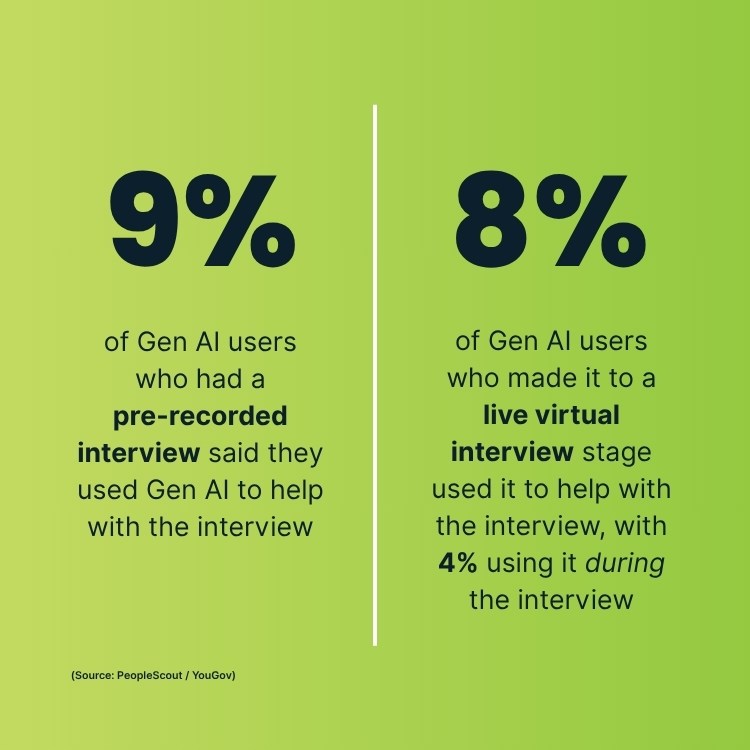
Just 9% of those using Gen AI at any point in the recruitment process used it to support their pre-recorded interviews. This was unexpectedly low, given the number using it to help with résumés, CVs and applications. It may be that its value in helping to prepare and practice for interviews is less well understood or harder to achieve. For example, Gen AI tools may need more sophisticated prompting to get high quality support for interview preparation.   

For candidates who used Gen AI at some point and who had a live virtual interview as part of their selection process, only 8% used Gen AI to help with this but, significantly, almost half of this group disclosed that they had used it for live support during the interview. Live interviews were previously a protected space from Gen AI use, and although this is reported by just handful of job seekers, it clearly suggests that real-time assistance during live virtual interviews is happening—and we would assume this is likely to increase.    

It isn’t evident from our survey exactly what type of live Gen AI assistance candidates were using, but newer Gen AI capabilities of ‘listening’ and responding in real time with a conversational style could allow candidates to deliver inauthentic answers without detection. This is something employers are likely to want to keep under observation and consider acting on, redesigning interview questions to make it harder to use Gen AI for deceptive purposes. Despite this, our survey indicates that this kind of potentially disruptive use is low amongst job changers and not a major cause for alarm at this point.   

3. No One’s Talking About It 

Perhaps most revealing for employers is that of those applicants who used Gen AI, only 38% would be willing to disclose their use to employers. The remaining 62% either wouldn’t disclose or are uncertain about whether they would—a concerning reality check for employers attempting to protect the integrity of their recruitment process.  

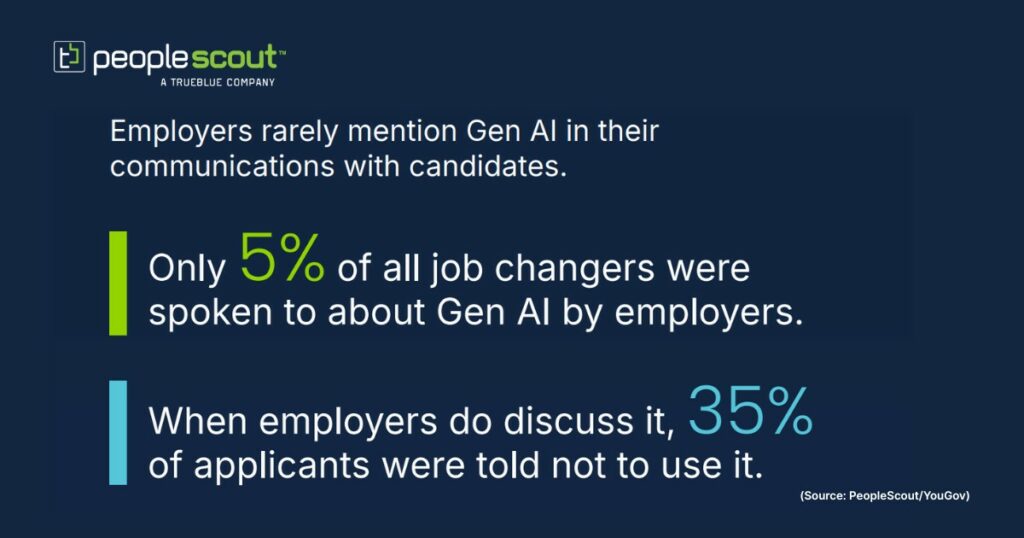
It begs the question—could this behaviour be driven by employers? According to our survey, employers rarely mention Gen AI usage in their communications with candidates. Only 5% of all job changers said their future employers spoke to them about Gen AI during the recruitment process. And for the few who did hear about it during recruitment,, 35% were told not to use it.   

The number of employers failing to communicate about AI in recruiting may contribute to candidates’ reluctance to discuss their Gen AI usage with employers due to an assumption that employers’ silence on the matter indicates that Gen AI use is inappropriate or unacceptable, and to reveal use of it would negatively impact their chances of getting an offer. 

Gen AI Opportunities & Risks 

Navigating this complex landscape effectively often requires specialized expertise and support. Working with a talent partner with deep assessment expertise can provide crucial advantages in maintaining recruitment integrity while achieving business objectives.  

As leading providers of talent assessment solutions, PeopleScout’s Assessment Design & Delivery team offers a Gen AI Opportunity & Risk Assessment Audit to provide organizations with a comprehensive review of their recruitment processes, identifying both vulnerabilities and opportunities related to generative AI throughout the candidate journey. This independent audit, grounded in psychological expertise, stress-tests each assessment element within your specific recruitment context to determine how Gen AI might impact selection accuracy and diversity outcomes. The resulting evidence-based recommendations allow employers to strategically focus resources on critical vulnerability points while potentially leveraging beneficial AI uses, enabling informed decisions about whether to accept, prevent or adapt to candidates’ use of Gen AI tools based on your organizational values and objectives. 

For more Gen AI insights, download the full The AI-Enabled Applicant: How Candidates Are Really Using Gen AI in Recruitment report. 

You may also be interested in: 

The AI-Enabled Applicant: How Candidates Are Really Using Gen AI in Recruitment

The AI-Enabled Applicant

How Candidates Are Really Using Gen AI in Recruitment

Is generative AI (Gen AI) disrupting your recruitment process? Our exclusive research unveils what’s actually happening right now—and the results might surprise you.

While headlines scream about AI taking over job applications, our fresh data shows the nuanced reality of how candidates in the UK are really using these tools in 2025.

In this comprehensive report, you’ll discover:

  • The true adoption rate of Gen AI by job seekers (spoiler: it’s not what most experts predicted)
  • Which specific recruiting touchpoints are most vulnerable to Gen AI impact
  • Unexpected findings about candidate attitudes toward disclosing Gen AI usage
  • Actionable strategies to protect assessment integrity without fighting technology

Don’t Base Critical Hiring Decisions on Outdated Information

As some organizations implement extreme measures like blanket AI bans, others are finding smarter, more sustainable approaches that embrace innovation while maintaining recruitment quality. Download the report now to get ahead of this rapidly evolving challenge and transform potential threats into competitive advantages for your recruitment strategy.

Employer Brand Social Media Strategy: Tactics for Building Your Buzz

Candidates can see and engage with your brand at hundreds of touchpoints before ever seeing a job posting or visiting your career page. Prospective employees research companies extensively through social media, employee reviews and digital content long before they consider applying. With remote and hybrid work now standard, an organization’s digital presence has become the primary way candidates form impressions about company culture and values. While this shift may sound daunting at first, digital recruitment marketing and the rise of social media mean organizations today can spread their message and establish a strong knowledge of their employer brand with prospective candidates—often before those candidates even think about looking for a job. Regardless of the economic climate and whether we’re experiencing talent shortages or market abundance, a strong employer brand social media strategy is imperative to an employer’s recruitment mix.

Building Your Employer Brand Social Media Strategy

Regardless of the platform, simply posting job openings isn’t going to cut it. Instead, think about how you can best show prospects what it’s truly like to work for your organization—whether that means showcasing your hybrid work culture, office environment, or remote team collaboration. In addition to insightful thought leadership, share employee activities, first-person stories, and authentic content that shows candidates how they can contribute and connect to your company in ways beyond their skills.

Let’s look deeper into how you can improve your employer brand social media presence on each of the five major social media channels and how you can utilize each of their unique features to your benefit.

LinkedIn

As the largest professional network, LinkedIn remains unmatched for B2B employer branding. With more than 900 million registered users globally, nearly half of whom are active monthly, it’s the number one platform to reach both passive and active prospective candidates across all experience levels.

Reach more candidates by:

  • Posting career advice and industry insights
  • Encouraging employee advocacy and content sharing
  • Using LinkedIn’s native video and document features
  • Leveraging LinkedIn Stories and newsletters
  • Optimizing your company page with relevant keywords
  • Utilizing LinkedIn Live for virtual events and Q&As

Instagram

With over 2 billion monthly active users, Instagram has become essential for reaching talent and showcasing company culture visually. The platform’s engagement rates consistently outperform other networks, making it ideal for building authentic connections with potential candidates through visual storytelling.

Engage employees and candidates with:

  • Instagram Stories and Reels (the platform’s fastest-growing features)
  • Story highlights for evergreen content
  • Creative feed posts and carousel content
  • Instagram Live sessions
  • IGTV for longer-form content
  • Comments, DMs and interactive stickers
  • Behind-the-scenes content and employee takeovers

TikTok

With over 1 billion monthly active users and the fastest-growing user base among social platforms, TikTok has become crucial for reaching Gen Z and millennial talent. The platform’s algorithm-driven content discovery makes it possible for employer brand content to reach massive audiences organically.

Capture attention and showcase culture with:

  • Short-form video content (15-60 seconds)
  • Trending sounds and hashtags
  • “Day in the life” employee content
  • Behind-the-scenes workplace footage
  • Company culture challenges and trends
  • Authentic, unpolished content that feels genuine
  • Employee-generated content and takeovers

X (formerly Twitter)

With approximately 450 million monthly active users worldwide, Twitter remains valuable for real-time engagement and thought leadership. The platform’s fast-paced nature makes it ideal for sharing timely insights, participating in industry conversations, and showcasing your company’s voice and values.

Utilize:

  • Industry conversations and trending topics
  • Twitter Spaces for live audio discussions
  • Thread-style content for deeper insights
  • Retweets with thoughtful commentary
  • Quick responses to showcase company personality
  • Employee advocacy through authentic sharing

Facebook

With nearly 3 billion monthly active users, Facebook offers the largest potential reach and sophisticated targeting capabilities. While younger demographics have shifted away from the platform, it remains valuable for reaching experienced professionals and building community around your employer brand.

To showcase your industry expertise as well as your company culture, take advantage of:

  • Facebook Groups for building professional communities
  • Facebook Live for virtual events and behind-the-scenes content
  • Detailed targeting options for recruitment advertising
  • Facebook Events for job fairs and company events
  • Employee advocacy through sharing and tagging
  • Facebook Insights for detailed analytics and optimization

Case Study: Employer Brand Social Media Strategy in Action

The Challenge: The UK Civil Service Fast Stream graduate program had no shortage of applicants, but faced a critical diversity problem. Research revealed that underrepresented groups perceived the Civil Service as “stuffy,” “outdated,” and only accessible to elite backgrounds—despite the organization’s goal to reflect the communities they serve.

The Employer Brand Social Media Strategy: Rather than traditional graduate recruitment advertising, PeopleScout developed an innovative influencer marketing approach specifically designed to reach diverse talent where they already engage online.

Key Tactics:

  • Partnered with Vee Kativhu, a YouTube influencer and Oxford graduate who advocates for underrepresented students, to create authentic “day in the life” content
  • Leveraged her 250,000+ YouTube subscribers plus Instagram and LinkedIn networks
  • Amplified reach through 12 diverse nano-influencers with targeted followings
  • Created genuine, behind-the-scenes content that challenged preconceptions about government work

Results That Matter:

  • 3,200+ increase in applications from diverse backgrounds
  • 18,056 views on YouTube in less than 48 hours (36,000+ total)
  • 351,304 social media impressions across the campaign
  • Significant increase in candidate diversity, including ethnic minorities, LGBTQ+ individuals, and those with disabilities or from lower socio-economic backgrounds
employer brand social media

Why It Worked: By meeting candidates on platforms they already trusted and using voices they could relate to, the Civil Service transformed perceptions and attracted talent that traditional job postings never could have reached. The campaign proved that innovative social media strategies can solve complex diversity challenges while staying cost-effective.

Conclusion: Employer Brand & Social Media

It’s no secret that candidates are going to research your organization prior to applying for any of your positions or even considering you as a potential employer. By balancing postings on job boards with an employer brand social media strategy and other touchpoints along the hiring process, you can create a well-respected online presence that accurately represents your employer brand and company culture. So, the next time a candidate researches your company, reads reviews or looks at what current employees are saying online, rest assured that a strong employer brand social media presence and strategic recruitment campaign will give you all you need to create a lasting impact in a candidate’s mind.

Mental Health in the Workplace: A Strategic Imperative  

One out of every two people in the world will develop a mental health disorder in their lifetime, according to a large-scale study co-led by researchers from Harvard Medical School and the University of Queensland. It’s not hard to understand why workplace mental health has become a larger part of our collective consciousness.  

For employers, it means the global workplace is experiencing a mental health crisis that directly impacts business performance. According to Gallup’s State of the Global Workplace report, in 2024, employee engagement fell to a 10-year low of 21%, matching the decline witnessed during COVID-19 lockdowns. Meanwhile, burnout symptoms affect one in five workers globally, with certain demographics and industries experiencing significantly higher rates. 

Today, more than 3.5 billion working adults each spend roughly 90,000 hours (or about 45 years) of their lives at work, underscoring the workplace’s potential to profoundly influence health. The business case for workplace mental health support has never been clearer—or more urgent. 

The State of Workplace Mental Health 

In the last five years, the typical organization has experienced disruption at every level. From pandemic turnover to a hiring boom then bust. From remote work to the return to the office. We’ve seen rapidly restructured teams, disrupted supply chains and shrinking budgets—not to mention eye-watering advancements in AI technology.  

It’s no wonder the global workforce is experiencing unprecedented levels of mental health challenges. According to the same Gallup report, two-thirds (58%) of the global workforce is “struggling” and 9% are “suffering.” Just a third of global employees (33%) class themselves “thriving.” 

Behind these data points are significant variations in the day-to-day emotional experiences of employees. When asked which negative feelings they experienced “a lot of the day yesterday,” 40% of global employees reported feeling stress, 23% sadness, 22% loneliness and 21% anger. 

The Demographic Divide 

Mental health challenges affect the workforce unevenly, creating targeted opportunities for intervention. 

Age 

According to a study from the World Economic Forum, the youngest workers (18-28) report burnout symptoms at three times the rate of older workers—27% versus 9% for those over 60. Nearly half (47%) of young workers report that their job negatively affects their mental health. This divide is further reflected in today’s multigenerational workforce—younger employees have reduced their weekly working hours by nearly two hours since 2019, compared to just one hour for older workers. 

Gender 

WEF also reports that women experience disproportionate mental health challenges at work. Female managers saw a seven-percentage-point drop in wellbeing in the past year. Women are 8 percentage points more likely to report exhaustion symptoms than men (46% versus 38%) and report higher rates of poor or fair mental health than men (23% versus 15%). Working women under 30 carry the greatest burden, with over a third (36%) reporting fair or poor mental health. 

Other Key Demographics 

  • LGBTQI+ individuals score 9 percentage points lower on overall health than heterosexual employees. 
  • Neurodivergent employees are 24 percentage points less likely to report “faring well” compared to neurotypical peers. 
  • Employees with financial stress show dramatically lower overall health (41% versus 76% for those with good financial status). 
  • Remote workers consistently report higher levels of negative emotions across all categories: stress (45%), sadness (30%) and loneliness (27%). 

The Hidden Productivity Crisis of Workplace Mental Health

The economic implications of poor mental health in the workplace are staggering. According to WEF, enhanced mental health for employees could generate up to $11.7 trillion in global economic value.  

The costs of poor mental health are evident in absenteeism, turnover and productivity losses which account for $2 to $9 trillion in losses globally every year. 

  • Workers with fair or poor mental health average nearly 12 days of unplanned absences annually versus 2.5 days for other workers—a $47.6 billion annual productivity loss in the U.S. alone.  
  • Organizations lose 15-20% of total payroll in voluntary turnover costs due to burnout 
  • Employees with untreated insomnia cost approximately $2,280 more for employers per year 

Despite these alarming figures, the gap between recognizing the problem and effectively addressing it remains wide. While 23% of CHROs now rank wellbeing among their top organizational priorities, only 21% of employees strongly agree that their organization cares about their wellbeing—matching a record low. 

The Layoff Effect 

The trend of large-scale layoffs has created significant mental health implications. In 2025 alone, over 51,000 tech employees and 61,000 U.S. government employees have been laid off. The ripple effects of layoffs impact entire organizational cultures, undermining engagement and productivity, as the fear of layoffs erodes motivation and contributes to anxiety and depression. Job insecurity leads to adverse mental health effects, with 45% of employees experiencing high job insecurity reporting burnout symptoms. 

The Connection Between Engagement and Wellbeing 

Record-low engagement is costing organizations billions in lost productivity. Gallup estimates the global cost of disengagement at $9.6 trillion annually (9% of global GDP). Employees who aren’t thriving report 61% higher likelihood of burnout and 48% higher likelihood of daily stress. 

Gallup’s recent data reveals a critical relationship between engagement and wellbeing: 

  • 50% of engaged employees are thriving in life overall, compared to just one-third of disengaged employees. 
  • Engaged employees report fewer daily negative emotions, including stress. 
  • Only 30% of employees feel connected to their company’s mission/purpose—a record low. 

These findings suggest a virtuous cycle: improving engagement enhances wellbeing, which in turn supports sustained engagement and productivity.  

So, what can organizations do to boost employee engagement and wellness in the workplace? 

Strategic Approaches for Supporting Workplace Mental Health 

Invest in Manager Development 

Manager burnout correlates directly with declining team performance, increased absenteeism and turnover. Yet less than half of the world’s managers (44%) say they have received management training, making it one of the most effective wellbeing initiatives employers can invest in. 

According to Gallup, when employers provide management training, manager thriving levels improve from 28% to 34%. Thriving increases further to 50% when managers are encouraged to pursue personal development opportunities.  

Address Core Drivers of Burnout 

In 2019, the World Health Organization (WHO) included burnout in its International Classification of Diseases, defining it as an occupational phenomenon, rather than a medical condition. Burnout is driven by much more than just hours worked. Workplace factors contributing to burnout include: 

  • Toxic workplace behavior 
  • Role ambiguity 
  • Being treated unfairly 
  • Unclear communication 
  • Lack of manager support 
  • Unreasonable time pressure 

Organization-wide, addressing factors like this that might be affecting mental health can have a more profound impact than generic wellness initiatives.  

Implement a Holistic Approach to Workplace Mental Health

Effective mental health strategies require interventions at multiple organizational levels. Providing access to support resources and mental health awareness training for managers can help support employees at an individual level. In addition, encourage managers to look at various roles to find ways to enhance employees’ autonomy and ensure they have reasonable workloads. At the team or department level, leaders can influence the ways teams work together and create space for recovery by ensuring employees are cross-trained and workloads can be transferred. Organization-wide structural changes are equally essential, addressing systemic issues like compensation equity, career development paths and recognition programs that reinforce psychological safety.  

Research shows that organizations taking this multi-level approach see significantly better outcomes than those implementing isolated wellness programs. According to the WEF report, comprehensive interventions targeting structural issues, leadership behaviors and individual support tools simultaneously can deliver up to three times the return on investment compared to fragmented approaches. The most successful organizations treat mental health not as a separate initiative but as an integrated consideration in every business decision, from office design to performance management systems. 

Focus on Presenteeism, Not Just Absenteeism 

While absenteeism is easier to measure, presenteeism (working while unwell) represents a larger economic impact. Many organizations track sick days but overlook the more substantial productivity drain of employees who are physically present but mentally struggling. 

According to WEF, conditions like depression cause productivity losses exceeding $300 per employee annually in the U.S., primarily through presenteeism. Employees experiencing mental health challenges often exhibit decreased focus, impaired decision-making, reduced creativity and diminished capacity for collaboration—all while appearing to be “at work” according to traditional definitions. 

Regular pulse surveys, performance analytics and team effectiveness assessments can help identify patterns of presenteeism before they translate into more serious issues like turnover or disability leave. Creating psychological safety for employees to disclose struggles before they become debilitating is equally important, as early intervention has been shown to significantly reduce both the duration and severity of mental health challenges. 

Building Resilience with Workplace Mental Health 

As organizations navigate economic uncertainty, technological disruption and evolving workforce expectations, they must also keep in mind that their employees are also impacted by these factors. In order to keep your workforce healthy and productive, mental health support must shift from a peripheral benefit to a core business strategy. 

The data is clear: organizations that invest strategically in mental health create competitive advantage through higher engagement, reduced turnover, increased productivity and stronger organizational culture. Few investments offer comparable returns. Building mental health resilience isn’t just about supporting employees—it’s about securing your organization’s future performance and sustainability in an increasingly complex world. 

The Essential Guide to Employer Branding From Concept to Competitive Advantage 

The Essential Guide to Employer Branding 

From Concept to Competitive Advantage

In today’s competitive talent landscape, your employer brand isn’t just nice to have—it’s essential for survival. Our comprehensive ebook delivers actionable strategies to revolutionize how candidates perceive your organization.


Why This Guide Matters to Your Organization:

  • 82% of candidates research your reputation before applying
  • Companies with strong employer brands see a 43% decrease in cost-per-hire
  • Yet only 8% of HR leaders have dedicated employer branding budgets


What You’ll Discover:

  • Proven frameworks to align your employer brand with business objectives
  • Practical strategies to authentically showcase your culture across channels
  • Step-by-step approaches to measure and optimize your employer brand ROI
  • Real-world case studies from organizations that transformed their talent attraction


While your competition invests in employer branding, can you afford to fall behind? Download our guide today and build the magnetic employer brand your organization deserves.

Beyond Intuition: Data-Driven Employer Branding for the Modern Talent Landscape 

With the research today’s candidates do before applying, a strong employer brand is no longer a nice-to-have—it’s essential. Your employer brand directly impacts your ability to attract and retain top talent, yet for many talent acquisition leaders, demonstrating the value of employer branding remains challenging.  

How do you quantify something that often feels intangible? How do you translate employer brand sentiment into metrics that resonate with stakeholders outside HR? 

The Employer Branding Paradox 

Despite 80% of HR leaders believing employer branding significantly impacts their recruiting efforts, only 8% report having a dedicated budget for these initiatives. This disconnect highlights a fundamental challenge: without concrete metrics and benchmarks, employer branding can be relegated to a “nice-to-have” rather than recognized as the strategic driver of recruitment success that it truly is. 

The reality is that today’s candidates approach job searches with consumer-like behavior. They research, compare and evaluate potential employers with unprecedented thoroughness.  

Your employer brand is front and center whether you’re actively managing it or not. 

From Gut Feel to Data-Driven Strategy 

For too long, employer branding has relied on subjective assessments and anecdotal evidence. Leaders might know intuitively that their brand needs improvement, but without comparative data, it’s difficult to: 

  • Identify specific areas requiring attention 
  • Prioritize investments for maximum impact
  • Demonstrate ROI to key stakeholders 
  • Track progress over time 
  • Understand how you stack up against competitors 

This is precisely why we’ve developed the Outthink Index—a proprietary benchmarking tool designed to transform employer branding strategy from an art to a science. 

Introducing the Outthink Index by PeopleScout 

The Outthink Index by PeopleScout provides comprehensive analysis across nine critical components of employer branding: 

  1. Search: Are your job openings easy to find in digital spaces? 
  2. Social Reach: What’s the breadth of your social media footprint? Are you achieving significant reach through interactions and engagement across audiences? 
  3. Social Authority: How much of the conversation does your brand own compared to competitors? How influential is your voice in the talent marketplace? 
  4. Social Impact: How effectively does your content engage your audience? Are you interacting with your talent audience on social media or just posting? 
  5. Values & Proposition: How clearly articulated and differentiated is your EVP? Are your values clear, authentic and evidenced? 
  6. Employee Experience: Can candidates get a clear understanding of what life is like within your organization?  
  7. Content: How compelling and relevant is your employer brand content? How authentically does it showcase your organization and your employees? 
  8. User Experience: How seamless and intuitive is your career site and application process?   
  9. Candidate Experience: How transparent, consistent and innovative is your recruitment process? 

Built by our in-house talent advisory experts and leveraging data from hundreds of employer brands, the Outthink Index delivers actionable insights with just a few clicks. 

Translating Insights to Action 

One of the most valuable aspects of the Outthink Index is its comparative nature. While self-assessment can identify obvious gaps, true optimization comes from understanding how you measure against both industry benchmarks and specific competitors. 

The real power of data-driven employer branding isn’t just in the metrics—it’s in what you do with them. The Outthink Index is designed to facilitate more productive conversations with stakeholders by providing concrete evidence of: 

  • Current employer brand strengths and weaknesses 
  • Competitive positioning within your industry 
  • Specific improvement opportunities with the highest potential ROI 
  • Progress tracking over time 

The Outthink Index helps companies to transcend gut instincts and harness concrete insights to maximize their employer brand. It provides organizations with precise visibility into how their brand measures up against competitors, highlights specific enhancement opportunities, and ultimately strengthens their capacity to attract and retain exceptional talent. 

Armed with these insights, talent leaders can make more strategic decisions about where to invest resources, how to refine messaging and which touchpoints in the candidate journey need the most attention.  

The Future of Employer Branding is Data-Driven 

Employer branding isn’t a one-time project but an ongoing strategic initiative. The Outthink Index provides both a snapshot of current performance and a framework for optimizing and measuring progress over time. By establishing clear benchmarks today, organizations can track the impact of their employer branding initiatives, demonstrate concrete ROI and continuously refine their approach. 

As the competition for talent continues to intensify, organizations that take a data-driven approach to employer branding will gain a significant advantage. The Outthink Index by PeopleScout equips talent leaders with the tools they need to transform employer branding from an intangible concept to a measurable business driver. 

Want to see how your employer brand stacks up? Explore the Outthink Index or contact us to receive your custom report. 

Wates: Reconstructing Industry Perceptions Through Vibrant Employer Branding

Wates: Reconstructing Industry Perceptions Through Vibrant Employer Branding

Early Careers

Wates: Reconstructing Industry Perceptions Through Vibrant Employer Branding

PeopleScout helped Wates to attract and engage a wider range of candidates to the male-dominated construction industry through a vibrant and inclusive employer brand and assessment center.

7,918 applications generated (30% from women)
343 candidates assessed
1 / 3 of offers went to women despite being underrepresented in the industry

Situation

The construction industry’s image has remained virtually unchanged for years—dominated by hard-hats, high-vis, and steel beams rather than stories highlighting inclusion, innovation, collaboration or opportunity.

When Wates, a UK development, building and property maintenance company, needed to recruit 81 trainees across 21 roles and 28 locations, our priority was to stand out meaningfully in a crowded market. Despite its impressive 125-year legacy as an industry leader, Wates suffered from limited employer brand awareness.

Our objectives were clear:

  • Raise overall awareness of the Wates organization
  • Encourage a shift in industry perception
  • Attract a more diverse range of candidates

Solution

With these hard-to-fill roles distributed nationwide, we needed a targeted approach. Based on research, we developed four distinct candidate personas that represented our target demographics, which then informed our channel strategy and creative approach.

Authentic Messaging

We crafted a new compelling, early careers employer value proposition that brought together everything Wates stands for:

Creating tomorrow together.

Headlines embodied Wates’ core values, speaking directly to the impact individuals would have on the company’s legacy while highlighting key benefits of joining the organization.

Distinctive Visual Identity

We developed bold, vibrant visuals that stood apart from industry norms. Our creative approach demonstrated how professional and personal lives intertwine, visually representing work-life balance and inclusivity. A dedicated photoshoot allowed us to not only capture images but also collect employee stories that inspired a bespoke set of illustrations.

Inclusive Assessment Process

We redesigned the video interview process to ensure accessibility for all candidates. While maintaining a standardized process to ensure fairness, each of the 21 roles required careful manual shortlisting based on performance metrics. With 343 candidates advancing to assessment, we conducted virtual assessment centers over three weeks, with each role getting a dedicated day.

Results

The campaign generated exceptional engagement:

  • 518,000 impressions (40% from TikTok)
  • 7,918 applications
  • 2,022 candidates invited to video interview
  • 343 candidates progressed to assessment centers
  • 30% female representation at application stage, increasing to 34% at offer stage
  • 117 offers extended

“We’re delighted with the quality of candidate applications and how much the collaborative work ethic stood out.”

– Annette, Wates

At a Glance

  • COMPANY
    Wates
  • INDUSTRY
    Building & Construction
  • PEOPLESCOUT SOLUTIONS
    Talent Advisory
  • ABOUT WATES
    The Wates Group was established in 1897 and is one of the leading privately-owned, construction, development and property services companies in the UK. They employ almost 6,000 people, working with a range of clients and partners from across the public and private sectors.