Breaking Barriers: Social Mobility in Early Careers  

In the United Kingdom, social mobility has gained more attention in recent years, particularly in relation to early career opportunities and their impact on an individual’s life trajectory. Social mobility refers to the movement of individuals or groups between different socio-economic positions within society—either upward (improving one’s social status) or downward. The impact that early career choices can have on social mobility cannot be overstated. The decisions made in the formative years of one’s professional life often set the stage for future opportunities, earning potential and overall quality of life. 

Currently, the state of social mobility in the UK presents a complex picture. While progress has been made in some areas, significant challenges remain. The article explores the social mobility landscape and offers ways your early careers recruitment program can make a difference. 

Historical Context of Social Mobility & Work 

To understand the current state of social mobility in the UK, it’s essential to consider the historical context of social class in the country. Traditionally, British society was stratified, with divisions between the working class, middle class and upper class, which often determined an individual’s life chances from birth. 

Over the past century, however, there has been a gradual evolution in social mobility. The post-World War II era saw significant changes, with the establishment of the welfare state, expansion of educational opportunities, and changes in the labour market contributing to increased social mobility. The 1950s and 1960s, in particular, are often referred to as the “golden age” of social mobility in the UK. 

Key policies and reforms have played a crucial role in shaping social mobility. The Education Act of 1944, which introduced free secondary education for all, was a landmark policy. The expansion of higher education in the 1960s and 1970s, including the establishment of new universities, also opened up opportunities for many. More recently, initiatives such as the introduction of the National Minimum Wage in 1999 and the Equality Act 2010 have aimed to reduce economic disparities and discrimination. 

Current Challenges for Social Mobility in Early Careers 

Despite progress, significant challenges remain in achieving social mobility, particularly for early careers talent. These challenges can be broadly categorized into three main areas: education disparities, employment opportunities, and socioeconomic factors. 

Education Disparities 

Access to quality primary and secondary education remains uneven across the UK, creating a foundation for career inequalities that can persist throughout an individual’s life. Schools in disadvantaged areas often struggle with limited resources and difficulties in recruiting and retaining experienced teachers. This creates a challenging environment where students from working-class backgrounds must overcome significant obstacles to compete with their more privileged peers.  

While overall university participation has increased in recent decades, students from disadvantaged backgrounds continue to face significant barriers in accessing higher education, particularly at elite institutions. Those who do secure places at universities often face additional challenges that their more privileged peers may not encounter, including financial pressures, lack of academic support networks and the need to balance studies with part-time work. These factors contribute not only to lower completion rates but also to reduced opportunities for networking, internships and extra-curricular activities that are often crucial for early career success. 

Moreover, those who do attend are more likely to drop out before completing their degrees. Recent data from the Office for Students highlights that students from the most deprived backgrounds are significantly less likely to complete their university courses, with only 82% finishing their studies compared to 92% of students from the most advantaged groups. This 10-percentage point gap represents thousands of talented individuals whose potential remains unfulfilled.  

The compounding effect of these educational disparities creates a concerning pipeline problem for social mobility in early careers. When students from working-class backgrounds face barriers at each stage of their educational journey, their ability to compete for prestigious graduate schemes and career advancement opportunities is significantly compromised. This perpetuates existing social inequalities and limits the diversity of talent that organizations can access. 

Employment Opportunities 

The transition from education to employment represents a critical juncture where social mobility often stalls, particularly in the realm of internships and entry-level positions. Recent research by the Sutton Trust reveals a troubling picture of how internships—increasingly essential for launching successful careers—have become a mechanism that reinforces rather than reduces social inequality. 

Thirty-one percent of new graduates secured full-time employment through internship experience. However, access to these crucial opportunities remains heavily skewed by social class. The data shows a stark disparity: while 55% of middle-class graduates complete internships, only 36% of their working-class peers do the same. More concerning still, this gap has widened from 12 to 19 percentage points since 2018, indicating that the problem is getting worse, not better. 

The financial barriers to accessing internships are substantial. The research reveals that 61% of internships offer inadequate compensation with 23% paying less than minimum wage and 21% entirely unpaid. This creates an obvious barrier for those from less privileged backgrounds. The impact is clear in the finding that 40% of unpaid interns rely on parental financial support—up significantly from 26 percent in 2018—effectively excluding those whose families cannot afford to subsidize their early career development. 
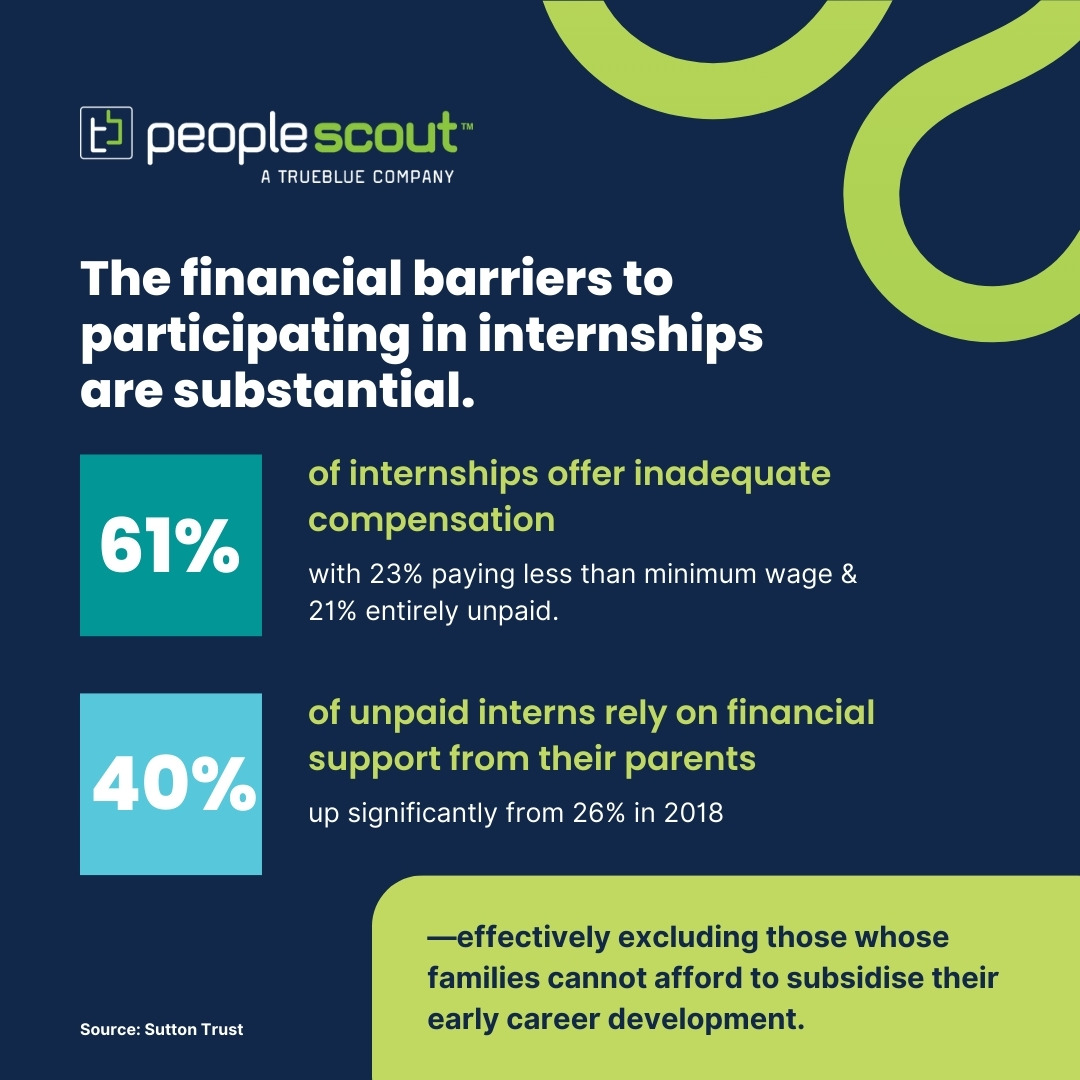
Image repeats text above. 
The financial barriers to accessing internships are substantial. 
61% of internships offer inadequate compensation with 23% paying less than minimum wage and 21% entirely unpaid. 
40% of unpaid interns rely on parental financial support—up significantly from 26 percent in 2018
—effectively excluding those whose families cannot afford to subsidize their early career development. 

The problem is compounded by how these opportunities are distributed. Internships are almost twice as likely to be secured through family and friends who work within an organization compared to through advertised positions. This “hidden job market” creates a double disadvantage for working-class graduates: not only are they less likely to be able to afford unpaid or low-paid internships, but they are also less likely to have the social connections necessary to access these opportunities in the first place. 

Socioeconomic Factors 

The interplay between educational disparities and employment barriers reveals a deeper structural challenge: how socioeconomic advantages create self-reinforcing cycles that perpetuate inequality across generations. This system of inherited privilege manifests in both obvious and subtle ways, creating what many now refer to as the “nepo baby” phenomenon—where family connections and inherited social capital play an outsized role in career advancement. 

Those from privileged backgrounds often have access to “social capital”—a network of relationships that can provide insider knowledge about opportunities, make introductions to hiring managers and offer informal mentoring. This can be as valuable as formal qualifications, creating a parallel pathway to success that remains inaccessible to those outside these networks. 

This advantage is compounded by the rising cost of living, particularly in major urban centres where higher paying career opportunities are concentrated. Those from wealthy families can afford to take unpaid internships, pursue additional qualifications, take career risks, and build professional networks through expensive social activities and events. 
Image shows a quote from the article, "This “hidden job market” creates a double disadvantage for working-class graduates: not only are they less likely to be able to afford unpaid or low-paid internships, but they are also less likely to have the social connections necessary to access these opportunities in the first place."

Meanwhile, those from working-class backgrounds face financial constraints that force them to prioritise immediate income over long-term career development. The rising cost of living, coupled with stagnant wages in many sectors, makes it increasingly difficult to save money or invest in further education and training that could enhance their career prospects. 

The impact of these socioeconomic factors extends beyond individual careers to shape entire organizational cultures. When leadership positions are disproportionately filled by those from privileged backgrounds, it can create blind spots in understanding the barriers faced by others and perpetuate hiring and promotion practices that favour candidates with similar backgrounds.  

Recruitment Best Practices to Improve Social Mobility in Early Careers 

To effectively promote social mobility in early careers, organizations need to implement fair and inclusive recruitment practices, particularly during the critical assessment centre stage. The following best practices can significantly improve fairness and support for candidates from diverse backgrounds, helping to break down the systemic barriers identified earlier in this article. 

Contextual Recruitment 

Academic achievements and experience must be evaluated within the context of a candidate’s circumstances in order to achieve a fair assessment. Contextual recruitment are practices that acknowledge and accommodate the limiting and complex factors influencing applicants from deprived circumstances.  

Tactics to consider: 

  • Contextualized Applications: Implement systems that consider candidates’ achievements in the context of their background. For example, an applicant who achieved ABB at A-level while attending a low-performing school and facing socioeconomic challenges might be considered equivalent to a candidate with AAA from a high-performing school in an affluent area. 
  • Diverse Shortlisting: Review shortlists for interviews and assessment centres to ensure they include a balanced representation of candidates from various socioeconomic backgrounds. 

Inclusive Assessment Design 

Traditional assessment methods can inadvertently favour candidates from privileged backgrounds who have had more exposure to professional environments, support from education and practice, and guidance on formalised testing. A well-designed assessment evaluates capability and potential through multiple lenses, giving all candidates the opportunity to demonstrate their capabilities. 

Tactics to consider: 

  • Accurate and Updated Assessment Criteria: The assessment criteria against which candidates are evaluated often contain implicit and invisible class-based definitions of what good looks like. This can effectively disadvantage candidates from lower socioeconomic backgrounds throughout the assessment process and reduce hiring diversity. Reviewing the criteria for these risk factors and updating them is an important first step in increasing diverse socioeconomic inclusion.  
  • Varied Assessment Methods: Use a mix of assessment techniques (e.g., interviews, group exercises, situational judgement tests) to allow candidates different opportunities to showcase their abilities. 
  • Skills-Based Assessments: Focus on assessing skills and potential rather than prior experience or knowledge that may be more influenced by socioeconomic factors. 
  • Blind Evaluations: Where possible, use blind evaluation techniques to reduce unconscious bias. For example, remove names and educational institutions from written assessments. 
  • Constructive Feedback: Offer detailed, constructive feedback to all candidates, regardless of outcome. This can be particularly valuable for candidates from disadvantaged backgrounds who may have had fewer opportunities for professional development. 

Preparation and Support 

Many talented candidates from disadvantaged backgrounds may be unfamiliar with corporate recruitment processes or lack the resources to prepare effectively. You can level the playing field by providing comprehensive support before the assessment. 

Tactics to consider: 

  • Pre-Assessment Information: Provide detailed information about the assessment process in advance, including what to expect, how to prepare and what will be assessed. This helps level the playing field for candidates who may not have access to insider knowledge or coaching. Include guidance on how candidates should and shouldn’t use Gen AI tools in their preparation to ensure candidates from all socioeconomic backgrounds take the opportunity to use them to prepare. 
  • Practice Materials: Offer free, accessible practice materials and sample assessments to all candidates. These provide proportionately more benefit to those who have had limited access to resources already by virtue of their deprived educational or social background. 
  • Travel and Accommodation Support: For in-person assessment centres, offering support with travel costs can ensure financial constraints don’t prevent talented candidates from attending. 

Assessor Training and Diversity 

The quality and composition of assessment panels significantly impact the fairness of recruitment processes. Well-trained, diverse panels are better equipped to recognize potential across different backgrounds and experiences. 

Tactics to consider: 

  • Unconscious Bias Training: Provide comprehensive unconscious bias training to all assessors involved in the recruitment process. 
  • Diverse Assessment Panels: Ensure assessment panels are diverse in terms of gender, ethnicity and socioeconomic background to bring a range of perspectives to the evaluation process. 
  • Structured Interviews: Use structured interview techniques with pre-determined questions and scoring criteria to ensure consistency in scoring methodologies and reduce potential bias. 

Feedback and Continuous Improvement 

Creating a fair recruitment process requires ongoing evaluation and refinement. Organizations should establish robust feedback mechanisms to understand what works and what needs improvement. 

Tactics to consider: 

  • Data Analysis: Regularly analyse recruitment data to identify any patterns of bias or areas where candidates from certain backgrounds may be disproportionately disadvantaged. 
  • Candidate Surveys: Conduct anonymous surveys with candidates to gather feedback on the assessment process and identify areas for improvement. 

Onboarding Support 

Supporting candidates through their transition into the workplace is crucial for long-term success and retention, particularly for those from underrepresented backgrounds. 

Tactics to consider: 

  • Mentoring Programs: Offer mentoring programs to new early career hires, particularly those from underrepresented backgrounds, to support their transition into the workplace. 
  • Skills Development: Provide additional skills training or support for candidates who show potential but may need to develop specific skills to succeed in the role. 

Conclusion 

While social mobility in the UK continues to face significant challenges, particularly in the realm of early careers, there are promising developments. Early careers recruitment practices play a crucial role in either perpetuating or breaking down barriers to social mobility. Progressive recruitment strategies can help level the playing field and provide opportunities for talented individuals regardless of their background. 

By implementing these best practices, you can not only promote social mobility in early careers but also help your organization identify and nurture talent from a wider pool of candidates, benefiting both the individuals and the organization. 
Apprenticeship Recruitment in the UK: The Key to Future-Proofing Your Talent Pipeline? 

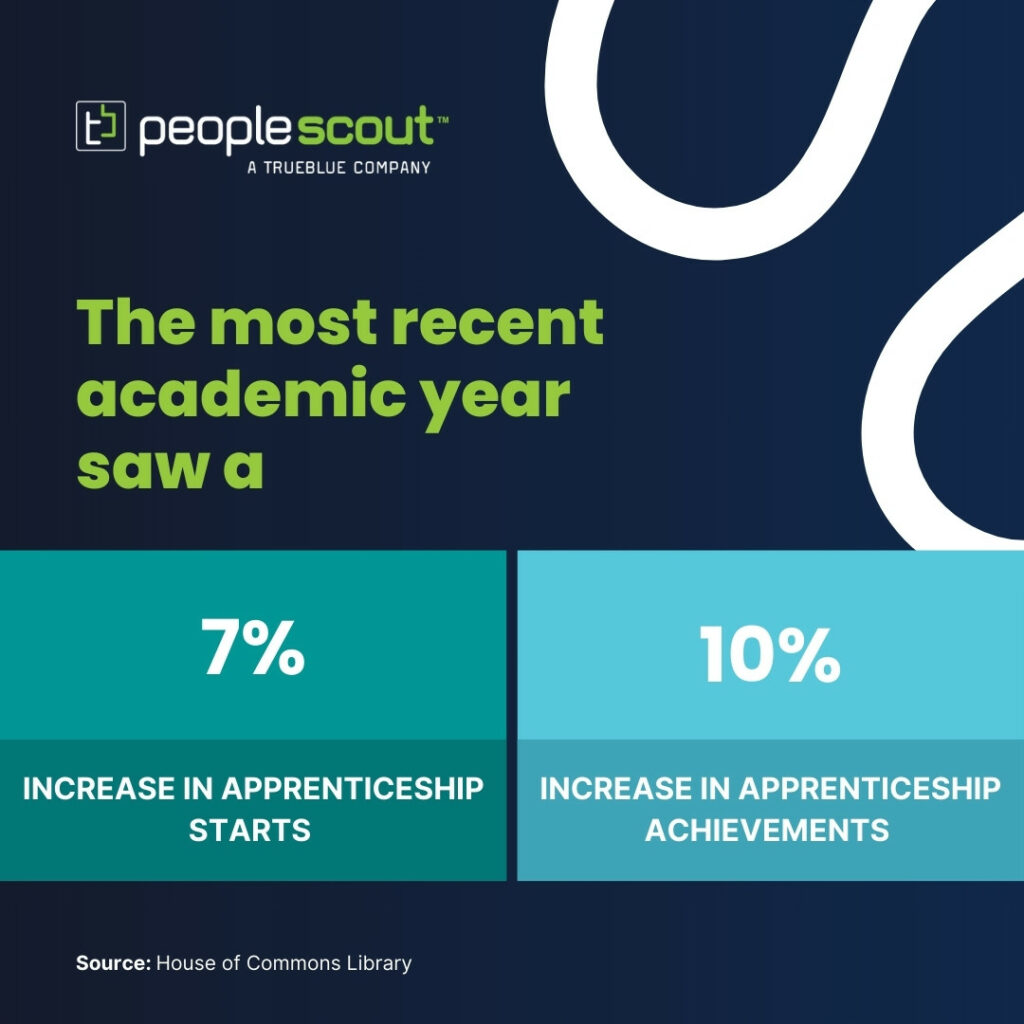
Apprenticeship recruitment has taken on more importance in early careers programs in recent years. According to UK Government data, the most recent academic year saw a 7% increase in apprenticeship starts and 10% increase in apprenticeship achievements. Organizations and employees alike are waking up to the fact that many skills can be learned on the job—and that it’s often more relevant training than a university degree.  

Whether for workers just starting out or those changing careers, apprenticeships help people gain valuable skills and on-the-job experience as they move toward a career in their field. For employers, field and business apprenticeships are one of the best ways of engaging early careers talent or career changers. Whilst providing opportunities for hands-on experience and training, apprenticeships help businesses to develop a talent pipeline that is equipped with future-ready skills. 

In this article, we’ll explore how designing and offering apprenticeship programs can be a smart way for organizations to create their own talent pipeline, close their skills gaps and diversify their workforce. 

What is an Apprenticeship? 

An apprenticeship is paid employment that offers on-the-job training and is often accompanied by classroom-based learning. Some employers may offer their own in-house training while others offer it in association with a college, university or other training provider. An apprenticeship must last at least a year but can go as long as 5 years. Through in-depth, job- and industry-specific skills training, apprentices gain a nationally recognized qualification or certification upon completion. 

Apprenticeship programs are a great choice for individuals who are early on in their careers, who are looking to upskill or who are exploring a career change. Employers are responsible for ensuring that apprentices work with experienced staff, learn job-specific skills and receive time off from work to complete their classroom training. 

Different countries have different laws and regulations around apprenticeships including wages and working hours. There are also various funding programs and government schemes available to encourage both workers and employers to embrace apprenticeships. For example, the UK Government introduced the (controversial) apprenticeship levy in 2017 which uses business taxes to fund apprenticeship training.  

Apprenticeship recruitment in the UK is on the rise with the most recent academic year showing a 7% increase in apprenticeship starts and 10% increase in apprenticeship achievements.

Types of Apprenticeships 

A common misperception is that apprenticeships are just for manual or skilled trade jobs. Whilst there are many apprenticeship programs in the skilled trades, there are also apprenticeship opportunities for all kinds of careers from actuaries to arborists. For example, our client, National Highways, offers apprenticeship opportunities for project management, business administration, legal, surveying and data analysis. Organizations are increasingly embracing corporate apprenticeships and traineeships as a means of diversifying their workforce and creating opportunities for social mobility. 

There are different levels of apprenticeship including degree apprenticeships which correspond to an equivalent education level. Completing a Level 2 apprenticeship is the equivalent of completing a GCSE, and a Level 7 apprenticeship is the equivalent of completing a master’s degree.  

Benefits of Apprenticeship Recruitment for Employers 

Apprenticeship recruitment can be an effective way of growing and upskilling your workforce. Here are just a few of the benefits for employers.   

Building a Talent Pipeline 

Companies in a variety of industries can build their own apprenticeship programs to help talent see the rewarding career opportunities available within their sector. As apprentices gain experience, organizations establish a pipeline of prospective employees. 

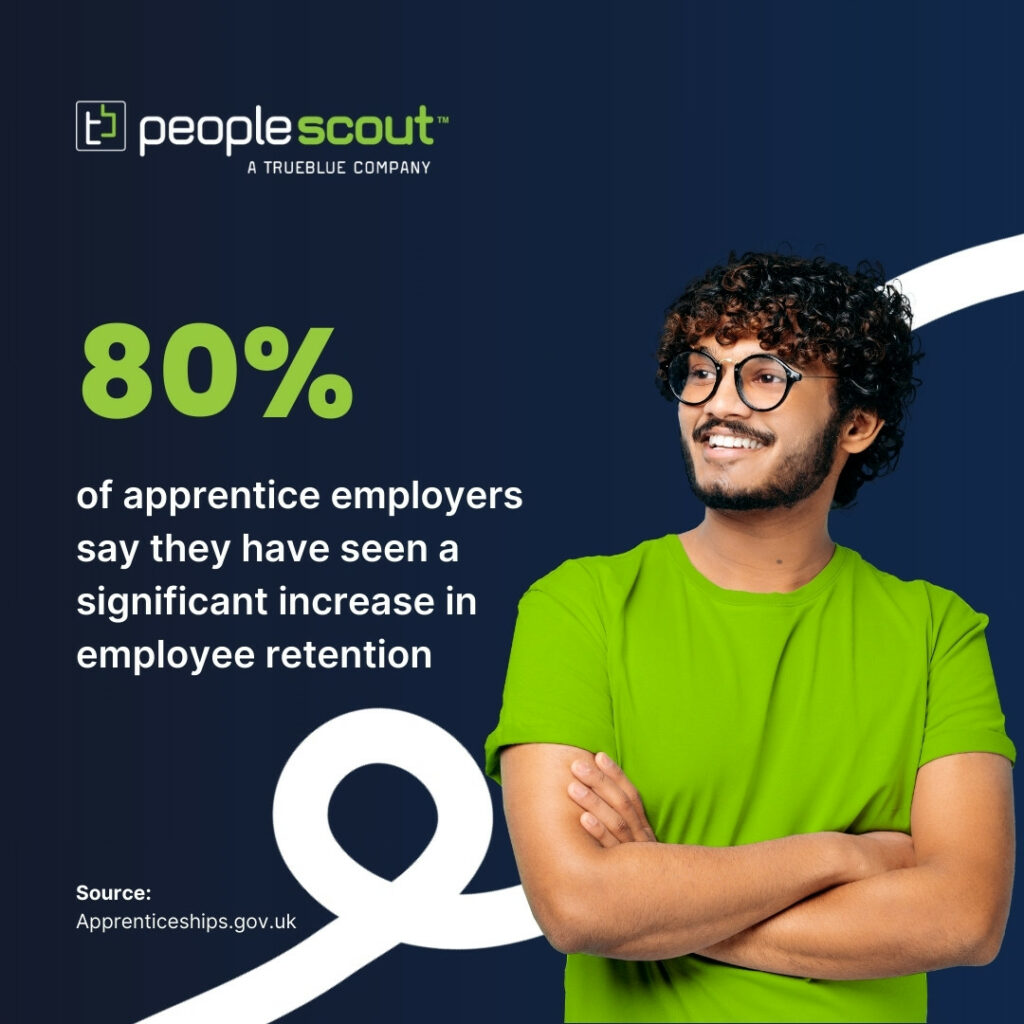
Early careers employees see apprenticeship programs as proof of an organization’s investment in their success and are more likely to stay with an organization after completing the program. In fact, 80% of apprentice employers say they have seen a significant increase in employee retention. Clearly, apprenticeship recruitment is an excellent way to “grow your own talent” and reduce attrition. 

80% of apprentice employers say they have seen a significant increase in employee retention

Closing Skills Gaps 

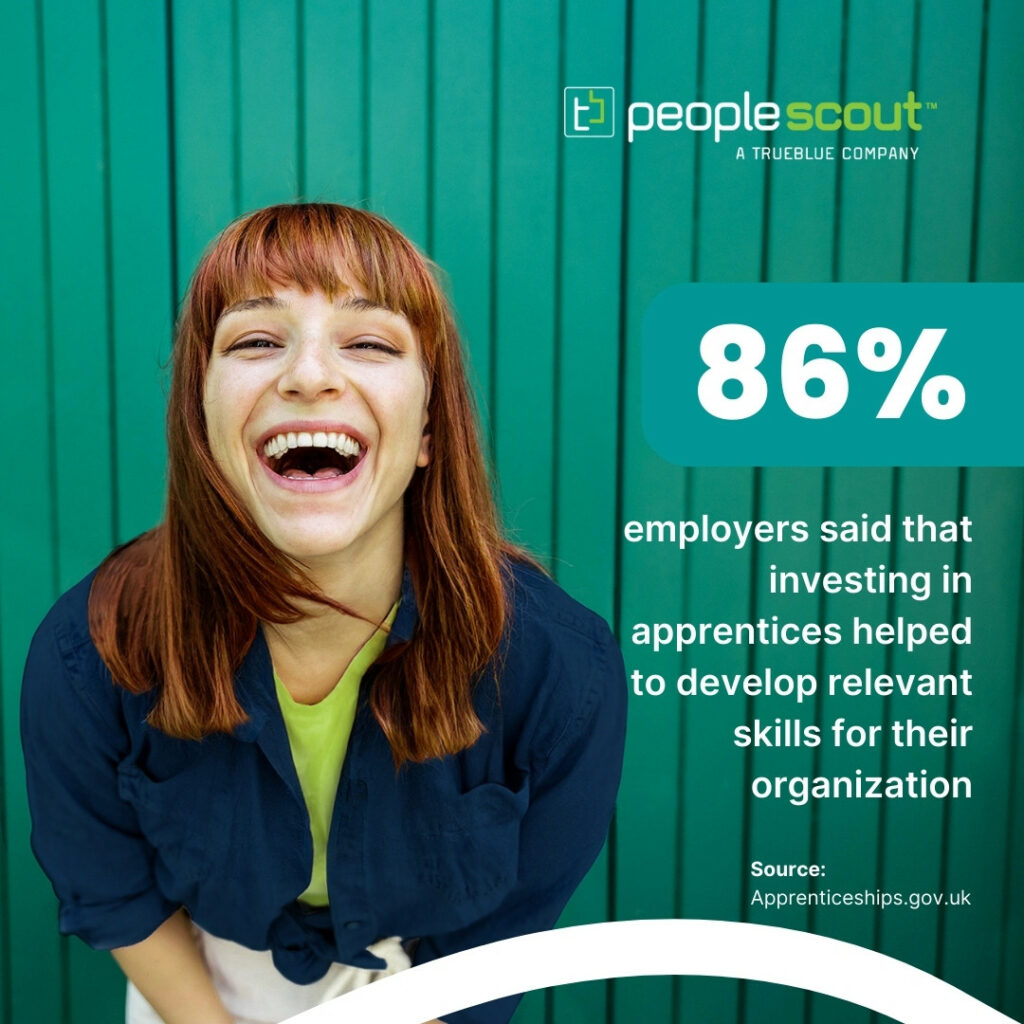
According to McKinsey, a whopping 87% of organizations are aware they already have a skills gap within their workforce or will experience one in the next few years. Apprenticeships offer a way to develop a new generation of workers to help your organization succeed into the future. A structured apprenticeship is an effective way to get a leg up in recruiting and retaining sought-after talent like software developers, data analysts and engineers. Indeed, 86% of employers said that investing in apprentices helped to develop relevant skills for the organization. 

The digital skills gaps alone could cause 14 G20 countries to miss out on a staggering $11.5 trillion USD in cumulative GDP growth. In the UK, companies like Dyson are partnering with the University of Warwick to offer apprenticeship training in engineering, data science and machine learning.  

86% of employers said that investing in apprenticeship recruitment helped to develop relevant skills for the organization

Boosting Diversity & Social Mobility 

A third of employers agree that apprenticeships have helped improve diversity within their business. They are particularly effective for creating career opportunities and boosting earnings for workers from disadvantaged socio-economic backgrounds. 

As more people struggle financially with student loans and education costs, apprenticeships have become an accessible career path for workers of all ages and backgrounds and give participants a shot at career success. They allow workers from underrepresented groups to increase their earnings potential—to work and earn money in the field while they learn. If your company cares about being a catalyst for sustained change in the community, apprenticeships are a great way to achieve this. 

RPO + Apprenticeship Recruitment 

As a leading recruitment process outsourcing (RPO) provider, PeopleScout helps organizations to obtain the talent and skills they need to succeed into the future through early careers recruitment solutions covering interns, graduates and apprenticeship programs. Unlike apprenticeship recruitment agencies, as an RPO partner, our expertise in talent acquisition strategy and workforce planning means we’re better equipped to successfully integrate apprentice programs into your overall talent attraction and training strategy. Plus, we have experts on staff that can design an assessment center that evaluates apprentice candidates against your organization’s values, culture and other requirements. 

Elida Beauty: Supporting a Recruitment Surge from Outreach to Onboarding

Elida Beauty: Supporting a Recruitment Surge from Outreach to Onboarding

PeopleScout Amplifiers™

Elida Beauty: Supporting a Recruitment Surge from Outreach to Onboarding

Elida Beauty turned to PeopleScout to support an early careers recruitment project with Talent Campaign: Surge Support, part of PeopleScout Amplifiers™

650 + applications generated
17 offers accepted, achieving 100% of target
3 months

Situation 

When Elida Beauty, a personal care product manufacturing company, underwent a transformation including breaking away from their parent company, Unilever, they found themselves in need of a boost to support their industrial placement year roles across several UK locations.  

Every year they bring in a number of industrial placements from various universities as part of their early careers program. These are students who spend a year learning “on the job” as part of their coursework. The Elida Beauty talent acquisition team had advertised for these opportunities, generating over 650 applications.  

However, with this many applicants to whittle down to just 17 hires across 12 role types in marketing, finance, supply chain, sales, ecommerce and R&D, they turned to PeopleScout for support. We  ot to work with our flexible recruiting service, Talent Campaign: Surge Support, part of PeopleScout Amplifiers™ suite. 

Solution 

The campaign was executed by a global team, led by a delivery director in our Krakow delivery center and supported by a team of senior recruiters in our global delivery center in Gurgaon, India. 

To support the project, we stood up an ATS for the client and a bespoke landing page which provided candidates with more details about the roles, recruitment process and organization. Our recruiters handled all touchpoints, including: 

  • Reaching out to applicants to gauge continued interest and availability 
  • Executing a screening questionnaire to confirm eligibility and a screening exercise 
  • Conducting telephone interviews with competency-based questions 
  • Scheduling virtual interviews with hiring managers  
  • Supporting a group exercise activity for successful candidates for the final screening step 

In just three weeks, we were reached out to and screened all applicants and scheduled interviews. 

We also supported the offer process and regularly checked in with successful candidates to keep them warm prior to their start date. All candidate communications were captured via a workflow in the ATS which allowed us to provide the Elida Beauty team with reporting at each stage of the recruitment journey. 

Results 

Ultimately, in just three months, we connected with and screened over 650 applicants, conducting 170 telephone interviews. Hiring managers were presented with a quality pipeline of 80 candidates for virtual interviews. As a result, we achieved our target of 17 successful hires for Elida Beauty for this industrial placement cohort. 

At a Glance

  • COMPANY
    Elida Beauty
  • INDUSTRY
    Consumer Goods
  • PEOPLESCOUT SOLUTIONS
    Amplifiers
  • ABOUT ELIDA BEAUTY
    Elida Beauty was formed in 2021 and its original beauty and personal care brands included Q-tips®, Impulse, Caress, Tigi, Timotei, Monsavon, Brut, Moussel, Alberto Balsam, VO5 and more. In 2022, it became a formalised global business unit within Unilever Personal Care. It was announced in December 2023 that the Unilever group has concluded an agreement to sell its Elida Beauty business to Boston-based private equity firm Yellow Wood Partners and the transaction is due to be completed by mid-2024 following completion of customary closing and regulatory approvals.

More Early Careers Insights

Beginner’s Guide to Early Careers Programs 

Articles

Beginner’s Guide to Early Careers Programs 

A well-designed early careers program is not just a nice-to-have—it’s a strategic imperative. As organizations vie for top Gen Z talent, those with robust, thoughtfully structured programs gain a significant edge. This article delves into the crucial elements of building a successful early careers initiative, and how engaging an RPO can help you structure your…

Read the Article

Global Early Careers Recruitment Trends [Infographic]

The landscape of early careers recruitment is undergoing rapid transformation. As we navigate through economic uncertainties and technological advancements, both employers and emerging talent face new challenges and opportunities.  

From the intensifying competition for top graduates to the shift towards skills-based hiring, the insights in our latest infographic will help you stay ahead in the evolving world of graduate and early careers recruitment.

Check out this infographic with key stats from the global early careers market. 

As our infographic illustrates, the early careers talent market is at a critical juncture. While competition for top talent intensifies and application volumes surge, many organizations are grappling with resource constraints and outdated tech stacks. However, the shift towards skills-based hiring presents a promising opportunity to tap into a more diverse talent pool. 

To thrive in this new landscape, employers must adapt their strategies to meet the expectations of Gen Z candidates while optimizing their recruitment processes. By leveraging the right technologies and focusing on skills over traditional metrics, organizations can position themselves as attractive destinations for emerging talent. 

Ready to elevate your early careers recruitment strategy? Download our ebook, Navigating the Gen Z Era: Insights for Effective Early Careers Recruitment, for tips on becoming a magnet for top Gen Z talent. 

Early Careers Solution Guide

PeopleScout Early Careers Solution Guide

Future-proof your workforce with award-winning early careers and graduate recruitment solutions from PeopleScout.

Download this solution guide to learn more about our early careers expertise.

Learn more about PeopleScout’s early careers solutions.

Dig into More Early Careers Talent Insights

Beginner’s Guide to Early Careers Programs 
Articles

Beginner’s Guide to Early Careers Programs 

A well-designed early careers program is not just a nice-to-have—it’s a strategic imperative. As organizations vie for top Gen Z talent, those with robust, thoughtfully structured programs gain a significant edge. This article delves into the crucial elements of building a successful early careers initiative, and how engaging an RPO can help you structure your…

Global Youth Employment Trends: AI, Automation and the Vanishing Entry-Level
Articles

Global Youth Employment Trends: AI, Automation and the Vanishing Entry-Level

Across the global economy, organizations are making a rational short-term calculation: automate the entry-level, reduce headcount costs and redeploy senior staff—augmented by AI —to cover broader workloads. The efficiency gains are real. The quarterly savings are visible.   But it’s worth pausing to ask what this strategy looks like not now, but in 2033.  The entry-level role has never simply been a unit…

Fairness, Disclosure and Gen AI: Navigating the New Normal in Early Careers Recruitment [Infographic] 
Articles

Fairness, Disclosure and Gen AI: Navigating the New Normal in Early Careers Recruitment [Infographic] 

The recruitment landscape is undergoing a fundamental shift as generative AI (Gen AI) becomes an integral tool for early career job seekers. Our new research, Gen AI Meets Gen Z, reveals that 69% of Gen Z candidates now use AI throughout their application journey—nearly four times the rate of the general population. This technology divide is reshaping how young professionals present themselves, from CV…

Early Careers Recruitment: Meeting Gen Z’s Expectations

Early careers recruitment is undergoing a seismic shift as Generation Z enters the workforce en masse. Gone are the days of one-size-fits-all early careers hiring strategies. Gen Zers aren’t shy about demanding more—more purpose, more flexibility, and more growth opportunities. Organizations who can navigate these expectations will win the hearts of Gen Z in the workplace.  

Meeting these expectations isn’t just about filling entry-level positions; it’s about future-proofing your organization. In this new landscape, companies that crack the code of Gen Z recruitment will gain a significant competitive edge. Let’s explore some of Gen Z’s expectations and ways you can revolutionize your early careers recruitment to attract and retain the brightest minds.  

Consumer-Like Experiences in Early Careers Recruitment 

This generation and mobile devices go hand-in-hand—literally. They’re accustomed to digital consumer brand experiences delivered through online platforms and mobile apps.  

Organizations that present tech-powered experiences throughout their recruitment process will get ahead with Gen Z. Consider incorporating:  

  • Mobile-enabled application processes with personalized and automated workflows 
  • Peer-driven recruitment content on socials 
  • Booking and confirming interviews via text message 
  • Tailored email campaigns and meaningful communications that provide hints and tips and explain timelines clearly 

However, just because they’re digital-first, doesn’t mean Gen Zers don’t appreciate a human touch, so personalization is a must-have with regular check-ins from human recruiters to ease anxiety and build connection.  

Authentic Storytelling 

Gen Z job seekers trust employees three times more than the company to provide credible information on what it’s like to work there. They want to hear from their peers, real people who can share their lived experiences in the program or at your organization. Focus on employee generated content rather than highly staged and polished marketing content. 

Featuring existing employees as brand ambassadors in early careers attraction content will help build trust and authenticity. Plus, it will help candidates see themselves in the role. 

Opportunity to Demonstrate Potential 

When it comes to early careers talent, their lack of experience makes it hard for employers to differentiate between candidates using résumés and CVs alone. Using a CV-blind approach, where only the critical requirements are assessed, helps to reduce unconscious bias and level the playing field. 

Emerging talent tends to struggle with competency-based questions and may have difficulty understanding how their studies could apply to a given role. And often, those candidates excelling in competency-based questions have utilized generative AI tools like Chat GPT or coaching from their careers service—which can result in an inauthentic assessment of the individual. 

Struggling to give evidence of a skill or behavior (i.e., competency questions, “tell me about a time when…”) when there is a lack of experience, doesn’t mean there is a lack of the potential. Leveraging realistic job previews, skills-based assessments or job simulations and situational-based interview questions gives emerging talent a feel for the job by showing them a snapshot of the real-life, day-to-day tasks of the role and the working environment. They are effective screening tools, giving candidates an opportunity to show how they might perform and demonstrate their potential. This helps level the playing field, and it can reduce early attrition by setting the right expectations from the start. 

Receiving & Giving Feedback 

What Gen Z lacks in experience, they make up for in enthusiasm. They’re keen to learn and grow and seek feedback in everything they do. While a candidate may or may not receive a job offer, feedback that they can use as they move forward in their career is the next-best outcome. 

Often, candidates may receive a generic email or—even worse—no communication at all. When they’ve invested a considerable amount of time and effort into an organization, no feedback can leave a bad taste. At every stage, taking the time to provide personalized feedback gives candidates actionable steps that they can take going forward in the process, or if they’ve been rejected, that they can use to apply to your company again in the future. If the candidate was a close match, the feedback you provide could help them become the ideal candidate in your next cohort. 

Additionally, with their consumer experience, Gen Z are keen to give feedback. In the absence of a mechanism for feedback, disgruntled candidates can take to social media and student forums to share their experiences and damage your employer brand. Instead, ask for feedback via a candidate experience survey like a Net Promoters Score (NPS) survey, which will allow you to measure your candidate experience and act on the feedback. In addition, monitor your social media platforms and forums and respond to demonstrate that you’re listening and taking it seriously. You may even consider offering candidates a means of contact via a dedicated email inbox and respond to any feedback you receive in a meaningful way. 

Leveraging RPO Expertise for Early Careers Recruitment  

Adapting your early careers recruitment to meet Gen Z’s expectations can be a complex undertaking, but you don’t have to go it alone. An experienced recruitment process outsourcing (RPO) partner can be instrumental in revolutionizing your approach. These specialists bring a wealth of knowledge about the latest recruitment trends, technologies and Gen Z preferences. An early careers talent solution can help you redesign your recruitment processes, craft compelling employer branding strategies and implement cutting-edge assessment techniques that resonate with emerging talent. Moreover, an RPO partner can provide the scalability and flexibility needed to handle fluctuating recruitment volumes, ensuring you’re always ready to capture top Gen Z talent.  

By leveraging an RPO provider’s expertise, you can quickly transform your early careers recruitment program into a powerhouse that not only attracts Gen Z candidates but also sets the stage for building a pipeline of talent that will drive your company’s future success. The organizations that adapt now will reap the rewards of a diverse, skilled and motivated workforce for years to come.

Navigating the Gen Z Era: Insights for Effective Early Careers Recruitment 

Navigating the Gen Z Era: Insights for Effective Early Careers Recruitment 

The future of work isn’t coming—it’s already here, and it’s powered by Generation Z.

Born into a world of uncertainty, Gen Z isn’t just adapting—they’re rewriting the rules. These digital natives are bringing fresh perspectives, unmatched tech-fluency and a hunger for meaningful work. But they’re also demanding authenticity, flexibility and a real commitment to social impact.

Can your organization keep up?

From TikTok-worthy employer branding to creating a workplace that balances purpose with work-life harmony, this ebook, Navigating the Gen Z Era: Insights for Effective Early Careers Recruitment, is your roadmap to successfully recruiting and retaining the Gen Z powerhouse.

In this ebook, you’ll discover:

  • What makes Gen Z tick: Understand their unique values and career expectations
  • Why your outdated recruitment tactics are falling flat with this generation
  • Strategies to align your early careers program with Gen Z’s values and expectations

Download your copy today for expert tips for reimagining your early career recruitment program to become a Gen Z magnet.

PeopleScout Named Talent Solutions Provider of the Year by TIARA Talent Solutions Awards U.S.  

The global talent solutions leader was also the winner of the Client Service and Best Talent Attraction Strategy awards 

CHICAGO – JUNE 27, 2024 – PeopleScout, a TrueBlue (NYSE: TBI) company and global talent solutions leader, was named Talent Solutions Provider of the Year, the top honor, at the 2024 TIARA Talent Solutions Awards – U.S. PeopleScout also received the Client Service and Best Talent Attraction Strategy awards for their work supporting their clients. This recognition comes after the company’s UK division received the same distinction, along with the Employer Brand and Best Talent Solutions Firm to Work For awards at the TIARA Talent Solutions Awards – Europe in October 2023.  

“We are incredibly honored to not only be recognized for our exceptional service and effective talent strategies, but to also receive the distinction of Talent Solutions Provider of the Year,” said Rick Betori, President of PeopleScout. “These awards are a true testament to the tremendous work our people do every day to elevate our clients’ connection to top talent, and the trust our clients put in us to deliver custom solutions to achieve their short- and long-term talent goals.” 

Judges praised PeopleScout’s exceptional service, thorough understanding of their clients’ business, effective strategies and sustainable results. The panel also shared the following award-specific feedback: 

  • Talent Solutions Provider of the Year One judge said, “PeopleScout delivered the type of service that every RPO and MSP provider should aspire to.”  
  • Best Talent Attraction Strategy – Judges applauded PeopleScout’s talent strategy, which “diversified the candidate pool in a male-dominated industry and lowered the cost-per-hire”.    
  • Client Service – Judges noted that PeopleScout “took the time to understand the business and its challenges by investing time in visiting sites, incorporating customer feedback and leveraging technology to deliver sustainable results.”  

The TIARA awards recognize companies across the RPO, MSP and Talent Solutions market and are open to independent providers and business units of recruitment solutions providers. The TIARAs set a standard of excellence and recognize exemplary growth, innovation and leadership.  

A three-stage judging process ensures credibility and enhances prestige for all award winners. TALiNT Partners’ senior team conducts an initial review to shortlist finalists from all entries. Finalist entries then go to a second round of judging by a panel of distinguished industry professionals. Judges then attend a judging day event to determine winners in each category.  

See the full list of 2024 TIARA Talent Solutions Awards US here.  
 

About PeopleScout   
PeopleScout, a TrueBlue (NYSE: TBI) company, is a global talent solutions leader that provides unmatched scalability to meet the hiring needs of organizations of all sizes. It connects clients with top talent through Recruitment Process Outsourcing (RPO), Managed Service Provider (MSP), Total Workforce Solutions, and talent and technology advisory services. PeopleScout is helping talent leaders harness the power of data, drive decisions and exceed expectations through tech-charged solutions founded on machine learning and AI. PeopleScout’s legacy of service and partnership has led to consistent recognition as a leader by industry analysts. For more information, visit www.peoplescout.com.     

Press Contact  
Taylor Winchell  
Senior Manager, External Communications  
pr@trueblue.com  
1-253-680-8291 

Changing Perceptions Across Asia with a New Employer Brand for a Beverage Manufacturer 

Changing Perceptions Across Asia with a New Employer Brand for a Beverage Manufacturer

Employer Branding in Asia

Changing Perceptions Across Asia with a New Employer Brand for a Beverage Manufacturer

A global beverage manufacturer and distributor engaged PeopleScout for a localized EVP and employer brand to boost their reputation amongst emerging talent in several markets across Asia.

Situation 

This global beverage manufacturer and distributor engaged in an internal strategic review of their corporate vision and purpose, which led to looking at their corporate brand and strategy for the future. The company’s people and culture team delved into how to ensure everyone in the organization is aligned with the strategy and how they could contribute to the business’s future success. Having developed a global employer value proposition (EVP) to support the strategy, a critical part of the roll out was to ensure it resonated with the specific cultural nuances of the APAC labor market, spanning such diverse countries as China, Japan, South Korea, India and Vietnam.  

The client engaged PeopleScout’s Talent Advisory team to localize their overarching EVP and employer brand to make it relevant for the candidate audience in each APAC market. It needed to be flexible in order to help them navigate cultural differences, target specific talent segments and address local recruiting challenges. 

The majority of the organization’s recruitment in APAC is for early careers and graduate talent, with roles in sales, marketing, product development, technology, consumer insights and more. There were five main challenges at play: 

  1. Emerging talent viewed working for this organization as a short-term option, not as a destination for a long-term career. Misperceptions about consumer goods brands in the region meant that people saw the beverage manufacturer as a place where early careers talent thrives, rather than where all talent thrives.
  2. In some Asian markets, there’s a lot of pressure on early careers employees to choose the right career. The consumer goods industry is not seen as a prestigious career path. 
  3. Cultural sensitivities around alcoholic beverages—which this client specializes in—created an additional challenge to overcome in some of their Asian markets. 
  4. The beverage manufacturer owns a portfolio of multiple well-known consumer brands and different brands are stronger in different markets. But, the client’s corporate employer brand itself is not well known. They needed to find a way to capitalize on their consumer brands to create recognition for their employer brand. 
  5. The beverage manufacturer was struggling to recruit for emerging roles in fields such as digital and data science, as their brand was not associated with these types of jobs. 

We set out to create a new employer brand that would help the client better manage candidate expectations, inject authenticity into their messaging and solidify what they had to offer emerging talent in APAC. 

Solution 

We started with a comprehensive exploration of data from multiple sources including competitive analysis, industry benchmarking, employer review sites, campus surveys, employee engagement surveys and exit interviews. Through the rigorous analysis of qualitative and quantitative data, we identified gaps and opportunities for each market.  

We also conducted visionary interviews with leaders in APAC to understand how they were executing the corporate strategy locally and how local culture in their various markets would impact this vision. This helped us to understand the aspiration for the employee experience and the behaviors that the business needed to achieve success. 

Then, we spoke to employees across key talent groups and demographics through a series of focus groups to understand their real working experience. From conducting previous projects in Asia, we knew that we had to be creative in the ways we gathered insights to respect cultural norms while still gathering good intel. We came away with a clear picture of what attracted and motivated talent across career stages and cultures as well as what could lead to attrition. 

With this in hand, we built an EVP framework that laid out the “give and get” for employees in each market. The framework was designed to leverage the corporate EVP whilst being flexible enough to resonate in each country. Certain messages could be dialed up or down to match the attractors and motivators for talent in each country. We rigorously tested the framework with employees in each market to stretch and test each brand pillar and ensure the EVP was both robust and future-proof.  

The next stage was to bring the employer brand to life with a universal creative platform for the APAC business tied to the manufacturer’s consumer brands in markets where the group brand was unknown.  

To create sharable content for the client’s careers site and social media channels, we interviewed more employees, gathering stories to boost authenticity through both written and video content.   

Outputs 

As a result of the employer brand engagement, PeopleScout produced the following outputs for the beverage manufacturer: 

  • A robust, validated EVP framework with clear promises for talent in each Asian market. 
  • Insights into key attractors and motivators for each talent segment to inform their future sourcing strategy. 
  • An employer brand and messaging framework to inform talent attraction campaigns. 
  • Localized recruitment marketing toolkit for each country to activate their new employer brand for various languages and cultures.  
  • A roadmap for people and culture initiatives to drive employee engagement and retention. 
  • Recruitment marketing collateral to support campus recruitment in China for the next academic year.  

At a Glance

  • COMPANY
    Global beverage manufacturer
  • INDUSTRY
    Consumer Goods
  • PEOPLESCOUT SOLUTIONS
    Talent Advisory
  • LOCATIONS
    China, Japan, South Korea, India and Vietnam