Leading in the New Reality: Keeping Employees Engaged Across Flexible Work Arrangements

Improved employee satisfaction and overall productivity have proven that the new models of flexible work organizations implemented during the COVID-19 pandemic won’t be going anywhere any time soon. In fact, 83% of U.S. companies surveyed by Mercer are considering implementing flexible working at a greater scale than they were prior to the pandemic. In order to improve employee engagement, just as leaders had to adapt to managing remote teams at the onset of the pandemic, they will again need to readjust their approach as they lead teams across a variety of locations, schedules and unique work arrangements.

At PeopleScout, implementing flexible work to support our people is something we know well. One example of this is Emily Gordon, a single mother to a pediatric cancer survivor and PeopleScout’s vice president of global implementation.

In late 2016, when Emily had her final interview before joining PeopleScout, she was sitting in a hospital hallway while her daughter was finishing her fight with pediatric cancer – or so she thought. Emily’s daughter was nine years old when she battled cancer the first time and almost 11 when it returned. As a result, Emily’s goal was to find a company in which she could both work remotely and continue to support her daughter and family. But, prior to COVID-19, there were limited options for people who needed to be adaptable and still work full-time to support loved ones. Thankfully, PeopleScout’s work flexibility options gave Emily that opportunity.

Emily’s team was willing to work with her on video, which enabled her to be in the hospital with her daughter for more than 100 days in a year, while also exceeding work goals and supporting one of PeopleScout’s largest RPO clients. In turn, Emily has been comfortable hiring people who also need flexibility, such as in part-time or split-shift roles. As Emily’s story illustrates, the need for flexible work options exists outside of COVID-19. These unique situations existed before the pandemic and will continue when it eventually passes; it’s up to organizations to have flexible strategies in place to support their workers.

Even with the variety of benefits of workplace flexibility, the management of it is not without its challenges. Chief among them is how to improve employee engagement, especially during COVID-19. When employees cannot safely interact in close quarters, making sure they remain motivated and attentive is not always easy. In this article, we outline tips for how to effectively manage teams and improve employee engagement through the remainder of the pandemic and beyond.

“My team was already leveraging technology and reporting to support communication, and when COVID-19 hit, we amplified that across the whole portfolio. We meet twice a week for up to an hour to just talk, listen, give updates and support one another. All it takes is a willingness to over-communicate. Flexibility does not mean less work or performance. In my experience, it means people work harder to achieve goals because they are grateful for the support and understanding that work is not one-size-fits-all.”

Emily Gordon, VP of Global Implementation

Focus on Communication

Communication was important before and throughout the pandemic, so it’s no surprise that a strong communication strategy is at the top of the list for best practices in the new work reality. Regardless of whether you’re leading in-person teams remotely, leading a remote team while you remain in the office, or a combination of both, frequent communication is paramount.

Specifically, managers should schedule regular check-ins with the team as a whole to quickly solve challenges, share knowledge, and communicate openly about what’s working and what might need improvement. Likewise, one-on-one meetings are also important so managers and employees can share feedback and stay on the same page even if they’re working in different locations. Keep in mind that, because many of these flexible work arrangements are still new, it might take some time to find the right meeting cadence that works for both parties. For instance, while it might start out as a weekly check-in, you may find that one employee prefers ad-hoc calls while another prefers a set schedule to keep them on track. Try to remain as flexible as possible when it comes to these check-ins; they’re crucial for helping employees feel connected and cared for.

Quick Tip: Remember to trust your people and approach communications with a sense of empathy and a people-first focus.

Improve Employee Engagement Through Collaboration

Because employees may be scattered across different locations, working different hours or job-sharing, it can be easy to feel a little disconnected from each other – especially for workers who are not regularly going into the office. Fortunately, leaders can help solve this challenge by leveraging the following tools and strategies that foster collaboration and connectedness across teams.

Create a Team Brief

Your flexible work model may see some people working special hours to care for kids or loved ones, while others are using a hybrid model to work both in the office and remotely on alternating days. To ensure everyone is on the same page, it can be helpful to create a short team brief that outlines key expectations, covers how and when you’ll communicate, and transparently shares each employee’s schedule.

Quick Tip: Utilize tools like Teams and Slack (or your preferred communication platform) to set messages for when you’re away and when you’ll be back online.

Encourage Video Meetings to Improve Employee Engagement

While some employees are working in-person because their job duties require them to or they don’t have the means to work effectively at home every day, others may be fully remote for safety and family obligations. However, if you’re not careful, these employees can easily feel left out because they’re missing out on the face-to-face interactions and impromptu conversations that naturally occur when people work together in the same office.

Quick Tip: Ensure employees have the tools necessary for high-quality video calls, including proper audio and video equipment.

Fortunately, according to OwlLabs, 93% of people agree that video conferencing is effective at improving the connectedness of remote employees. Therefore, encourage calls to be taken on video so virtual workers have the opportunity to view and share non-verbal reactions, as well as their verbal insight. At the same time, pre-determine which meetings will be on video so employees have a chance to prepare. And, to combat video fatigue, be flexible in allowing people to remain off video if it is not conducive for them on a given day.

Quick Tip: Create a digital space where meeting attendees can post thoughts and notes once they’ve reflected on the call. This can give remote employees the chance to contribute to the “meeting after the meeting” that often occurs in person.

To enhance participation in video calls, show people how to ask questions in the chat, virtually raise their hand, and/or use breakout rooms so everyone has a chance to work and connect with one another.

Utilize Shared Dashboards

With people working various hours and in different places, staying aligned on goals and the work that is being done can be a challenge. However, by leveraging available technology, you can create team dashboards that share which projects are currently in progress and who is working on what. This can then give the whole team insight into the work that everyone is contributing, as well as the progress being made toward goals –regardless of when and where they’re working. Digital project management dashboards are also a great way to assign tasks, track targets and share ideas.

Quick Tip: To boost connectedness, create sub-channels within your communication platforms to group individuals with similar professional skills and personal interests.

Build Community to Improve Employee Engagement

It’s important that neither the in-person nor the remote teams become isolated from the other. As a manager, it’s your job to ensure you’re not mistakenly focusing more on one team over the other. To that end, a great way to build team culture and community is to spend some time each month on a virtual happy hour, coffee break or other team-building activity perfect for hybrid teams. Then, when the pandemic is no longer looming over us, it will also be important to make time to see people in-person when possible. For example, if you are traveling to the same location as an office or remote employee, set aside some time to meet them for a cup of coffee or lunch. Or, if you normally have a virtual check-in at the time you’re visiting, conduct your meeting face-to-face.

Quick Tip: To create equity between your remote and in-person teams, try to find unique ways to extend perks to virtual team members, as well. For example, when providing lunch for a meeting at the office, offer your remote workers a gift card for their lunch at home.

Create opportunities for hybrid teams to connect with each other on a personal level. For example, if it’s “bring your kid to work day” in the office, allow remote employees to bring their child to video sessions. This is an easy way to stimulate real connections between colleagues.

Flexible work models are quickly becoming the norm and are already proving to be an integral part of the way we work during the pandemic. The modes of work established in these instrumental months will pave the way for a future of flexible work beyond the current global health crisis. In that future, leaders will need to prioritize communication, collaboration and connectedness to create sustainable team engagement, productivity and culture.

Preparing & Planning for a Hiring Recovery

I don’t need to tell you how different the world, economy and talent landscape look today compared to just nine months ago; we’ve all experienced it within our organizations, on our teams and in our own homes. However, despite the uncertainty of 2020, we can be sure that the job market will recover and hiring will begin in earnest once again. And, although we don’t know exactly when this will happen, now is the time to prepare.

As I write this article, we are moving into fall in the U.S. Cities and states are reopening at different rates, and some regions are shutting down or adding new restrictions as clusters of COVID-19 cases pop up. Meanwhile, employers are dealing with new challenges as students head back to school – leaving parents functioning as both employee and teacher – and several large companies are anticipating new rounds of furloughs and layoffs. 

On top of all that, how do you plan for your organization to start hiring again? In this article, I’ll outline: the biggest challenges employers will face; how a recruitment process outsourcing provider is uniquely positioned to help with a hiring recovery surge; and what employers should be doing right now.

Talking Talent Podcast

How to Capitalize on an Uncertain Talent Market

A Challenge of Scale

First, employers preparing for recovery face the issue of scaling their internal talent acquisition teams. Unfortunately, throughout the crisis, many have had to make reductions to their teams, limit or cancel contracts, and set aside projects. However, scaling back up in anticipation of a hiring recovery surge isn’t a simple process because the individuals who were laid off or furloughed may have found other positions inside or outside of your organization, or there may be another reason that they’re unavailable for work.

This creates three questions about how to manage your internal team when you need to ramp up hiring again:

  1. How quickly do you want to rebuild your own talent acquisition team?
  2. How much risk do you want to take with the internal operational cost involved in pulling those workers back? 
  3. How realistic is it for a team to take on all of the challenges included in your hiring recovery, including reigniting talent pipelines and implementing new technology?

Meanwhile, the shift in the economy makes answering these questions more complicated. Plus, at many organizations, we’re already starting to see that recovery hiring volumes will be higher than those that the previous team was managing. For instance, organizations like retail stores and quick-service restaurant chains have been operating with low staff. But, eventually, they’ll need to undergo a large hiring recovery surge to get back to normal staffing levels before leveling out to their pre-pandemic hiring volumes. What’s more, even if you decide to bring back your full internal talent acquisition team, you’ll need to decide if they’ll be able to handle this additional, temporary volume.

The other factor to consider when evaluating if your internal team is prepared to scale is the current high unemployment rate, which will translate into high applicant volumes. Nine months ago was one of the most difficult job markets to hire in; it was challenging to find someone for virtually every job, and recruiters were dealing with low volumes of applicants. Fast forward to today and now we’re seeing scores – if not hundreds – of applicants for every job posting. As such, talent acquisition teams will have to deal with not only more job postings, but also more applicants – which could potentially create a poor candidate experience if recruiters are overwhelmed and don’t follow up with candidates.

So, to be prepared to take on higher hiring volumes, employers need to decide whether they will build their internal team or work with a partner. And, for leaders looking to reduce risk as recovery continues and the future is uncertain, working with an RPO provider is the best solution.

The Value of RPO

As an RPO provider, PeopleScout can immediately fill in the gaps and help teams scale. Specifically, we bring the expertise, the insights from across our client base and the people needed to supplement spikes in hiring.

Furthermore, depending on the needs of each organization, we can also: create a more automated hiring process; bring technology solutions; assist with sourcing strategies; or work on diversity and inclusion projects. Plus, we can provide value either through ongoing, operational support or on a strategic, project-by-project basis. Essentially, an RPO provider can provide businesses with the flexibility and scalability they need for the next several months – and potentially longer as the virus continues to affect the economy.

Hiring Recovery Value of RPO

At PeopleScout, we have clients across different industries, segments of the market, geographies and sizes. As you can imagine, each client has its own unique situation, solutions, best practices and lessons learned. As a result, we can bring that broad expertise to each of our clients and use that experience to craft the best solution for each employer’s needs.

In particular, when I think about the current challenges of scale from an RPO perspective, there are two significant ways in which we can help: 1) We can supplement internal talent acquisition teams by bringing in additional recruiters, and 2) we can add technology – automation technology and digital tools – to handle the increase in volume of hires and applications.

The best part is that when it comes to scaling with an RPO partner, the process is seamless on the employer’s end. That’s because we: develop a relationship as early as possible and train our teams on your processes; introduce them to your hiring managers; and prepare the right technology suite for your needs. That way, our teams are trained and ready to go, but we don’t start our work until you are ready to hire. Then, when hiring begins, you don’t have to worry about finding recruiters and getting them up to speed. Instead, when it’s time to flip the switch and start hiring, our teams are able to begin working very quickly.

At PeopleScout, we have two ways to accomplish our speed to scale: 1) our industry-specialized flex team of recruiters can be activated on short notice, and 2) our global delivery centers provide 24/7 support and recruiting capabilities that enable a faster recruitment process. Consequently, we can scale up these experienced recruiters very quickly. Then, as your needs change, we can scale the team back down.

Our teams also rely on our technology solutions to ramp up quickly. With AffinixTM Virtual Interview Management, our teams can automate on-demand virtual interviews and allow candidates to self-schedule their own live interviews, thereby saving valuable time.

Here’s an example of how quickly the process works: When one of our clients needed to ramp up immediately to provide aid after a major hurricane hit the southern U.S., PeopleScout quickly sourced and hired 100 workers in just three days. 

From a client perspective, it’s invisible. There’s no risk in having to make investments, and there are no large teams to manage. You simply share with us what the demand is, and we build in processes to make sure that we’re available to hit those ramps and, just as quickly, turn it off.

The Conversations You Should Have Now

Even if your organization is not ready to make hires now, you should begin having conversations about when and how you will hire when the time comes. That way, you won’t have a week-long lead time.

If you haven’t been hiring since the pandemic began, you may also need to revamp parts of your recruitment process for the health and safety of your employees and candidates. This means looking at a virtual solution that, depending on your needs, may include adding virtual interviews, interview scheduling, a remote offer and onboarding process or more. Now is the best time to work with your RPO provider to have the solution up and running when you start hiring.

When things do ramp back up, I think a big piece of a strong recovery for your organization will be timing. We know the economy is going to get better; we don’t know exactly when, but we know it will happen. It’s time to start these conversations and start planning.

COVID-19 Series: How the Pandemic Impacts Talent Program Implementation

As the COVID-19 pandemic continues and talent leaders around the world respond to the constant uncertainty, many are partnering with RPO and technology providers. Meanwhile, hiring and technology needs are changing quickly and frequently, which necessitates a nimble partner who can scale quickly. However, the days of implementing new programs in the traditional ways are over. Specifically, there are no days-long, in-person kickoffs or hands-on, face-to-face trainings. Now, it’s all virtual.

At PeopleScout, Emily Gordon has risen to the challenge of building partnerships and implementing new talent programs without even a handshake. She has more than 21 years of experience in talent acquisition and has overseen sourcing, continual process improvement and client implementations. In particular, her expertise is in transitions, process improvement, team building, client relationship development and operational delivery.

We spoke with Emily from her home in Michigan about what implementation looks like right now.

How has the COVID-19 pandemic transformed the RPO implementation process?

The first and most obvious change is that it has moved everything to a 100% virtual process. That was a big shift for us. We depended on in-person meetings and non-verbal cues. Implementation has been a human-to-human process. We’ve been really pushed to leverage technology and use new tools. We’ve also added an emotional intelligence expert, who is helping our internal teams and our customers adapt. We’re interacting with stakeholders in different ways.

We’re using a lot of video and doing lots of checking in, but we’re also taking more breaks. In a traditional implementation, we’d have a big kickoff that would take place over multiple days. We’d meet in person and get the butterflies and nervousness and excitement out. That’s difficult to manage now; because of video fatigue, people have a hard time spending a full workday on camera in a video meeting. So, we break our kickoff into more manageable chunks.

That means that while implementations during the pandemic have moved faster than they did before, it feels like we’re moving slower over the first few days as we get started. Relationships take longer to grow over video calls than they do in person. At the same time, we save a lot of time because we don’t need to build in travel or work as hard to coordinate schedules. This speed is important right now because a lot of customers want to implement new solutions faster because they had to scale down so quickly due to COVID. Now, they’re needing to ramp back up just as quickly.

What does the process look like now?

We’ve boiled the process down to four steps, and we use the acronym NEXT. It stands for Needs analysis, Engage and evaluate, eXecute and Transform.

In our needs analysis, we meet internally with our business development team and solutions architects, and we meet externally with clients to really understand their needs. We define what success looks like in this partnership and ensure that all their needs are met.

Then, we move into engage and evaluate, where we bring in even more stakeholders, including our PeopleScout client delivery teams. We go through every step of the client’s current process and look for ways to optimise and bring in our expertise. We make sure there aren’t any missed opportunities to accelerate success.

Then, we’re in the execute phase, where we add in our technology teams. We start to test and bring our new processes into practice. We bring the full delivery team into place, complete trainings and get ready for go-live.

Finally, we move into transformation. When you think about an implementation, it is really just the beginning, right? Our philosophy at PeopleScout is that implementation is a process and not an event. When we get to that last phase, we’re really at the beginning of our relationship with a new way of working established for both organisations.

What are the best virtual partnership building strategies you’ve developed – especially when it comes to communication?

Video is so important. At first, I think people were shy about being on video all day, every day. We broke up meetings to make it work for everybody. We also use collaboration technology to update our notes and project management tracking in real time so clients can watch everything happen. Building transparent communication virtually is difficult, so this has been an important step.

We’ve also learned not to be afraid to say, “I think we need to try that again.” Sometimes, we need to have another call to dig into an issue a little bit more, or maybe the right stakeholders couldn’t make part of a call. Sometimes, we ask the same questions two or three times throughout the process to make sure everyone is still on the same page.

A lot of talent acquisition teams are running lean right now. What advice do you have for organizations that are implementing RPO with a small internal team?

That’s the best part about RPO, right? Whatever you’re trying to implement – whether you’re trying to expand scope or add technology – that’s what we’re made for. Just be honest about the team you have and the needs you have. If you don’t have access to subject matter experts, let us know and be flexible. Maybe you previously had a reporting analyst, but now you can only provide access so that our team can find the necessary data ourselves. That’s okay. That’s our job. Our job is to bring the solution to you and to support you. It can feel overwhelming to start a new relationship. It’s a lot of work. To get through it, we need to acknowledge that and talk about the support you need so we can help you get there.

A lot of organizations find themselves needing to quickly implement a new technology solution, especially around virtual interviewing. What advice do you have for the process?

I recommend starting by selecting a technology solution that can be flexible and ramp up and down quickly. A best-in-class technology solution includes integrations, but that adds time and complexity when a lot of talent acquisition leaders are looking for speed. We encourage people to be flexible. We’ll pilot a new solution in a certain way and then decide what integrations we need to do and where we can best spend our time and effort. You have to design the process around your immediate needs and then build it from there.

At PeopleScout, we use Affinix™, and that’s always my recommendation. When a client needs it, we can just turn on our virtual interviewing solution. I just did this with one of my clients, a healthcare organisation, where we had to get video interviewing up and running really quickly at the start of the pandemic. If you need that, we can do it.

Are there any final thoughts you’d like to leave us with?

Remember that change is always difficult. Having a good partner makes it better, but there will always be bumps in the road. Communicate. Don’t be afraid to ask questions. Be vulnerable. Admit what’s working and what’s not. As an RPO provider, we are here as a consultant. Our job is to come forward with solutions to problems you might not even be able to articulate yet. So, be open. Implementation is hard, but it doesn’t need to be painful.

PeopleScout Jobs Report Analysis – October 2020

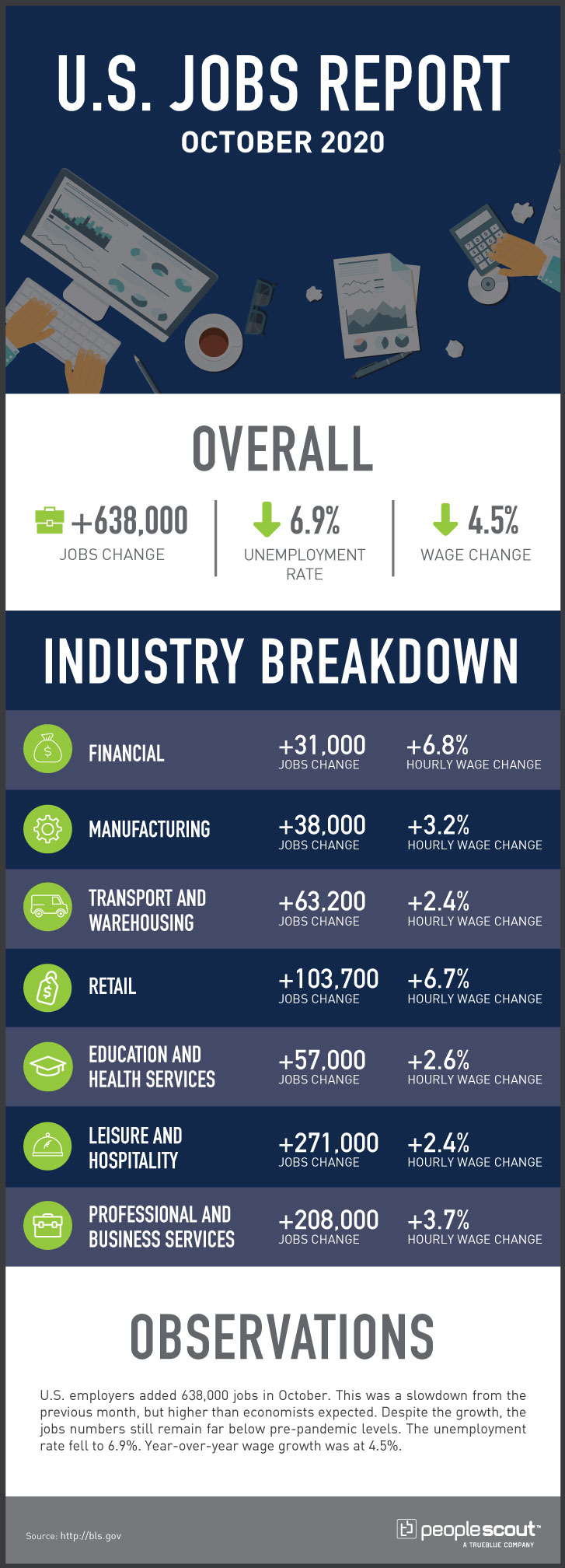
U.S. employers added 638,000 jobs in October. This was a slowdown from the previous month, but higher than economists expected. Despite the growth, the jobs numbers still remain far below pre-pandemic levels. The unemployment rate fell to 6.9%. Year-over-year wage growth was at 4.5%.

U.S. jobs report infographic October 2020

The Numbers

638,000: Employers added 638,000 jobs to the economy in October

6.9%: The unemployment rate fell to 6.9%

4.5%: Wages rose 4.5% over the past year

The Good

The U.S. economy continued to add jobs for the sixth straight month. The 638,000 jobs added surpassed economists’ expectations, especially because the number was offset by the loss of 268,000 government jobs. Most of those losses were temporary census jobs. The gain for private sector employers was 906,000. The biggest gains came in leisure and hospitality, retail and construction, as the Wall Street Journal reports. The drop in the unemployment rate to 6.9% is also good news.

The Bad

In a normal year, the 638,000 jobs would have been considered a great month of growth; however, 2020 is not a typical year. The Washington Post reports that October’s job growth is another slowdown. About 11 million people remain unemployed. The unemployment rate is also unevenly distributed. Black American workers still face an unemployment rate of 10.8%, while the unemployment rate for white workers is only 6%.

The Unknown

The October jobs report has come down at a particularly uncertain time in an already uncertain year. Coronavirus cases are surging across the country and there is still no clarity on further federal aid.

As the New York Times reports, some of the hardest hit industries could face another setback as winter arrives. Outdoor dining has helped bring back restaurant jobs, but as the weather cools and some states add more restrictions on indoor dining, the leisure and hospitality industry faces another difficult period.

McKesson: High-Volume Veteran-Focused Hiring Solution

McKesson: High-Volume Veteran-Focused Hiring Solution

Life Sciences RPO

McKesson: High-Volume Veteran-Focused Hiring Solution

As one of the world’s largest life sciences and healthcare companies, McKesson required a high-volume hiring solution to fill positions across multiple departments. PeopleScout delivered an RPO solution with a special emphasis on boosting diversity and the client’s veteran hiring initiatives.

10 + Year Partnership
95 % of All Requisitions Have Diverse Candidates
8 % Over 8% Veteran Hiring Achieved, Up from 3.3%

McKesson has engaged with PeopleScout for 10 years. Over the course of our partnership, PeopleScout has managed hiring for a variety of positions including professional, managerial, sales, finance and administrative roles. PeopleScout’s engagement includes a specific focus on hiring veterans in all positions to support McKesson’s goal to become known as a top employer for veterans and military spouses.

Solution

VETERAN TALENT COMMUNITY

PeopleScout created a Veteran Talent Community which provides McKesson with access to thousands of active and passive veteran job candidates and opens the door to additional job opportunities for veterans.

IMPROVED WEB DESIGN

PeopleScout helped to administer a customized McKesson veteran careers webpage to attract and process veteran candidates.

RECRUITMENT MARKETING

Veteran-targeted marketing and sourcing strategies were developed including improving relationships with more than 800 military organizations, posting jobs on veteran job boards and social media marketing.

ONGOING TRAINING

PeopleScout provides ongoing training and education for members of the recruiting team to ensure military resumes are matched with civilian job requirements.

SCREENING PROCESSES

A veteran priority screening process was created to identify and prioritize veteran candidates.

DIVERSITY & INCLUSION

PeopleScout hired a Navy veteran to lead the D&I initiative on the recruiting team.

Results

HIRING SUPPORT

In 2019, PeopleScout managed more than 3,000 hires across North America.

DIVERSITY IMPROVEMENT

PeopleScout provides a diverse slate of candidates on 95% of all requisitions.

INCREASED VETERAN HIRING

Veteran hiring improved from 3.3% to 8.6%.

STRONGER EMPLOYER BRAND

Targeted veteran recruitment and marketing strengthens McKesson’s veteran employment brand, resulting in McKesson being recognized as a leader in veteran hiring by national media outlets.

McKesson’s Veteran Talent Community, veteran landing page and recruitment marketing strategy are supported by PeopleScout’s proprietary talent technology, Affinix.

At a Glance

  • COMPANY
    McKesson Corporation
  • INDUSTRY
    Life Sciences, Pharmaceuticals, Healthcare
  • PEOPLESCOUT SOLUTIONS
    Recruitment Process Outsourcing, Talent Advisory, Affinix
  • ANNUAL HIRES
    3,000
  • ABOUT MCKESSON
    McKesson Corporation is a diversified life sciences and healthcare services leader dedicated to advancing health outcomes for patients everywhere. The organizaiton partners with biopharma companies, care providers, pharmacies, manufacturers, governments and others to deliver insights, products and services to help make quality care more accessible and affordable.

A Dynamic IT Recruiting Solution to Support Growth and Improve Candidate Experience

A Dynamic IT Recruiting Solution to Support Growth and Improve Candidate Experience

RPO Recruiting for IT Professionals

A Dynamic IT Recruiting Solution to Support Growth and Improve Candidate Experience

PeopleScout partnered with this healthcare revenue and payment cycle management company to provide RPO recruiting solutions for niche IT roles.

3,000 + Annual Hire in IT Roles
40 % Reduction in Time-to-Hire
Tech-Enhanced Candidate Experience Powered by Affinix<sup>®</sup>
Tech-Enhanced Candidate Experience Powered by Affinix®

A healthcare revenue and payment cycle management company needed an RPO partner to support the rapid growth that occurred when it acquired a healthcare IT business. Healthcare IT is a niche field with a limited number of candidates and many hard-to-fill positions. To meet its new workforce demands, the client engaged PeopleScout to implement a full-cycle RPO program for both exempt and non-exempt hiring. In addition, they partnered with PeopleScout to provide additional support to their internal talent acquisition teams in areas where hiring volume increased through our Recruiter On-Demand (ROD) solution. 

Situation

The client requires a scalable RPO solution that is flexible enough to navigate hiring spikes throughout the year and to access talent in the niche healthcare IT field. PeopleScout’s RPO program spans high-level technology roles as well as HR, finance, marketing, sales, legal, customer service and sourcing for executive-level candidates. Due to COVID-19, the client also required a new digital interviewing platform to create a consistent experience for candidates as they move through the hiring process.

Solution

Solution Highlights

  • Full-Cycle, Exempt and Non-Exempt Hiring  
  • 3,000+ Annual Hires 
  • Recruitment of Hard-to-Fill Roles 
  • Dedicated Veteran Hiring Resources  
  • Tech-Enhanced Candidate Experience Powered by Affinix® 

SOURCING FOR LEADERSHIP ROLES

The client leverages PeopleScout’s experience and expertise to source executive-level candidates to fill key leadership roles. 

SOURCING FOR NICHE ROLES

PeopleScout’s expert recruiters work with the client to identify qualified candidates in the competitive healthcare technology talent landscape. 

EMPLOYER BRANDING

PeopleScout’s RPO teams consult with the client to craft precise employer branding messaging and a social media strategy to attract talent for hard-to-fill open positions. 

ATS IMPLEMENTATION

PeopleScout assisted the client in the implementation of a single ATS platform to decrease redundancy and recruiting errors and create a pipeline of better-quality candidates. 

IMPROVED CANDIDATE EXPERIENCE 

PeopleScout implemented Affinix digital interviewing technology to ensure a consistent experience for candidates as they move through the hiring process.  

EMBEDDED RECRUITMENT SUPPORT

PeopleScout recruiters are embedded within the client’s organization and work with their internal teams to navigate sourcing, screening and hiring challenges to improve talent acquisition outcomes for all positions in scope. 

DIVERSITY & VETERAN HIRING

To support the client’s commitment to diversity and veteran recruiting, PeopleScout has a specialized focus and dedicated resources in this area. 

IMPROVED METRICS

PeopleScout’s RPO team provides the client’s leadership with full transparency by monitoring and reporting on metrics important to them including time-to-fill, candidate quality and the speed of the recruiting program.

Results

IMPROVED PERFORMANCE

PeopleScout has improved the client’s recruitment performance by merging people, process and technology to enhance the experience with the recruitment process for candidates, recruiters and hiring managers. Average days to offer accept dropped from 62 days to 37 days for exempt positions, and from 40 days to 22 days for non-exempt, below the client’s target goal of 50 and 40, respectively.

INSIGHTS & EXPERTISE

The client values the input and insights provided by PeopleScout’s experienced RPO team and their ability to quickly source and hire candidates for hard-to-fill positions.

ACQUISITION SUPPORT  

The client has successfully navigated the challenges presented by its acquisition of the previous client’s healthcare IT business with the support of PeopleScout talent acquisition professionals. 

EXPANDED TALENT POOL

PeopleScout’s RPO solution has expanded the client’s talent pool and now sources veteran and diverse candidates more efficiently. 

At a Glance

  • COMPANY
    Healthcare revenue and payment cycle management company
  • INDUSTRY
    Healthcare Technology
  • PEOPLESCOUT SOLUTIONS
    Recruitment Process Outsourcing, Affinix
  • ANNUAL HIRES
    3,000+ IT roles

Talent Pipeline and Candidate Engagement

As we return to work, resiliency, business continuity and recovery are fast emerging as critical priorities for business leaders. Creating a talent pipeline strategy for vital roles is one way organizations can build greater resilience, have clear succession plans and ensure talent continuity. However, with hiring freezes and uncertainty around when hiring will resume has left many talent teams in limbo.

That said, there has never been a more important time to focus on building your talent pipeline strategy to ensure you have the best possible talent on your team and are well-positioned as things return to normal. You may not have positions to fill now, but by building a robust talent pipeline now, you will place yourself in a better position when we return to business as usual.

In this article, we cover how to build a better talent pipeline and engagement strategies and best practices for building stronger relationships with your candidate pool.

What is a Talent Pipeline?

A talent pipeline is a proactive talent acquisition strategy that seeks to identify, engage and recruit talent to build a robust pool of candidates to fill roles as needed. Similar to a sales funnel where leads progress through multiple stages of engagement and are eventually converted into clients, a talent pipeline moves potential job candidates through engagement stages that hopefully lead to making a hire. Like most modern recruitment practices, talent pipelining has been derived from proven sales and marketing strategies.

Talent pipeline

With a talent pipeline, organizations can pick and choose from a highly qualified group of candidates who are already familiar with the organization. The key to a successful talent pipeline strategy lies in candidate engagement because recruiting teams are not focused solely on filling open roles. Rather, they are thinking about how to best meet future talent needs through building better relationships with top talent. In addition to better candidates, talent pipelining allows you to diversify your talent pool, deliver personalized candidate experiences and improve your overall employer brand. 

How to Build a Pipeline of Candidates: Talent Pipeline Strategy and Engagement Starts with Your Employer Brand

how to build a pipeline of candidates

Talent pipelining is about influencing candidate behavior, so the first and most logical place to begin when creating a talent pipeline is the answering the following questions:

  • How do you generate interest in your organization?
  • What differentiating factors set your organization apart from other employers?
  • Why should candidates choose to work for your organization?

To find the answers to these questions, you need to turn to your employer brand. In a talent market that’s reeling from the effects of a global pandemic and calls for increasing racial diversity, your reputation as an employer is now more important than ever to attract high-quality candidates.

What’s more, at a time when candidates can quickly look up information about your organization, from compensation and benefits to the work culture and advancement opportunities, building a strong employer brand is paramount. In fact, according to the Harvard Business Review, a negative employer reputation can costs organizations up to 10% more per hire.

To attract and bring top talent to your organization’s talent pipeline, maintaining and personalizing your candidate-facing content should be a top priority. You can achieve this by improving the content on your careers page and in your social media outreach with high-quality resources, guides, videos.

So, how do you position yourself as an employer of choice in your industry and fill your talent pipeline with qualified talent? Below are some simple steps that can help you get started:

Leverage Your Career Site

The first place many candidates will engage with your employer brand will be through your career site. Use your career site to highlight your corporate values, culture and provide a real glimpse of what life for the employees of your organization is like.

Make sure that your employer brand messaging on your career site is consistent with that on your social media channels, company website and review pages such as Glassdoor and Indeed. Also, make sure your career site is mobile optimized as many mid-career professionals are more likely to search for opportunities on their mobile devices. The easier it is to apply and interact with your organization, the more top candidates you will be able to add to your pipeline.

Candidate Engagement Best Practices: Engage Your Talent Pipeline on Social Channels

Social media has fast become a top recruitment marketing channel. Moreover, according to Glassdoor, 79% of job applicants use social media in their job search, so engaging with candidates and presenting a positive employer brand on social media is essential.

For example, you can build a stronger employer brand and engagement with your target audience by promoting authentic conversations about life within your organization and asking candidates to share what they seek in an employer. You should also celebrate employee achievements, share real-life stories, photos and videos to show potential candidates what it is like working with you. This will make it more likely that candidates will feel comfortable applying for positions at your organization.

Your Employees Are Your Best Advocates

Building on your social media strategy, you can also look at employee advocacy as an effective branding and talent pipeline building tactic. Employee advocacy is the word-of-mouth marketing equivalent for recruitment. Your employees can tap into their networks, refer friends to open roles and bring in more candidates into your talent pipeline.

talent pipeline strategy

Identify employees who can act as your brand ambassadors and share the perks of working with your organization with their network and build a great referral pipeline for talent. Candidates are three times more likely to trust your employees over recruiters to provide credible information about your work culture.

How to Build Talent Pipeline: Communicating with Your Talent Pipeline

how to build talent pipeline

Send Confirmation Emails to Candidates

Sending confirmation emails to candidates in your pipeline who have applied to open positions should be an obvious step, as 96% of job applicants want confirmation their application has been received. However, just 8% say they always get one from a potential employer. You can leverage technology and automate your communication with candidates to make sure emails are sent on time and reach candidates.

You should include in your replies a “thank you” for taking the time to fill out your application, let candidates know when they can expect to hear back about their application status. You do not have to provide feedback to unsuccessful candidates, just make sure you tell any unsuccessful candidates that they have not progressed and thank them again for taking the time to apply. This reply can be automated too.

Keeping your Talent Pipeline Warm During a Hiring Freeze

You may have many talented professionals out of work looking for new opportunities but might not be in a position to do any hiring right now. That does not mean that your recruiting activity should be on hold. In fact, this is the perfect time to work on building and nurturing your talent pipeline.

Keeping candidates “warm” is a balancing act, especially in uncertain times. You can keep candidates engaged by sending them updated press releases, and managers can periodically send a personal note or text to keep the lines of communications open.

You can share updates about the conditions at your organization, statements your CEO has made, or other information to give them an understating of how your organization is dealing with this crisis. These efforts might impress candidates and make them want to work with you even if you do not have an opening yet.

Consider Using a Chatbot

Candidates in your talent pipeline will have questions for you – about the role itself, about the application process or the timeline between applying and hiring. If you have high-volume hiring needs, or your internal recruiting teams are stretched too thin to answer all of the questions, deploying a chatbot to answer some of the most common questions immediately can prevent candidates from losing touch with you or becoming frustrated.

If you are wonder if candidates would be happy accepting answers from a chatbot, modern candidates are already interacting with them, because like Alexa or Siri, they mimic our natural conversational styles.

Your job is to figure out what the most common questions will be and craft answers that the chatbot can supply. Just ensure you have a process in place if the candidate’s question was not answered satisfactorily – that the question then gets routed to a human who can answer it.

Conclusion

Ultimately, effective talent pipelining engagement boils down to how you plan, strategize and leverage technology to support your long-term business needs. The landscape for candidates today is drastically different from the past years. Empathy, flexibility and understanding will go a long way in building lasting relationships with candidates and successfully adapting to the realities of a post-COVID world.

Diversity and Inclusion: Building Employee Resource Groups and Driving Change

Diversity, equity and inclusion have long been a key point of discussion in many organizations’ human resources departments. While the topic has always been top of mind, events in 2020 have shined new light and emphasis on the importance of social justice, anti-discrimination and diversity and inclusion.

Why is Inclusion Important?

employee resource groups

However, according to a PricewaterhouseCoopers Global Diversity & Inclusion Survey, two-thirds of respondents indicated their organizations have not adopted practices to reduce unconscious biases and other barriers to inclusion. Moreover, even among organizations that have adopted such practices, employees are not likely to be aware of the efforts. This illustrates the importance of inclusion in the workplace for candidates.

Creating employee resource groups (ERGs) is an approach you can use to build a more inclusive environment and addresses diversity and inclusion in a more holistic, community-based way. Employee resource groups, also known as affinity groups, have emerged in the workplace as a standard component of diversity and inclusion initiatives. In fact. according to a report from Bentley University, nearly 90% of all Fortune 500 companies have ERGs.

For many organizations, the benefits of employee resource groups have evolved from the primary intent — to provide a forum in which members of an organization who share common interests, issues, or concerns meet to address those issues — to multifaceted benefits that impact an organization’s strategic diversity and inclusion efforts in recruitment, retention, mentoring, leadership development, marketing, customer relations and return on investment.

What is an Employee Resource Group?

The first employee resource groups were initially workplace affinity groups created in response to racial strife of the civil rights era. Joseph Wilson, the former CEO of Xerox, developed the concept following race riots in Rochester, NY in 1964. Wilson and his African-American employees designed and launched the National Black Employees Caucus in 1970 to address racial tension and the issue of workplace discrimination.

Modern ERG programs are the enduring legacy of Mr. Wilson and his colleagues’ courageous efforts. In its most basic form, an ERG is an employee identity or experience-based group that helps employees within an organization build community and share a common cause.

what is an erg

ERGs are generally based on building or strengthening community, providing support and contributing to personal and professional development in the workplace. Most ERGs are volunteer based, though some companies support organizers with a percentage of paid time off or other recognition, including leadership development opportunities.

What is the Purpose of an ERG Program?

While each ERG must define its purpose and goal, common ERG drivers are:

  • An ERG program creates an open forum for employees who share a common identity to meet and support one another in building their community and sense of belonging.
  • ERG programs empower these groups by offering them financial support, organizational support and access to decision-makers.
  • ERG programs facilitate a clear line of communication from ERGs to leadership to voice concerns and solve problems.
  • ERGs provide a resource for leadership regarding employee and community issues, needs and policies.
  • ERG programs seek to advance a respectful and inclusive company culture and reinforce the importance of inclusion.

What Does an ERG Look Like?

ERGs come in a variety of forms, with some of the more popular ones taking the shape of:

  • Diversity groups that foster a sense of belonging among employees that belong to a minority group in the organization
  • Volunteer programs where employees can support charities and other volunteer initiatives
  • Affinity clubs where employees with similar interests get an opportunity to socialize
  • Professional development groups that provide employees the opportunity to share knowledge with their peers from other departments

The Value of Employee Resource Groups and Why is Inclusion Important

ERGs deliver value to organizations and their workforces in multiple ways. They build a sense of community and belonging for employees by connecting people in a social and professional way and encouraging interaction between employees.

What’s more, according to a report from the Society for Human Resource Management, 90% of companies examined said ERGs helped make new hires more comfortable during the onboarding process, and 70% of organizations relied on ERGs to build a workforce to reflect the demographics of their customer base.

ERGs empower employees by giving each group a collective voice to speak with decision-makers and management. Groups are also empowered to assemble and voice concerns as a community. ERGs support learning and development by offering formal and informal leadership opportunities and creating visibility for employees who are active.

ERGs also provide a resource for leadership and decision-makers regarding staff/community issues, needs and policies. And ERGs offer to the company their expertise and experiences to improve equality and equity. They can also be an asset in business decisions to make better, more inclusive products and services.

Lastly, ERGs can also support retention because employees are likely to stay with the company longer if they have built or are part of a strong community within the company and feel heard again, this is why why is inclusion important.

Creating an Employee Resource Group

erg diversity

If you or other employees within your organization would like to start an ERG, it can be difficult to know where to start. Below, we outline the steps to get your ERG off the ground.

Align Your ERG with your Organization’s Broader Objectives

For your ERG to be successful, your purpose should be tied to your organization’s overall mission and values. Is your organization focused on giving back to your community? Or is your goal to build a more diverse workforce?

Choose a topic around diversity and inclusion for your employee resource group that aligns with overall company goals. Think about writing a mission statement for your ERG that touches on your organization’s core values. Showing how your ERG advances the overall organizational strategy will help earn support from other areas of the organization.

Secure Executive Support

Executive support for your ERG is essential for continued success. To gain buy-in, find executive or C-suite sponsors who are personally committed to diversity and inclusion or social impact initiatives. Executives are busy and oftentimes metrics focused, so it may be helpful to come with talking points and data that showcase how an ERG will make a positive impact on your organization.

Make sure HR leaders are invested as well, as you will need their support to share ERGs during the new hire onboarding process and in promotional materials for the ERG.

Building Your ERG Team

Before launching the ERG, establish a communication plan and identify benchmarks for success, including long-term goals and potential challenges. Recruit colleagues willing to take on a leadership role, such as committing to a monthly meeting or making time to plan and execute events.

Then, find other like-minded coworkers who are passionate about supporting your ERG. It’s just as important to have members who are willing to participate and spread the word as it is to have leaders and planners.

Deploying Your ERG Program

A strong communications plan is a major component of an employee resource group’s success strategy. You can begin by creating a simple presentation that outlines the ERG’s goals, events and ideas for participation. You can leverage your organization’s marketing team to use your organization’s brand standards to create a logo for the ERG that ties it directly to the organization. This is an effective way to clearly communicate that your ERG is supported by leadership and is an important initiative.

Equipped with your members and materials, generate excitement for the ERG by hosting a company event. Throwing a happy hour — virtually now, because of COVID-19 — is a great way to introduce your ERG’s mission, lay out future events and recruit attendees to grow your group’s core membership.

How Your Organization Can Support Your Employee Resource Group

Your organization can support your employee resource groups in a variety of ways. Your ERG may receive budget and organizational support. However, your organization should not dictate which groups should form, who should join each group or what impact the groups should have. That should be a decision of the group, but it’s important for the organization to provide tools to work towards and measure that success.

This could include charter documentation, purpose workshop, road-mapping templates and exercises, budget tracking tools, support in setting and tracking OKRs, a platform for communication with their group and potential members, visibility within the organization and meetings with senior leadership.

Conclusion

A sense of belonging and inclusion in the workplace is important in order to empower employees and help them bring their whole self to work. Building a strong network or community is a very important step in creating this sense of belonging.

In order to truly empower and support ERGs, it’s important to give the employee resource groups the autonomy to define the scope of their group, to define membership eligibility and most importantly, to define what success means to them.

Succession Planning: Maintaining Talent Continuity

The immediate response to the COVID-19 pandemic by many organizations correctly focused on workplace safety, maintaining business continuity and preserving relationships with key clients and suppliers.

Now, organizations are rebuilding and preparing themselves for the new normal. And, they are taking a good look at their people, processes and systems, including creating or revisiting organizational succession plans.

Establishing a well thought out succession plan is now more important than ever and will continue to be a vital process as baby boomers move into retirement and skills gaps and shortages that were challenges before COVID-19 persist. In this article, we explore best practices for designing and executing a successful succession planning program to help your organization better prepare for workforce disruptions.

ebook

Five Tips for Leading Teams Through Crisis

What is Succession Planning?

For some organizations, succession planning simply means making sure there are replacement candidates for key positions. For organizations with a more comprehensive view, succession planning is a systematic process to ensure leadership continuity in key positions, retain and develop institutional knowledge within key employees for the future, encourage individual advancement and ensure the stability or “bench strength” of key personnel.

Having employees identified as backups makes good business sense, as it allows organizations to fill vital roles with qualified successors quickly. A successful succession planning program should align talent management with an organization’s culture, vision and strategies.

Key Benefits of Succession Planning

  • Identify skill gaps and training needs
  • Retain institutional knowledge in a knowledge economy
  • Replace unique or highly specialized competencies

Building Your Succession Planning Team

The role of HR in succession planning should be to support business leaders, facilitate the process and provide tools and guidance along the way. Engaging stakeholders, particularly senior leadership, is critical. As part of the process, you should conduct interviews with them, invite them to take surveys and attend focus groups to get a better understanding of which roles are considered most essential to operations and the future talent needs of your organization

Plan for Both People and Positions

The first step of succession planning begins with identifying which positions your organization should target based on urgency and how critical the roles are to your organization’s operations. Your succession plan should address both specific positions and individuals to ensure you are covering all of your bases.

When identifying individual employees as potential successors for a role, consider the following traits:

  • Flexible and willing to change roles and work environments
  • Interested in professional development and learning new skills
  • A good communicator who works well with other teams and departments

When identifying positions to include in your succession plan, considering the following:

  • Positions central to strategic goals or that can provide you with a competitive advantage during uncertain times
  • Positions that are specific to your organization or industry
  • Positions of influence and leadership within your organization
  • Jobs with long learning curves, training requirements, specialized licenses and certifications
  • Positions that require institutional knowledge and experience

Assessing Successor Candidates

Once critical positions have been identified, it is time for your succession planning team to identify the employees who can potentially fit into those roles when opportunities emerge. But what should your team look for in a potential successor? To answer this question, examine a candidate’s knowledge, skills and abilities (KSAs). The three terms seem interchangeable. However, they are distinctly different dimensions of a potential successor’s qualifications.

Knowledge: Focuses on the candidate’s understanding of key theoretical concepts important in the role.

Skills: Skills are the capabilities or hands-on experience needed for the application of theoretical knowledge important for the role.

Abilities: Abilities are the innate traits or talents that a person brings to the role if selected as a successor.

KSAs are the core competencies used when assessing talent and can create a better picture of a potential candidate’s strengths and weaknesses and are useful in paving an organization’s development programs and eventually, a successors’ growth in their new role. 

It is essential for you and your organization to develop a KSA profile of each candidate and see if their attributes align well with a specific role.  

Your succession planning team can start building KSA profiles by asking these three questions: 

  • Where does the organization see the role evolving in the next three to five years? 
  • What unique or specialized competencies are needed to succeed in the role?
  • What qualities should the new successor possesses in order to thrive in the role and meet your organization’s business objectives? 

A successor does not need to be someone who will think, talk and react the same way as the incumbent, you just need to be confident that the candidate can step up to the plate when called upon.

Develop Future Leaders Today

While every job is important, leadership positions within your organization would significantly impact your business if left open for a long period. In fact, according to SHRM’s Selecting Leadership Talent for the 21st-Century Workplace report, the cost of replacing a senior executive can range from $750,000 to $2.5 million, and up to $52 million for a chief executive officer. Leaders will undoubtedly be a significant competitive advantage as your organization rebounds and recovers. This means retaining, developing and leveraging future talent is even more important than it was pre-pandemic.

Your succession planning team, which should include HR and other key members of your executive leadership team, should conduct a thorough review of the skill sets of each member of your leadership team and identify candidates with similar skills who could become potential successors. Your team should also determine skills that you might be missing on your current leadership team and will be needed to emerge successfully from the pandemic and beyond.

PeopleScout Solution Spotlight

Design and delivery of leadership and development centers for a law enforcement agency.

  • Our client’s promotion criteria were historically focused on operational knowledge; we lead a shift in focus to also consider leadership capabilities and behavior.
  • We designed a behavioral framework aligned with national law enforcement standards and local leadership aspirations and organizational values.
  • We led the creation of both operational and behavioral exercises for each rank in the law enforcement agency.
  • We trained talent assessors and developed a digital assessment platform with automated feedback reports to create a more centralized process for succession planning.

Leverage Succession Planning to Retain Institutional Knowledge

According to research conducted by Panopto, 42% of the skills and expertise required to capably perform in a given position will be known only by the person currently in that position. Institutional knowledge is a combination of experiences, processes, data, expertise, cultural values and information possessed by specific employees or teams within your organization. It can span decades and is comprised of your organization’s tangible and intangible knowledge that defines who you are and how you operate. While some of this knowledge gets translated into processes and policies, most of it resides in the heads and hands of individual employees.

For example, what happens if your organization’s top sales manager is decides to take an early retirement or accepts a new position at another organization? Do you have a ready replacement? If yes, do they possess the deep institutional knowledge of your organization needed to rally their team and engage clients effectively?

With succession planning, you can ensure that knowledge sharing can occur concurrently between an employee and their potential successor, giving the successor the unique opportunity to gain useful skills and knowledge without a long, on-the-job learning curve. In the following graphic, we outline best practices for training and developing successor talent.

Training and Development of Successor Candidates

Training and development for potential successor candidates can take many forms and should include both real-life scenarios and classroom-style training. Below are a few common exercises to help ease the candidates into their future roles. 

  • Stretch Assignments: Just like the name implies, the employees will have to complete a set of tasks or assignments that stretch their limits. Examples include leading a special project, being assigned to a challenging task, or chairing a committee. 
  • Job Rotations: Enable successor candidates to rotate and assume different roles to obtain new experiences and learn more about the operations and processes of your organization. 
  • Mentoring and Coaching: Create or leverage existing corporate mentorship programs and pair successor candidates with senior employees to provide candidates with ongoing guidance, deeper insights and career support. 

Communication is Key

Clear and concise communication makes the succession planning strategy much smoother. According to research conducted by Massachusetts Mutual Life Insurance Company, around 25% of employees in line to take over a key role in an organization did not know they had been chosen for the role. Consider what this might mean — an employee might believe they have no real future at your company and so might make plans elsewhere.

Be sure to inform each employee you have identified as a potential successor — especially in the case of leadership roles — that they have been ear­marked for a future role (without making an outright promise). Take this opportunity to determine if they are interested. While they might be content with their current position, knowing that you see real promise in them might make them feel valued, resulting in better employee retention.

Conclusion

A well-implemented succession plan will give your organization a sense of the investment you will need to make should backups for key positions be necessary. Whether it’s temporary or long-term, employees who are asked to assume greater responsibilities need support. Regularly checking in with employees will make you keenly aware of what they will need to be successful.

Remember, succession planning is not a one-off task. Organizations need to be agile to keep up with the fast-paced and ever-evolving world. You should regularly discuss and reevaluate your strategy with key stakeholders including front-line managers, your executive leadership team and HR leaders to make sure your plan is up to date.

PeopleScout U.S. Jobs Report Analysis – September 2020

U.S. employers added 661,000 jobs in September, a slowdown from the previous month. Despite the growth, the jobs numbers still remain far below pre-pandemic levels. The unemployment rate fell to 7.9%. Year-over-year wage growth was at 4.7%.

U.S. Jobs Report September 2020 infographic

The Numbers

661,000: The U.S. economy added 661,000 jobs in September.

7.9%: The unemployment rate fell to 7.9%.

4.7%: Wages rose 4.7% over the past year.

The Good

September marked the fifth straight month of job growth, and the unemployment rate fell to 7.9% from nearly 15% in April. This brings the unemployment rate below the peak of the last recession. The largest gains came in the leisure and hospitality sector, which added 318,000 jobs, 200,000 of which came from bars and restaurants. MarketWatch also reports that workers are putting in more hours at work, which is good news.

The Bad

The recovery is slowing down. CNBC reports that the 661,000 jobs added to the economy in September fell short of the 800,000 expected in the Dow Jones estimate. This is also the first month of recovery where fewer than 1 million jobs were added. The New York Times reports that if the recovery continues at September’s pace, it will take 17 months to return to pre-pandemic employment levels.

The Wall Street Journal reports that the number of people reporting their layoffs as temporary has decreased, indicating that more layoffs are becoming permanent. This follows several large corporations announcing large numbers of planned layoffs. Though those numbers were not included in the September report, the news indicates that the recovery will continue to slow.

The Unknown

The September report leaves a lot unknown. This will be the last jobs report released before the 2020 U.S. election, where both President Donald Trump and democratic challenger former Vice President Joe Biden have promised to create millions of jobs. It’s not clear what, if any, impact the report will have on the election. The report was also released on the same morning when millions of Americans woke to learn that President Trump has been diagnosed with COVID-19.

Additionally, MarketWatch also reports that economists don’t agree on what will happen next. Some believe that the recovery will continue to slow and slide backward because of the end of federal aid and the start of the cold and flu season. Others believe the recovery will grow stronger as restrictions continue to lift and people find new ways to cope with the impact of the pandemic.