The Future of Work: 4 Key Factors That Will Shape the Workplace by 2030

It’s no secret that the labor market has been volatile over the last several years, and talent acquisition teams have experienced a multitude of highs and lows. In our capacity as trusted advisors, PeopleScout analyzed patterns in global workforce trends to help our clients create informed strategies for future-proofing their workforce by examining how these patterns may affect their workforce. While we can’t predict the future of work, we think there are four key factors will shape the world of work over the next decade.

1. Flexibility

Flexibility is here to stay, and it will apply to everything from where and how we work to the roles we do and who we do them for. There will be no hard and fast rules about working hours and shifts in the future.

As life becomes increasingly characterized by change, employees will need to be agile—always ready to reskill. Learning becomes a constant, and we may even find ourselves counting AI robots as our trainers and mentors.

Flexibility and upskilling will manifest differently from generation to generation, so organizations must facilitate working arrangements for different demographics. Over the next decade, the generation gap will widen and then gradually close as Baby Boomers begin to settle down to retirement by blending work and leisure. Millennials and Gen Z will bring their progressive perspectives to work.

10 Predictions for What’s NEXT in the World of Work

DESTINATION 2030

2. Fluidity and the future of work

Globalization will enable much more cross-border, cross-company collaboration. Project teams will be established based on all sorts of factors, not just who’s in what department or which location. People will work with talent from all sorts of specialities as they move from project to project.

Technology helps to support our wellbeing as the lines between work and home become more blurred. But with new technologies come new laws, so security and compliance will also be strategically important, especially for organizations working at the cutting-edge of innovation.

3. Focus 

future of work

Organizational culture will become more important than ever before as people make career choices based on ethics, values and purpose above things like pay and benefits. More and more employees will choose to work for organizations that have a clear purpose and are committed to working in the most ethical, sustainable and socially responsible ways.

Technology also plays a role here, in helping people focus on the work that matters to them as automation takes over the mundane tasks. However, more AI and machine learning will make some roles redundant and create many others—generating even greater demand for technical, analytical and digital skill sets across sectors.

4. Forward-thinking and the future of work

Organizations will continue to compete when it comes to creating innovative new technologies and using those technologies in the most creative ways. But they’ll also be happy to pool some resources to create a better future for everyone. 

Issues like equality and climate change will continue to grow in importance, forcing organizations to find new and better ways of making social and environmental improvements at speed.

Onward, Upward and Who Knows Where the Future Workplace Will Go

You may feel more prepared for some changes more than others as we approach 2030, but it’s safe to say that there will be plenty of surprises that will require creative thinking in order to stay resilient.

PeopleScout will be on the journey with you to support, challenge and inspire you—no matter what the future holds.

To learn more about how we came to these predictions and see our research findings, check out our Destination 2030 white paper.

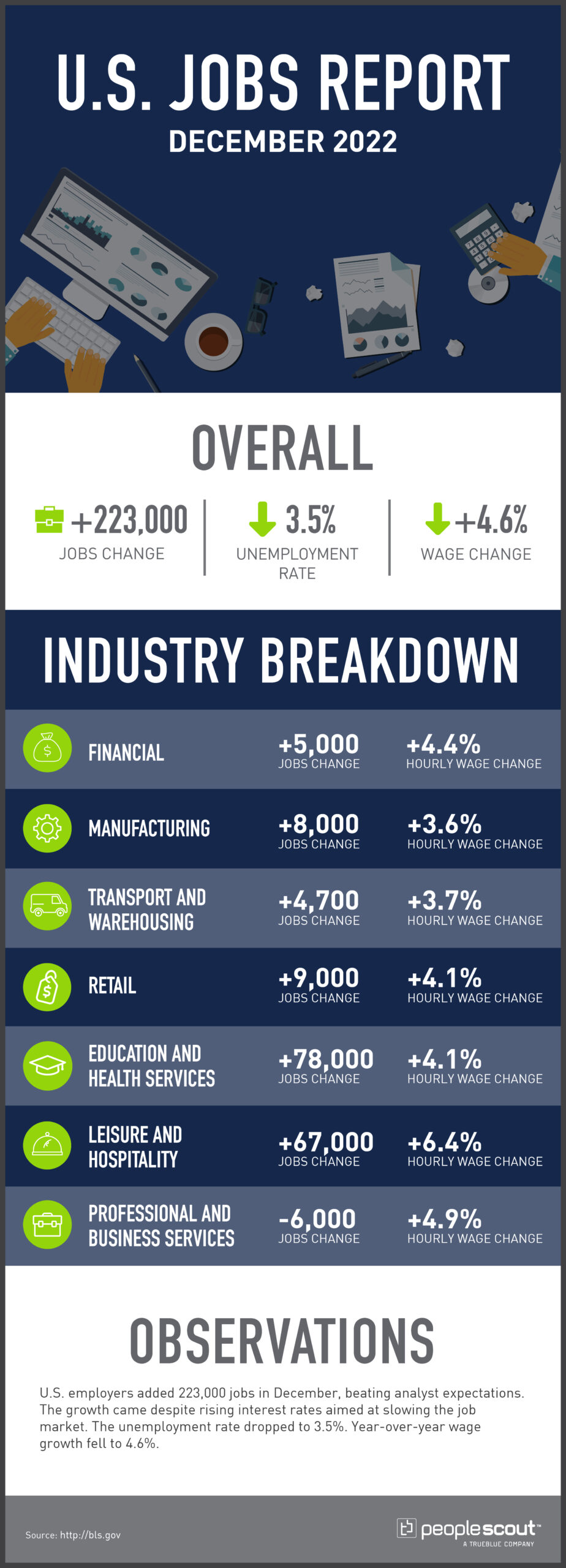
PeopleScout Jobs Report Analysis – December 2022

U.S. employers added 223,000 jobs in December, beating analyst expectations. The growth came despite rising interest rates aimed at slowing the job market. The unemployment rate dropped to 3.5%. Year-over-year wage growth fell to 4.6%.

jobs report infographic

The Numbers

223,000: U.S. employers added 223,000 jobs in December.

3.5%: The unemployment rate fell to 3.5 percent.

4.6%: Wages grew 4.6% over the past year.

The Good

December’s jobs report shows evidence the Federal Reserve’s strategy of increasing rates to provide a “soft landing” for the U.S. economy may be working. So, what would look like bad news in almost any other year is actually good news.  

The 223,000 jobs added to the economy is the smallest increase in the past years, as the Wall Street Journal reports, but it is still a healthy pace of job growth. Additionally, year-over-year wage growth slowed to 4.6%. Wage growth has remained stubbornly high over the past two years, and economists feared it could contribute to high inflation. December’s report helped allay some of those concerns.

The Bad

Though December’s job report was generally taken as good news, there are still some signs of unwanted weakness. As MarketWatch reports, layoffs in the technology sector are making an impact in the report. The business and professional services sector, which covers many tech roles, posted a decrease of 6,000 jobs. Additionally, while the labor force participation rate did increase in December, it still remains below prepandemic levels. This continues to contribute to the ongoing labor shortage.

The Unknown

Economists say that the slowing growth in December’s report will likely cause the Federal Reserve to slow the pace of interest rate increases aimed at slowing inflation. As the New York Times reports, the S&P 500 rose 2.3% with the release of the report. Investors have been eager for fewer and smaller interest rate increases. The Federal Reserve meets next on January 31.

Global Banking School: Increasing Offer Conversion to 87% for a Suite of Hard-to-Fill Roles

Global Banking School: Increasing Offer Conversion to 87% for a Suite of Hard-to-Fill Roles

Global Banking School: Increasing Offer Conversion to 87% for a Suite of Hard-to-Fill Roles

Global Banking School (GBS), a higher education provider offering a range of sector-relevant courses, turned to PeopleScout for project RPO to fill 35 professional and academic roles across eight campuses in London, Manchester, Birmingham, and Leeds.

87 % Offer acceptance rate across all roles
Increased diversity within roles filled through targeted messaging and sourcing
Enhanced candidate and hiring manager experience

Situation

GBS needed to fill 35 roles across a range of job families and levels, including professional and academic positions. They had a challenging timescale of just four weeks to go-live.

GBS was facing several challenges:

  • Some of the roles had been out to market several times, in some cases for up to a year, with little traction.
  • As an educational institution, face-to-face teaching is a vital part of the student experience, and therefore essential for the client. GBS needed this to apply to staff availability as well and wanted to avoid a two-tiered approach for academic and non-academic roles. This meant the client was unable to offer remote or hybrid working models. In a market where candidates have more choice around how and where they work, this resulted in a low interest from candidates.
  • Sourcing from other higher education institutions and universities meant the audience was hard to engage.
  • Hiring managers were disengaged due to high workloads. Plus, the previous recruitment processes were transactional and didn’t keep candidates engaged.
  • The hiring managers also had competing priorities, which meant the overwhelmed internal recruitment team were struggling to obtain the required information to fill the roles.

Solution

Our dedicated and skilled recruiters became an extension of the in-house team, optimizing and managing GBS’s recruitment process from attraction to offer for a four-month project RPO solution. PeopleScout managed each position in its entirety, from briefing through to verbal offer acceptance, including creating a sourcing and attraction plan for each role.

Our team seamlessly integrated into the organization’s culture, mapping the end-to-end candidate journey in collaboration with hiring managers. PeopleScout very quickly became trusted colleagues with the in-house recruitment team, and through our consultative approach we offered recommendations based on our labor market research and feedback.

A dedicated PeopleScout recruitment marketer was brought in to reimagine the organization’s messaging, job descriptions and attraction channels. GBS received a suite of copy, both bespoke to individual roles and templates which they could use into the future. Our recruitment marketing strategy included a social media attraction campaign featuring a one-click application.

On top of these attraction efforts, we directly sourced passive candidates to raise GBS’s profile in the market. Throughout the project, we gathered market feedback and tracked hiring metrics, presenting it through customized dashboards to guide hiring decisions. GBS received weekly analysis of market insights, salary benchmarks and candidate feedback.

Result

Our consultative approach to hiring and tailored strategies for each role resulted in:

  • An 87% offer acceptance rate.
  • An enhanced candidate and hiring manager experience.
  • Increased diversity within roles filled.

At a Glance

  • COMPANY
    Global Business School
  • INDUSTRY
    Higher Education
  • PEOPLESCOUT SOLUTIONS
    Recruitment Process Outsourcing, Talent Advisory
  • ABOUT GBS
    Global Banking School (GBS) is a higher education provider with campuses across the United Kingdom. GBS offers a range of courses in banking, management and healthcare designed to enhance students’ career prospects in the financial services industry.

Destination 2030: 10 Predictions for What’s Next in the World of Work 

Destination 2030:

10 Predictions for What’s Next in the World of Work

The last few years have been tumultuous for talent acquisition leaders, and it doesn’t look as if the pace of change is going to let up. Are you looking for ways to future-proof your workforce and create a resilient talent strategy?

Buckle up and join us as we travel to the world of work in 2030! Our ebook, Destination 2030, explores the latest research and global workforce trends and how they might impact the way we work.

In this ebook, we explore:

  • Demographic changes in the workplace and how to engage each generation
  • The changing role of technology in candidate and employee engagement
  • Our top 10 predictions for what’s next in world of work

The UK Talent Shortage: How to Engage & Support the “Missing Million”

By Joe Mongon, Head of Recruitment Delivery, EMEA

When Dame Sharon White, former Chief Executive of Ofcom and current Chairman of the John Lewis Partnership, was recently interviewed on BBC radio, she said: “One area that I think has not had enough attention is what has happened in the jobs market over the last 18 months.” Not enough attention? The UK talent shortage, and the tightness of the labour market, has been at the heart of many mainstream news stories in the UK over the past year: petrol shortages, queues at air and sea ports, and general “skimpflation” in the customer experience.

In this case, White touched upon an interesting factor in the dynamic between an oversupply of job vacancies and an under-supply of job seekers—the “missing million” in the UK workforce who have left employment all together since the start of the COVID-19 pandemic in March 2020.

Who Are the Missing Million?

White identified that there are “1 million fewer people in work,” adding that, “Some think about it as the ‘great resignation’. I think about it as the ‘life reappraisal’, because this is predominantly people in their 50s.”

This latter point is broadly correct: four-fifths of the recent rise in economic activity is among older people, and while the concerning increase in long-term ill health negates the idea that this is most often the result a positive “reappraisal” of life priorities, growth in early retirement started in summer 2021 and remains persistent.

White rightly called for government action to address the challenge of encouraging early retirees back to work, and it’s possible that “flexible retirement” will in the future be discussed as often as “flexible working.” In the meantime, there is much that employers can do directly to support and re-engage early retirees including approaches to recruitment, job design, workplace support, and – yes – flexibility.

How to Attract and Retain Older Workers

A clear and informative job profile that brings the role to life and amplifies these factors can be the first step to finding the right candidate, including engaging overlooked or under-engaged audiences like the missing million. Job seeker priorities are often straightforward and are typically unaffected by age. Salary and flexibility—especially work from home considerations—lead the way when it comes to potential job switches.

To succeed, employers must recognise that temporary solutions to business problems, such as hybrid working, have turned into ongoing employee preferences and expectations. If you can’t advertise jobs as flexible and leverage that advantage due to the type of role, investment in pay or upskilling offers may be the answer.

At PeopleScout, we are certainly giving the UK talent shortage our full attention. We’re offering our clients bespoke strategies and tactics to overcome these challenges. By helping organisations understand their audiences—including the missing million—we’re able to support targeted candidate attraction efforts that create real results.

Are You Ready for RPO? 3 Common Questions to Ask

Shrinking talent pools, widening skills gaps and high turnover rates are driving companies across industries to look for new ways to boost their global talent acquisition program—including recruitment process outsourcing (RPO).

Whether your organization is thinking of outsourcing some, most or all parts of your recruitment, an RPO partner can help. It’s not just about outsourcing your recruiting, it’s important to find the best partner to help manage the people, process, technology and strategy behind your talent acquisition function, which touches every employee, team and department within your business.

So, how do you know if RPO is the right choice for your organization? In this article, we’ll cover three questions to ask to understand how your company can benefit from RPO.

Why RPO?

RPO is a cost-effective and scalable talent acquisition solution. Whether you’re looking for a regional solution or a multi-country partnership, RPO has been proven to boost the ability to hire at speed, manage the employer brand, streamline the candidate experience and maximize economies of scale across geographies.

Here are just a few of the benefits of RPO:

Improved Candidate Quality

Your RPO partner can help you boost your number of qualified candidates and the quality of hires. In fact, according to Aberdeen Group, 81% of best-in-class organizations say RPO helps to fill their skills gaps. This keeps hiring managers happy and helps your organization achieve its goals while also boosting retention.

Better Candidate Experience

You want your recruitment process to leave every applicant, regardless of whether they get the role, with a positive experience. Your RPO team will provide consistent and honest feedback throughout the recruitment process, so they know exactly where they stand and what comes next.

Improved Hiring Manager Experience

Your RPO team reduces the administrative burden on your hiring managers by taking over résumé and CV screening, candidate assessment administration, initial interview steps, candidate communication and feedback tasks. RPO partners prepare hiring managers for interviews, provide them with feedback and identify any candidates at risk of dropping from the process so managers can make informed decisions.

Reduced Time-to-Fill

The longer a position goes unfilled, the more likely your business is to experience productivity loss—and loss of revenue. RPO teams are able to find candidates and fill roles faster by building and maintaining talent pipeline, providing quick access to qualified talent. By streamlining and optimizing recruitment processes, improving the time-to-hire and retention rates, RPO providers can increase your recruiting return on investment and deliver real cost savings to your bottom line.

Improved Diversity, Equity and Inclusion

In their global Diversity Wins report, McKinsey revealed organizations in the top quartile for ethnic and cultural diversity outperformed laggards by 36% in terms of profitability. So, it’s imperative that recruitment is an element of your DE&I journey. RPO teams are knowledgeable about different talent attraction options and can expand to new job boards, social media groups, online forums and events to engage more diverse candidates. Plus, RPO recruitment companies understand the regional nuances of DE&I issues. For example, in some countries like Poland, it is not legal to ask candidates their ethnicity, gender, etc.

Not sure if you should go for RPO or staffing agencies? Here are the top differences.

Is RPO Right for Me?

So, how do you know if RPO is right for your business? Here are some questions to ask yourself:

  • Is your talent acquisition approach slow and clunky or failing to meet your organization’s talent needs?
  • Do you lack the ability to scale your recruitment efforts up or down quickly as your business needs change?
  • Are you seeing high candidate dropout rates or low offer acceptance rates, which could indicate a bad candidate experience?
  • Are low conversion rates more pronounced for candidates from diverse backgrounds?
  • Are you hearing complaints from hiring managers about the quality of candidates?
  • Are new employees leaving your organization less than a year after joining?
  • Do your assessments and other selection tools need to be updated?
  • Do your in-house teams lack the cultural literacy to support recruitment in all regions?
  • Are your hiring costs going up?
  • Is the time it takes to fill positions getting longer?
  • Is your usage of talent acquisition technology immature or out-of-date?
  • Do you lack access to the right data to make workforce planning decisions?

If you answered “yes” to even a few of these questions, RPO can help you meet your talent acquisition goals.

CHECKLIST

Is RPO Right for You?

What Should I Look for in an RPO Partner?

If you’ve decided to that RPO will be a good for your organization, you may be wondering how you go about choosing the best provider. Below are just three things to consider in order to make RPO a truly transformational model for your business.

Partnership

If there’s one thing we’ve learned in 30 years of developing talent acquisition programs, it’s that no two organizations are the same. That’s why it’s important to look for an RPO partner that is collaborative, that will listen to your ideas and take the time to truly understand your business and pain points.

We hear a lot from clients who have worked with other providers who tried to squeeze them into their standard program, and it just doesn’t work. RPO creates efficiencies and improvements to the candidate experience through repeatable processes, but these processes should be adapted to your unique needs and challenges. Look for an RPO partner who understands the balance between consistency and customization.

Talent Advisory

The success of your recruitment program starts with your employer brand. Many RPO providers offer talent advisory solutions that help you to develop and improve your employer brand, EVP, recruitment marketing approaches, candidate assessments and more.

So often we see companies who have agencies that execute recruitment marketing campaigns separate from their RPO program. However, with this siloed approach, the agency is less likely to be held accountable for their campaigns leading to high quality candidates entering later candidate journey stages like interviews and assessments. On the other side, the RPO partner has limited means to provide feedback on the campaigns and the impact the ads have on recruitment outcomes. By having both functions under one partnership, you get a holistic program that not only attracts candidates—but truly delivers against your hiring goals.

Look for a partner with in-house resources (not one who outsources to an agency) who takes a consultative approach to maximizing the effectiveness of your whole talent acquisition program, beyond just filling vacancies.

Technology

Digital transformation has hit HR and recruitment, bringing an influx of new solutions to the market that offer a range of benefits. RPO partners increasingly offer tech consulting and can show you how emerging technologies like artificial intelligence, machine learning and predictive analytics can boost your ability to attract top talent.

Some RPO partners have proprietary technology, like PeopleScout’s Affinix®, while some offer expertise in well-known platforms. Look for a modular approach that can integrate with your existing systems, so you can continue to benefit from existing investments and grow your recruitment tech stack as your needs change. Any technology you implement must comply with data privacy regulations in all regions where you’re recruiting, including any rules about where data can be stored. A SOC 2 certification is a great way to tell that a vendor takes information security seriously.

In this era of tight competition for talent, augmenting your recruiting capacity and ability with an RPO provider could be a crucial step for the future of your business. When it comes to RPO, there is no single best option, only the option that best aligns with your organizational needs. By understanding your current recruitment challenges and requirements, you can find an RPO partner with right capabilities to support your global recruiting goals.

Learn more about RPO in our ebook, The Buyer’s Guide to Global RPO.

[On-Demand]: Recruiter On-Demand: How Project-Based RPO Can Solve Your Toughest Talent Challenges

[On-Demand]: Recruiter On-Demand: How Project-Based RPO Can Solve Your Toughest Talent Challenges

Right now, employers across all industries are dealing with a difficult talent market as demand accelerated at a record pace. If your organization is struggling to meet a sudden need for talent or your internal recruiting resources are stretched thin, selecting a project-based RPO solution can drastically improve your talent acquisition outcomes.

Join PeopleScout’s Trish Koester, senior director of client delivery, and Karen Wendelberger, operations manager for our Talking Talent webinar, Recruiter On-Demand: How Project-Based RPO Can Solve Your Toughest Talent Challenges, available on-demand now.

Trish and Karen discuss the advantages of project-based RPO and how employers can best leverage an on-demand recruiting solution to source and hire top talent.

This webinar will cover:

  • Common challenges faced by employers and how project-based RPO can help solve them
  • The difference between working with an agency and a project-based RPO provider
  • How sourcing specialized talent through a project-based RPO reduces time-to-hire metrics
  • Real-world case studies from PeopleScout’s Recruiter On-Demand team
  • And more!

Healthcare RPO: How to Bring Top Talent to Your Healthcare Workforce

Fuelled by an aging population and the growth of chronic conditions, jobs in healthcare are expected to grow 13% by 2031, much faster than the average for all occupations. In fact, nurse practitioners are predicted to grow by 46%. So, finding the right recruitment process outsourcing (RPO) provider is critical for healthcare organizations looking to hire top healthcare talent. Whether a healthcare organization is looking to improve its recruiting processes, improve healthcare staff retention or enhance its employer brand, developing a strong relationship with a trusted RPO provider begins with the selection process. In this post, we review the best practices when it comes to selecting the right RPO provider for your healthcare staffing needs.

What is Recruitment Process Outsourcing for Healthcare?

To understand RPO solutions, it’s important to understand what they are not. RPO providers are not healthcare staffing companies or headhunters. Rather, RPO providers implement solutions designed to streamline and improve the hiring process, and as a result, fulfill your healthcare hiring needs.

👉 Download the Healthcare RPO Fact Sheet

Dig Deeper

Revolutionizing Healthcare Staffing: The RPO Advantage

From employer branding to employee engagement, hiring, onboarding and much more, a well-executed RPO program can make a huge impact on a healthcare organization. RPO solutions are not one-size-fits-all plans. Each RPO solution must be tailored to meet an individual company’s needs and take industry specific concerns into consideration.

How Healthcare RPO Supports Staffing

Before contacting an RPO provider, a healthcare organization must first assess both its hiring and business needs. If you are looking to streamline your healthcare organization’s talent acquisition processes and procedures as a means to become more cost-effective, then engaging an RPO provider can help you reduce spend with healthcare employment agencies, yield lower turnover and create a higher quality pipeline of candidates for your open positions. The work of a good RPO provider will save your organization money throughout the new employee’s tenure at your organization, beyond when they’re hired.

RPO Providers Can Secure Specialized Healthcare Talent

The right healthcare RPO provider understands the unique challenges presented by the healthcare industry and has experience sourcing quality candidates for niche/technical healthcare positions.

RPO providers with expertise in the healthcare industry will quickly target and assess both passive and active candidates for hard-to-fill positions rather than placing an ad and waiting for job seekers to answer it. By understanding your healthcare hiring needs, an RPO provider reduces the need for training internal personnel or hiring those with healthcare-specific experience.

RPO Providers Can Provide Scalable Solutions to Accommodate Growth

As the U.S. population ages, the need for healthcare services is on the rise. As a result, many healthcare organizations are growing rapidly to meet the demand. If your organization is experiencing growth, an experienced RPO partner can source the right talent quickly to make sure your organization is staffed adequately to meet growth demands.

RPO providers can handle background checks, drug screens and other onboarding tasks as needed. They will make sure that all the applicants presented to you for interviews have the specific skills required for your open positions.

RPO Providers Can Improve Your Employer Brand to Attract Better Talent

Whether your healthcare organization is an established medical provider or a new player in the industry, building strong employer brand appeal can attract the best talent to your job postings. An RPO provider can help build your brand and your reputation as a good place to work. An RPO engagement can provide solutions to help you maintain healthy relationships with both prospective candidates—including ones that are not hired for open positions—former and current employees, which improves your employer brand in the healthcare industry.

Which RPO Provider is Right for Your Healthcare Staffing Needs?

Once you have considered your own needs, you need to research to see what your prospective RPO partner brings to the table. When consulting with a prospective RPO provider ask yourself the following questions:

  • Does the prospective RPO have expertise in fulfilling the specific staffing needs of healthcare organizations?
  • Do they have multiple healthcare organizations as current clients?
  • Can they provide scalability with full-cycle, partial-cycle or modular recruiting solutions?
  • Where do they source healthcare professionals to build their talent pipeline?

Choosing the right RPO partner for your healthcare staffing needs is a carefully thought out process with many factors to take into consideration. You are not only selecting a company to help you with your recruiting processes, but you are also choosing a partner that will help you improve multiple business functions for your organization. Just like when choosing other products or services, you need to identify your specific business needs and what you want an RPO provider to handle or assist you with. This primarily means identifying your weaknesses/pain points and your organizational objectives, such as staffing cost reduction, organization expansion or reconfiguring your recruiting structure.

The Right RPO Provider Values Accountability & Transparency

Accountability and transparency are key factors in a successful RPO partnership. When you select the right healthcare RPO provider, they will deliver a high level of transparency and will encourage you to hold them accountable for how well the hires they make work out for your organization. A good RPO provider will also want to be judged on how quickly they can fill open positions and on how cost-efficient their service is for you. To ensure accountability, your RPO provider should work with you to establish mutually agreed upon Service Level Agreements (SLAs) to establish how you and your RPO provider will work together and can cover items like terms, liability, billing and payment, confidentiality, solicitation, insurance, warranties and employment relationships.

The Right RPO Provider Understands Healthcare Staffing

The right RPO provider knows healthcare staffing top to bottom. They have strong connections with healthcare professional organizations, they understand the technology used to source top healthcare talent, they know how to screen candidates effectively and they understand the compliance requirements for each healthcare position. An RPO provider who is knowledgeable about healthcare hiring can easily fill any position in your organization and will help you find the best candidate both in terms of cultural fit and fitness for the position.

The Right RPO Provider Understands Your Unique Needs

Each healthcare organization is unique, so a cookie-cutter approach to your healthcare staffing needs may not work to your advantage. The right RPO provider will take the time to form an in-depth understanding of your staffing needs and preferences, and will work to tailor a seamless RPO plan for you. No matter how many positions you need to fill, the right RPO provider will take that into consideration and make sure your new 10 or 1,000 employees all hit the ground running and seamlessly integrate into your organization.

The Right RPO Provider Understands Your Talent Market

Whether your healthcare organization has one location or multiple locations across many regions, the right RPO provider understands the laws, regulations, customs and structures in your regions of operation. Your RPO provider should possess the know-how and have experience in sourcing candidates in your talent market(s) to make sure you hire the best talent available. The right RPO provider will take as little time and money as possible sourcing your new workforce, and get them hired as quickly as possible.

Benefits of RPO for Healthcare Organizations

When you enter into an RPO partnership, you will find that a successful relationship is based on collaboration between your RPO provider and internal team, who need to work together to make the engagement a success. Here are six key things healthcare organizations should expect from an RPO partnership.

Seamless Integration Between Your Healthcare RPO & Internal Recruiting Teams

An ideal RPO partner should have a well-developed practice for integrating into a client’s organization and working with a client’s recruiters, hiring managers and leadership teams. During the implementation process, your healthcare RPO partner should conduct a needs assessment to understand your healthcare recruiting requirements. They will then develop a custom solution that meets the needs of your organization and business model.

Engaging an RPO partner is an opportunity to create change in the way you recruit talent across your organization. Changes in the recruiting process can include training hiring managers to be better interviewers, implementing new recruiting technology tools and establishing a unified message and employer brand. This is the time to take the recruiting process seriously and bring attention to it internally. Your RPO partner will work with you to be an agent of change in your organization in order to successfully implement new tools and processes.

Best-Fit Technology and AI-Powered Sourcing Methods

In a tight healthcare labor market, sourcing and attracting the best talent can be difficult. The right RPO provider understands this, and will employ cutting-edge recruiting technology and sourcing methods to meet a client’s healthcare staffing needs.

Your RPO partner should be deploying the most current and best-in-class recruiting technologies to access and leverage data, attract and source candidates, automate recruiting processes, and screen and shortlist candidates. Healthcare recruiting technology that utilizes AI and machine learning to source and screen candidates gives healthcare organizations a distinct advantage in finding the right candidates quickly. An RPO partner equipped with an experienced team of recruiters trained in using advanced tools and resources can use AI and predictive analytics to quickly find candidates with the skills and qualifications you’re looking for.

Recruiting technology can reduce the cost-per-hire and streamline the often disjointed healthcare staffing process by merging multiple recruiting functions into one easy-to-use interface. Healthcare RPO partners should also be able to help you quickly implement the best recruiting technologies into your talent acquisition program that can save both time and money.

Value-Added Recruiting Functions

As talent acquisition becomes more sophisticated, organizations are looking for additional services from an RPO partner such as employer branding capabilities, advanced analytics and new technology. When considering healthcare RPO partners, look for capabilities that will add value while improving your recruiting processes.

For instance, if your organization is anticipating a merger and requires a solution to swiftly ramp up your current healthcare workforce, talent acquisition services such as social media sourcing, video interviewing and recruitment marketing provide additional value by improving the candidate experience and your position in the talent market. To determine which value-added services would most benefit you, audit your current recruiting processes and performance to identify where your in-house teams excel and where outside expertise can make a positive impact.

In-Depth Program Analysis and Reporting

You should expect that your RPO partner will provide you with a complete analysis of your healthcare recruitment processes’ strengths, weaknesses and challenges. This assessment should include:

  • Detailed process mapping before, during, and after implementation
  • Understanding gaps and opportunities within your program
  • Visibility into real-time workforce data and analytics

From this deep-dive, your RPO partner should develop customized solutions for your immediate and long-term talent needs and consult with stakeholders on ways to improve your program. Recruiting metrics and analytics are powerful tools. When an RPO partner dives into the data, they can provide guidance on big and small recruitment changes that will lead to improved hiring metrics.

References from Other Clients

You would not hire a doctor or nurse without checking their references, and the same applies when partnering with an RPO provider. An RPO partner can always tell you about their solutions, skills and expertise. However, to get a real sense of an RPO partner’s true capabilities, you need to speak to their clients and hear success stories directly.

You should receive references from organizations that the RPO partner has worked with, ideally in the healthcare space, that have dealt with similar challenges as you, so you can really understand how the RPO has delivered effective solutions in the past. For example, if your organization is having a difficult time sourcing healthcare talent in a rural community, your RPO partner should provide you with a reference that illustrates their ability to source candidates in lean talent markets.

Conclusion

Healthcare staffing can be complicated, that’s why partnering with the right RPO provider is crucial for success. Once you have found the right RPO provider for your staffing needs, it can take time to build a strong relationship. Once the relationship is established, you will see all of the benefits the right RPO provider can bring to the table, and you will see how much easier the healthcare staffing process can be.

Selecting the right RPO partner is a big decision for any healthcare organization and outsourcing recruitment processes can have a tremendous business impact. Your healthcare RPO partner should possess the ability to understand the capabilities and reach of the latest emerging talent tools, provide both significant cost savings and a competitive advantage, and give you access to talent, quality of hires, process efficiencies and workforce management support.

Specialized Nurse Recruitment at a Not-for-Profit Healthcare System

Specialized Nurse Recruitment for a Not-For-Profit Healthcare System

Project RPO for Healthcare

Specialized Nurse Recruitment for a Not-For-Profit Healthcare System

A not-for-profit healthcare system serving the New England area of the United States engaged PeopleScout to help find specialized nursing candidates through a project-based recruitment solution.

6 Weeks to Fill Vacancies that Had Been Open for Over a Year
13 Week Engagement Renewed —Twice
Improved Quality of Hire

Situation

This healthcare facility is the only level III NICU and level I trauma center in the region. Offering this kind of specialized medical care requires specialized nursing recruiting. The client’s HR team had difficulty sourcing candidates who met the minimum education and experience requirements.

The client engaged PeopleScout for Recruiter On-Demand™ project-based recruitment solution to hire nurses at two facilities, included labor and delivery nurses, surgical nurses and emergency nurses.

Solution

PeopleScout deployed a Recruiter On-Demand solution with virtual recruiters working alongside the client’s internal TA team by sourcing and recruiting specialized nursing talent.

Our recruiters developed a close relationship with the client’s hiring managers to better understand their needs and company culture. This helped us to source candidates that closely aligned with the organization’s values and expectations.

To attract nursing talent in a competitive labor market, PeopleScout positioned the client’s employer value proposition to better align with candidate expectations for career growth, sign-on bonuses and educational assistance. We also monitored the regional labor market and identified recruiting opportunities at competitors or facilities closing operations or laying-off staff.

Our healthcare experts also posted on job boards and updated content regularly on niche healthcare sites, social media and medical association sites to source both active and passive candidates.

Results

Unfilled Positions Sourced Within Six Weeks

In the first six weeks, PeopleScout sourced and hired nurses for eight vacancies that had been unfilled for a year.

Contract Renewed

As a result of the success of the program, the client renewed its initial 13-week project RPO contract with PeopleScout, not once but twice.

Dedication and a Quality Partnership

The healthcare system’s HR team valued the quality of candidates our dedicated nursing recruiting brought to the table, and the relationship continued to improve with each engagement.

At a Glance

  • COMPANY
    Not-for-Profit Healthcare System
  • INDUSTRY
    Healthcare
  • PEOPLESCOUT SOLUTIONS
    Recruitment Process Outsourcing
  • About the Client
    This New England-based not-for-profit healthcare system operates a level III NICU and level I trauma center in the region.

Three Potential Pitfalls of High-Volume Hiring and How to Avoid Them

A fairly large handful of colleagues and clients are aware that my family and I are having some fairly extensive renovation work done on our home. Partly because I have moaned about it on a weekly basis since January. Partly because the endless background sounds of drills, hammers and circular saws— and on one particularly fraught occasion, a builders exposed backside descending from a loft ladder behind me—have all permeated some of my Zoom video calls. 

Now that the work is 90 percent finished, I look back on the project, and there are some aspects of it that I wish we had done differently. In doing such a lot of work at one time, we inevitably compromised on our standards in some small ways when faced with the size of the project ahead. 

Hopefully, you can see where the analogy is leading. When we, or our clients, are faced with a mountain to climb in terms of the complexity or scarcity of required talent in big numbers, it’s easy to deviate away from best practice. And this is never more common than now. 

As organisations switch from hiring freezes to acute growth mode, we are seeing a dramatic shift back towards a candidate-driven market. As the next 12 months play out, I personally believe this will prove to be one of the most dramatic shifts in several decades, and employers will be scratching their heads at just how they are going to close the hiring gap. 

During these impending and inevitably large-scale campaigns, there are three potential risks that stand out to me:

1. Introducing new people will impact the company culture.

Firstly, hiring lots of new people can present a risk to the company culture you’ve spent a lot of effort crafting. This may be more prevalent within smaller organisations or for those hiring at the leadership level, but no organisation is truly immune. With any hiring that significantly impacts a team, you must consider not only the skills and competencies match, but also how the existing cultural makeup of that group will be affected. One way to counter this is through thorough training to help align old and new employees on the same cultural path. This should be led by leadership and serve as a catalyst for people—old and new—to embrace your organisation’s mission and values. 

2. High-volume hiring can increase the risk of compromising on quality.

When it comes to high-volume hiring, hiring managers are more inclined to drop their standards on quality-of-hire. Not so much in terms of matching skills and experience, which tends to be a more objective. Plus, a deviation away from the requisite profile can be harder for the hiring manager to justify in their own mind. However, I’ve seen a “lowering of the bar” when it comes to the softer skills—the personality traits and competency matches which are naturally more subjective. One effective antidote here is robust candidate assessment practices. Backing up your gut feel with a bespoke or even “off the shelf” assessment package can help make your judgement more objective. 

3. Diversity amongst new hires suffers.

Thirdly, there is naturally a risk to diversity in your hiring. We’re all hopefully well-versed on the myriad benefits that fostering a diverse and inclusive workforce can bring. But, what is a valid, primary consideration when hiring one or two team members can begin to feel like an added challenge when filling a large number of openings starts to weigh down on a manager. Is there a temptation to let diversity standards slip if the challenge of filling critical gaps on your team already feels impossible? Is one allowed to be pragmatic in the circumstances and just hire, regardless of the diversity credentials? 

I would argue that you wouldn’t hire someone who has the wrong skills for your team, so you shouldn’t be any more inclined to lower standards on diversity. As we all know, the wrong hiring decision now, only costs us in the long-term when we have to re-hire down the line. Better to get it right first time, whether that be a diversity match or a skills match. 

Ultimately, any short-term concessions we might be tempted to make under pressure to hire at the time will be a source of regret. So, don’t lower your standards and suffer from these pitfalls. Take it from me—the decision not to fit underfloor heating in our family bathroom will likely haunt me for the next decade or two!