The Multigenerational Workforce: Gen Z in the Workplace

To continue our series, The Multigenerational Workforce, this article explores the challenges and opportunities of Gen Z in the workplace. For the first time in modern history, four generations are working side-by-side: Baby Boomers, Gen X, Millennials and Gen Z. The ratios will change over the coming years—and so will each group’s level of influence.  

Gen Z is overtaking Baby Boomers as the largest generation history, boasting an incredible two billion people globally, and is set to become the largest demographic in the workplace by the end of the decade. Leaders must not underestimate the impact this generation’s ideas and perspective will have on the world and the workplace. By understanding their needs and preferences, you can attract, engage and hire the best Gen Z talent to propel your workforce into the future. 

Who is Gen Z? 

While sources vary, Gen Z is generally defined as the generation born approximately between 1995 and 2010. They are the first generation to grow up with the internet and social media and have come of age in a time marked by 9/11, polarized politics, economic fluctuations and climate woes. They watched their parents lose jobs during the Great Recession. Then, they experienced the biggest educational and workplace disruption in modern history as COVID-19 lockdowns led to their classes moving online, a surge in unemployment and psychological distress.  

As voracious consumers and creators of digital media, they focus on curating their online presence and have developed an “unapologetically me” ideology. As a result, they are generally socially progressive and value diversity.  

Perhaps ironically, growing up in this hyperconnected online world has also fueled feelings of isolation and loneliness among many Gen Z-ers. Seeing friends posting content and having fun (cue the #FOMO), alongside the pressure to keep on top of social trends, can make the feelings of disconnection even more acute, leading to increases in depression and anxiety.

Gen Z in the workplace

What Matters to Gen Z in the Workplace? 

Gen Z-ers have different expectations and priorities than previous generations of workers. They’ve expressed less loyalty than past cohorts and are more pragmatic. They don’t assume they’ll have a social safety net upon retirement since seeing layoffs and pensions shrinking.  

Here are some more characteristics to look out for when hiring Gen Z candidates. 

Fighting for Social Change  

After witnessing the #MeToo and Black Lives Matter movements as well as the increased frequency of natural disasters due to climate change, Gen Z is seeking employment that matches their personal values. They believe in their ability to make a difference individually and are also demanding that employers do their part to help build a better future.  

LinkedIn released a global study of nearly 10,000 professionals which found that 68% of workers in the UK, France, Germany and Ireland consider it important to work for companies that are aligned with their values. In the U.S., it’s higher at 87%. Gen Z is driving this shift, with nearly 90% in Europe saying they would leave a job to work somewhere that better matches their values.  

Digitally Native but Digitally Unsure 

Growing up with access to the internet and mobile devices has led to a widespread presumption that Gen Z-ers are innately good with tech. However, new research shows this may not be the case at work.  

One in five of the 18-to-29-year-olds polled in HP’s Hybrid Work: Are We There Yet? report said they felt judged when experiencing technical issues in the workplace. Furthermore, this “tech shame” leads 25% of young professionals to actively avoid participating in a meeting if they think it will expose their tech shortcomings.  

Generation Disenchanted? 

Much has been said about the number of older workers taking early retirement, but the biggest rise in inactivity since the pandemic has not been among Baby Boomers, but workers aged between 18 and 24. In the UK, the share of workers in this age group classed as economically inactive—meaning they’re not actively working or looking for a job—stood at a record high of 32% in the second quarter of 2022. Plus, of those who are students or currently unemployed, 1 in 10 said they never intend to start working.  

In a rejection of the “girlboss” and “hustle culture”, the hashtag #IDontDreamOfLabor has taken off as a platform for Gen Z to speak candidly about their rejection of work as the basis for identity, framing it instead as a financial necessity for paying the bills. In the shadow of the Great Resignation, Gen Z is vocal about the role of work in their lives—sometimes to viral acclaim. Some have taken to TikTok to coach their peers on how to negotiate salaries, which red flags to look out for in the interview process and how to stick up for what they want at work.  

The formative experience of the Great Recession combined with entering the workforce during the pandemic has taught young people that hard work doesn’t necessarily guarantee stability. They want better than what their parents had and aren’t shy about demanding more from their employers. Organizations who can navigate these expectations will win the hearts of Generation Z. 

Gen Z at work

Strategies for Engaging Gen Z at Work

To help Gen Z workers become as productive and successful as possible, employers need to showcase their values and offer a combination of ongoing wellbeing support and robust skills training.  

1. Evaluate Your Employer Brand for Gen Z 

As most young people seeking employment with a company they can believe in, it’s important to build an employer brand that resonates with Gen Z values. In the recent global study, Inside the Candidate Experience, PeopleScout found that the top things Gen Z job seekers look for when evaluating a job are: 

  1. Mission and purpose 
  1. Flexible working and work/life balance 
  1. DE&I; Company culture (tied) 

With mission and purpose as the top factor for Gen Z job seekers, it’s surprising how few organizations include this information on their career websites. On the sites we examined, we found an organization’s mission and purpose less than half (48%) of the time. This means that half of companies are passing up an opportunity to engage emotionally with their young talent audiences and assist prospects in understanding how the job they have applied for fits into that goal. Candidates won’t look at your open roles if they can’t identify your mission on your careers site. 

2. Embrace Social Media  

Despite concern over how much Gen Z-ers use and consume social media, it is their main way of staying connected, so it is imperative for employers to have a strong presence on social. Two-thirds of candidates use social media to research companies during their job search. Yet, a third of employers are not posting career related content (above and beyond job listings) to their social channels at least once a week.  

Favorite social platforms for Gen Z include TikTok, Instagram and YouTube—so consider creating video content to engage talent from this generation. “Day in the life” videos are a great way to provide a realistic job preview and show early careers talent what it’s like to work at your organization. 

3. Showcase Your DE&I Efforts 

Diversity, equity and inclusion (DE&I) is a top consideration for Gen Z candidates when looking for a job, and they’ll be scrutinizing any employer to separate lip service from authentic DE&I action. When candidates from underrepresented groups are searching for jobs, the right job title might be enough to get them to click on a posting—but whether they actually apply is influenced by what they read and hear about how an organization treats its people.  

Representation matters, and employers who showcase employees across a range of demographics show candidates that people from diverse backgrounds can flourish at their organization. Ensure your recruitment communications include voices and stories from underrepresented groups at all levels of the organization.  

Employers should also strive for transparency with their diversity recruitment data and share any plans they have in place to shift the dial around representation. Then, when candidates from underrepresented groups encounter similar voices throughout the recruitment process, they’ll realize that not only are they welcome at the organization, but they’ll also have the opportunity to thrive and progress.  

4. Offer Employee Mental Wellness Benefits 

Growing up entirely in the digital age has undeniably had an impact on how this generation interacts with others. With fewer in-person exchanges, some 37% of Gen Z feels worried that technology weakens their ability to maintain strong interpersonal relationships and develop people skills. Living in a world of non-stop communication through apps and social media also contributes to mental health conditions like anxiety. The strain of modern living on mental health has been further exacerbated by the pandemic and lockdown life. 

Gen Z-ers are proud advocates for mental health, sharing their experiences and removing the stigma around depression and anxiety. According to Cigna International Health’s 2023 survey of almost 12,000 workers around the world, 91% of 18-to-24-year-olds report being stressed. And they’re looking for support from their employer. A whopping 92% of university students say employers should offer mental well-being benefits, and more than a third (36%) are prioritizing those who do as they start their careers. 

Employee assistance programs, employee resource groups and workplace mental health training are all ways employers are creating a culture that promotes mental health and wellbeing. Gen Z will be drawn to employers who are joining the conversation around mental health and creating a safe space to raise and address these issues. 

5. Highlight Growth Opportunities for Gen Z

Worryingly, 37% of young people say their education did not adequately prepare them with the technology skills they need for their career. This digital native generation is lacking in the digital literacy most organizations need to fuel future innovation.  

Gen Z is prioritizing employers who demonstrate investment in developing their employees’ skills and career paths. Employers who highlight training, mentoring and professional development programs in their recruitment materials will satisfy Gen Z’s ambition and desire to grow.  

Training for new Gen Z joiners should center around soft skills like resilience, relationship building and empathy, enabling people from this cohort to manage their own stress levels effectively and to understand when and how they should ask for help. Face-to-face support and mentoring programs are a core elements of training for Gen Z in the workplace. Mentoring and reverse mentoring are being widely embraced by organizations across industries, enabling more senior employees to share their experience with the younger generation to counteract skills gaps, while also tapping into the knowledge and insights of Gen Z in the areas of social trends and digital media.  

Gen Z in the Workplace: Embracing Positive Change 

As organizations plan for the future of work, they must work harder to appeal to the savvy Generation Z-ers entering the workforce. While most employers understand the importance of inclusivity and ethical decision-making, this generation will hold them accountable to putting those principles into action. Employers must embrace these values and the positive changes brought by Gen Z in the workplace. Talent acquisition leaders should keep their finger on the pulse of how these young workers will shape how we hire and develop talent in the coming decades. 

Check out our report to learn more about the future of work:
Future of Work

DESTINATION 2030: 10 PREDICTIONS FOR WHAT’S NEXT IN THE WORLD OF WORK

Workforce Planning: Applying What We’ve Learned to Drive Future Success

In the past three years, we’ve seen a talent market that has shifted more drastically and rapidly than we’ve ever seen. These weren’t the standard economic oscillations that take place slowly throughout many years—rather, this pace of change was something new and required talent leaders to spend the last three years fighting fires instead of focusing on workforce planning. 

Now, it’s as important as ever to be more intentional about our strategy as we ask, “What’s next?”  

Taking Time to Reflect 

As talent leaders, we’re no strangers to the Great Rehire, quiet quitting and the Great Resignation—it seems at every turn, we are learning about a new workforce movement. At PeopleScout, we feel the real value comes not from labeling the next talent trend, but in doing the work to help employers struggling with today’s very real talent obstacles and developing custom solutions to address our clients’ unique talent challenges.  

Right now, there is an opportunity to take a look back at everything we’ve learned from our experiences over the past three years and apply those lessons to our talent programs to drive continued success. It’s time to change strategies, rewatch the tapes and recalibrate our approach to meet whatever challenges the future holds.  

So, where do we go from here? We step back, take a breath and reflect, then take action by challenging the status quo.  

In this article, we’re going to outline many of the different lessons learned, as well as opportunities for you to revitalize your own workforce planning.  

The Economic Reality 

While the global economic landscape continues to fluctuate, the pace of change has decelerated. In the U.S., most economic indicators give a mixed picture: some companies have made headlines with layoffs, but job growth in other industries has remained strong. What’s more, monthly jobs reports still show strong hiring numbers and economists have seen positive signs around inflation.  

At the same time, we’re starting to see a bit of “gas pedal, brake pedal” as talent leaders try to read the tea leaves of the economic picture amid these mixed signals. While employers across some industries are still hiring, the pace has slowed from the height of the Great Rehire. 

Globally, we’re seeing the setup for similar environments. In the UK, job vacancies have fallen from their 2022 high, but still remain far above average with a shrinking labor force; however, issues like high inflation, rising wages and worker strikes persist. And, in Australia, the unemployment rate remains at a very low 3.5% and our clients are seeing a tighter applicant pool. 

These are certainly challenges to contend with, and the best way to move forward is with a quick glance back. 

Opportunities for Adjustment with Workforce Planning

With large variances across countries, regions and sectors, the lessons learned and resulting transformations will depend on how the past three years have affected you.  

Here are the five main areas we recommend you prioritize as part of your workforce planning strategy enhancement.  

1. Recruitment Process Improvement 

The first place to start your recalibration is the recruitment process. Did the pandemic and Great Rehire introduce changes into your process? For example, many employers were forced to shoehorn their in-person hiring process into a virtual one through the pandemic and Great Rehire. If that was the case at your organization, does that process still work, especially for your remote and hybrid employees?  

This is one of the biggest opportunities for talent leaders to connect with their teams to understand what worked and what didn’t. Your team members have built up so much knowledge on the ground working through the challenges of the last three years. How can you harness that going forward?  

Similarly, take a step back and look at the data you’re using to define success with your recruitment program. Are you hitting your goals, but still feel like something is missing? If so, you may be looking at vanity metrics, as opposed to sanity metrics. There’s always room for improvement; you just need the right data points to identify it. 

In this case, consider bringing in a recruitment process outsourcing (RPO) partner. A partner can help with any future scaling up and down as your hiring needs change, but they also provide value in helping benchmark your progress and success. For instance, the most frequent questions we get from clients during our routine business reviews with them are around what other employers are doing. What technologies are out there? What innovations have been made? What suggestions do you have? Without an RPO partner, you miss out on that insight.  

2. Employer Brand 

There has probably been more discussion about employer brand during the last year and a half than ever before, and this has been driven largely by the change in workforce and candidate priorities. During the Great Resignation, employees left for perceived greener pastures. To that end, it’s important to understand what you did right and where you may have let employees down during the last few years. In particular, there’s an opportunity to talk to the people who stayed with you to understand what kept them at your organization through some difficult years. Then, you can apply those lessons to your employer value proposition. In fact, if you haven’t updated your employer value proposition and employer brand since before 2020, you’re behind the curve.  

Outside of the pandemic and recovery, the growing influence of Gen Z in the workplace has also influenced employer brands. Our research shows that Gen Z—more than any other generation in the workforce—says that your mission and values, company culture, and diversity, equity and inclusion initiatives influence their decision to apply. With that in mind, does your employer brand reflect the changing values of the workforce?  

 3. Candidate Experience 

The world has fundamentally changed in the last few years, and so have candidate expectations. Specifically, we’ve seen a shift toward the need for a consumer-like candidate experience in recent years, and it has only accelerated. As consumers, we’ve grown to expect even more convenience. In 2020, many of us expanded our use of services, like grocery pick-up and delivery. We order our coffee with an app so we don’t have to wait as it’s made. Even as the pandemic receded, many of us kept up with these conveniences. Candidates expect a similar experience when it comes to finding and applying for jobs.  

In the same vein, when was the last time you evaluated your candidate experience? Have you taken on the task of simply applying for a job at your organization to see the experience through the candidate’s eyes? Did you make compromises in the depths of the pandemic or the chaos of the Great Rehire? Or did you implement tools—like on-demand video interviews or automated text message screenings—and discover that they reduced candidate fall-out? In any case, it’s probably time to recalibrate your candidate experience.  

PeopleScout recently released research around candidate expectations and candidate experience best practices. Read our three most important takeaways. 

4. Retention 

The Great Resignation forced employers to renew their focus on employee retention, and it has definitely had an influence. According to HR Digest, employers that invested in employee development saw a 58% increase in retention in 2022. Beyond employee development, many organizations have also made their moves to remote, hybrid and flexible work permanent.  

In 2023, we expect the pace of turnover to slow down for many employers. That’s because the changing economic landscape has left candidates less confident in their job searches, according to CNBC. As such, we anticipate more workers will place greater value on stability after several turbulent years.  

As you look at your own program improvements, the employees you retain will be valuable assets as they’ve learned the key lessons firsthand. They’ve stayed with your organization and adapted through the changes of the past several years. They know your company better than anyone. What can you do to provide benefits like work/life balance, professional development and wellness? 

5. Optimizing Technology 

Finally, take a look at your technology. Many employers quickly added new recruitment technology solutions in 2020 to support remote recruitment during lockdown. If that was the case at your organization, are those tools optimized for your current needs? 

When it comes to improving your recruitment program, your technology is one of your most important tools: Your recruitment tech stack likely affects every one of the other opportunities for enhancement that we’ve highlighted. With machine learning and artificial intelligence, we can learn from the history of candidate behavior. The right tools can then help recruiters prioritize interactions with candidates and automate communications to candidates in your recruitment funnel. Similarly, the right technology can also make your recruitment process more efficient; help you more effectively share your employer brand; improve your candidate experience; and provide benefits for current employees. If you’re reevaluating your talent acquisition strategy, technology needs to be a part of the conversation.  

Lessons Learned 

During the last three years, many of us have spent so much time dealing with the present that there hasn’t been an opportunity to think about the future. That said, we have learned the value of scheduling time to focus on what’s next; over and over again, we’ve seen the importance of being nimble. With that in mind, we’re encouraging our clients to think about the elements discussed above and identifying ways that PeopleScout can help them meet their talent needs. So, I urge you to take the time to think about how you can adjust your talent program for whatever the future brings. 

PeopleScout Releases Q2 2023 Issue of PeopleScout NEXT

Latest issue provides research-based insights and practical actions to help employers build a more resilient talent acquisition program 

CHICAGO – APRIL 11, 2023 – Today, PeopleScout released the Q2 2023 issue of its award-winning PeopleScout NEXT magazine, which provides actionable insights on the rapidly changing talent acquisition, talent technology and workforce management landscape. 

The past three years have seen the depths of pandemic job losses and a talent market that has shifted more drastically and rapidly than before. While talent market and economic complexities remain, employers now have an opportunity to reflect on the lessons from the past few years and apply those learnings to hone their recruitment strategies to meet the demands of today’s market. 

This edition of NEXT includes research-based insights and practical actions to improve recruitment outcomes and build a more resilient talent acquisition program to ensure future success. 

In the issue, talent acquisition leaders will find: 

  • A guide for applying the lessons learned over the past few years to their current talent program 
  • Exclusive, data-driven insights about what candidates want out of the recruitment process and how the right technology can make it happen 
  • How to keep the human in Human Resources by understanding what is driving high turnover and tips for turning it around 
  • Real-life examples demonstrating how employers can recalibrate and transform their talent program 
  • A roadmap to prepare your talent program all the way to 2030 

PeopleScout NEXT began publication in 2018 and has received numerous awards for its content and design. In February 2022, PeopleScout NEXT was named a Gold winner in the 2022 AVA Digital Awards for its Q3/Q4 2021 issue. In October 2020, PeopleScout NEXT magazine was named a Gold winner in the Publication, Magazine category in the 2020 MUSE Creative Awards competition. This win followed two 2019 MarCom Awards: Platinum in the Print Media – Writing category and Gold in Print Media – Design for PeopleScout NEXT. 

Access the Q2 2023 issue of PeopleScout NEXT today at www.peoplescout.com/next 

About PeopleScout NEXT 
NEXT is PeopleScout’s bi-annual publication covering an expansive array of talent acquisition and workforce management topics and technology trends, designed to provide readers with the knowledge they need to go from advice to advantage. PeopleScout’s audience is focused on what’s next—the future of work, impending skills shortages and technological advances. The goal of PeopleScout NEXT is to provide talent leaders with both the big ideas and small steps they can take today to make sure they are set up for future success. You can access the latest edition of PeopleScout NEXT here. 

Press Contact 
Taylor Winchell 
Senior Manager, External Communications 
pr@trueblue.com 
+1-253-680-8291 

PeopleScout Jobs Report Analysis—March 2023

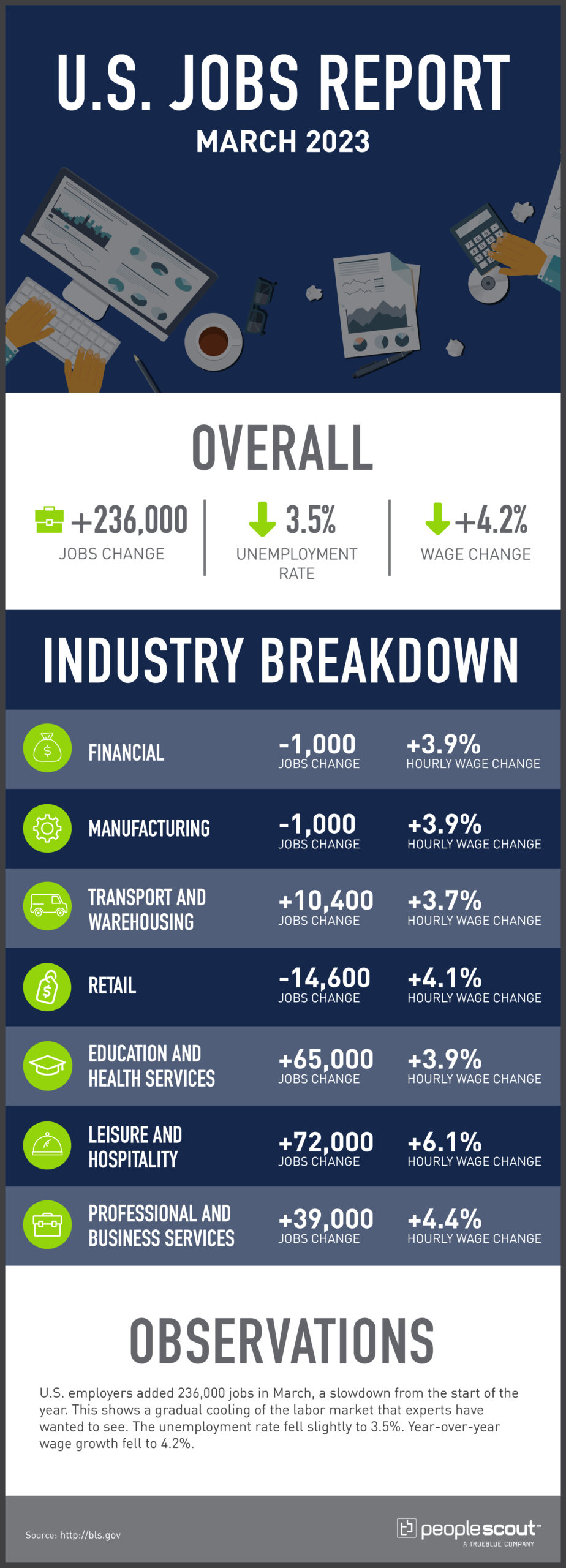
U.S. employers added 236,000 jobs in March, a slowdown from the start of the year. This shows a gradual cooling of the labor market that experts have wanted to see. The unemployment rate fell slightly to 3.5%. Year-over-year wage growth fell to 4.2%.

march jobs report infographic

The Numbers

236,000: Employers added 236,000 jobs in March.

3.5%: The unemployment rate fell to 3.5%.

4.2%: Wages rose 4.2% over the past year.

The Good

As the Wall Street Journal reports, March’s report shows that the job market is starting to cool after a very strong start of the year. This is what officials at the Federal Reserve have been hoping to see as they’ve increased interest rates in the hopes of slowing hiring, wage growth and inflation. The most recent numbers also show a decrease in wage growth, though some industries, like leisure and hospitality, are still seeing rapidly rising wages. The leisure and hospitality sector led wage growth again last month, followed by education and health services.

Additionally, more workers entered the workforce in March, boosting the participation rate for Americans considered in their prime working age to the highest level since 2001. The overall labor force participation rate rose to 62.6%, the highest rate since February 2020.

The Bad

The most recent report is starting to show the impact of recent layoffs. As the New York Times reports, several of the industries most impacted by borrowing costs shed jobs in March, including financial services, manufacturing and retail. This is difficult news for workers as we have also seen increases in unemployment claims over the past several weeks.

The Unknown

March’s jobs report does not reflect the impact of the failure of Silicon Valley Bank as the numbers reflect trends at the beginning of the month. The fallout will begin to show up in the revisions to March’s numbers in April’s report.

Additionally, the big question for experts is whether or not this cooling will be enough to slow the pace of rate hikes at the Federal Reserve. As MarketWatch reports, the slowdown is good news, but it may not be slow enough for officials. The Fed next meets May 2-3.

PeopleScout Jobs Report Analysis—January 2023

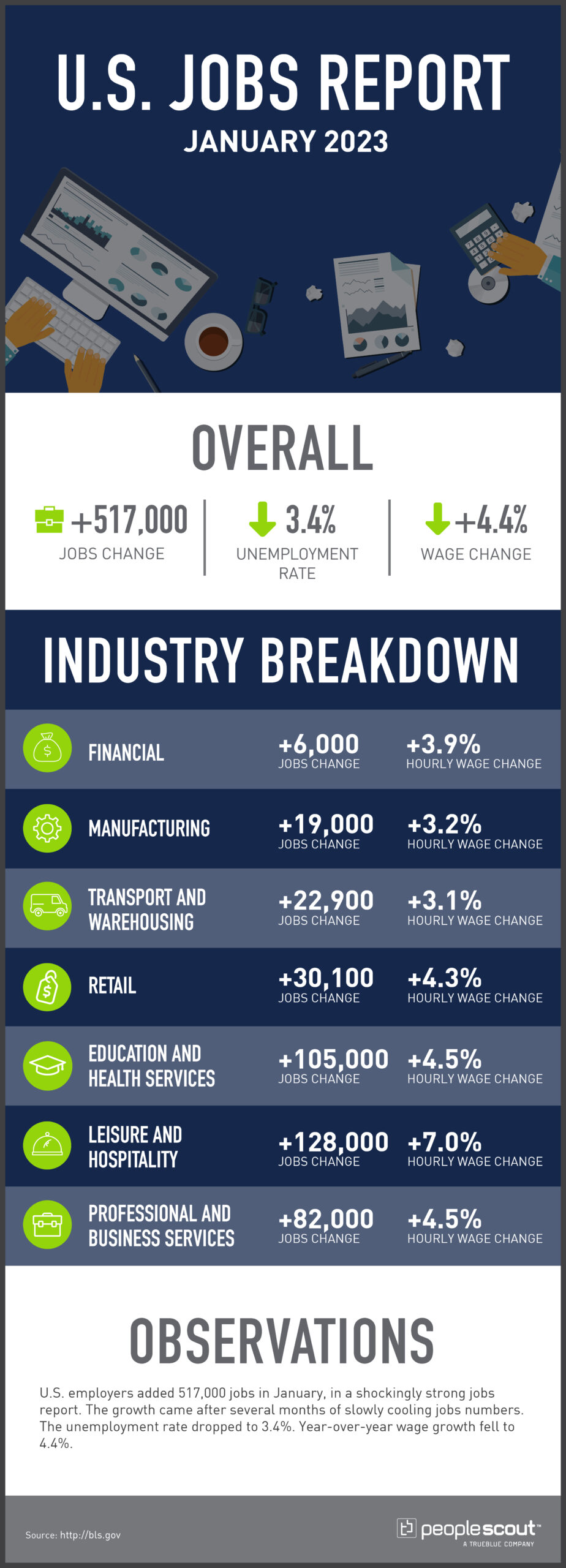
U.S. employers added 517,000 jobs in January, in a shockingly strong jobs report. The growth came after several months of slowly cooling jobs numbers. The unemployment rate dropped to 3.4%. Year-over-year wage growth fell to 4.4%.

jobs report infographic

The Numbers

517,000: The U.S. economy added 517,000 jobs in January.

3.4%: The unemployment rate fell to 3.4%.

4.4%: Wages rose 4.4% over the past year.

The Good

The numbers in January’s jobs report were surprisingly strong. According to the Wall Street Journal, the unemployment rate of 3.4% is the lowest in 53 years. The monthly job growth was the strongest we’ve seen since July 2022, with the leisure and hospitality sector leading in job gains.The length of the average work week grew, which means that not only are more people working, but they’re also working more hours.  Finally, despite the strong growth and low unemployment rate, wage growth continued to soften, a good indicator of decreasing inflation.

The Bad

The bad news in January’s report is that the Federal Reserve likely has more work to do to combat high inflation. According to the New York Times, Fed officials have said that they are looking for the labor market to cool. While the slower wage growth is a step in the right direction, January’s numbers show a robust, competitive and resilient job market. Federal Reserve Chair Jerome Powell said that they will continue to watch economic data ahead of their next meetings in March and May.

The Unknown

When combined with other economic indications, January’s jobs report highlights the mixed signals of the U.S. economy. Like wage growth, inflation is starting to slow. Tech company layoffs have made significant headlines, and more job cuts are expected. Despite the strong job growth, the labor participation rate remains well below pre-pandemic numbers. Now, as MarketWatch reports, many businesses are reluctant to lay off workers that they struggled to hire in 2021 and 2022, which could help the U.S. economy avoid a recession.

What Candidates Want: Key Research Findings [Infographic]

At PeopleScout, we hear a lot of talk about the candidate experience. Most organizations understand the importance of improving how they engage with job seekers. Yet, our latest research shows that less than two in 10 candidates would rate their recent recruitment experience as excellent.

We audited the candidate journeys of over 215 organizations around the world, assigning each a Candidate Experience Quotient (CandidateXQ) score based on 40 key experience indicators, 15 of which are critical to the candidate experience. Then, we analyzed these scores alongside data gathered from surveying over 2,400 job seekers globally. The results revealed a clear disparity between candidate expectations and their reality.

Check out this infographic to explore the key findings from the Inside the Candidate Experience 2023 Report.

For more global candidate experience insights, download the full Inside the Candidate Experience 2023 Report.

Less Than Two in 10 Job Seekers Rate Their Recent Recruitment Process Experience as Excellent

PeopleScout’s latest research reveals hard truths about candidate expectations versus the reality of their experiences  

CHICAGO–January 25, 2023 – Today’s job market is experiencing a clear disparity between candidate expectations and the reality they face when searching for and applying for jobs, according to a recent report by leading recruitment process outsourcing provider PeopleScout, a TrueBlue company. Survey findings showed that less than two in 10 candidates would rate their experience as “excellent”—a clear indicator that expectations for their job search are not being met by employers. The global research report, Inside the Candidate Experience, surveyed over 2,400 job seekers and analyzed 217 companies around the globe to see how employers stacked up against candidate expectations.  

Technology, social media and lightning-fast consumer experiences have driven job seekers to expect seamless, quick, digital-first experiences. For employers to succeed in this market, they must deliver the same intuitive and personalized experience. For example, survey results showed that two-thirds of candidates use social media to research companies during their job search. Yet, a third of employers are not consistently posting career-related content to their social channels.  

Job seekers also showed a desire to make an emotional connection with prospective employers. The study revealed that an organization’s mission, purpose and values are top considerations for candidates when deciding whether to apply for a job. Yet less than half of organizations include this information on their career site. Also, 35% of employers do not feature real employees in their recruitment material.  

In addition, candidates want to know that applying to an organization is worth their time and effort. Of those surveyed, 21% of candidates said lack of information regarding next steps would make them likely to drop out of the process after applying, but less than two in 10 employers provided candidates with those details. Plus, only 30% of employers clearly stated that adjustments were available for candidates with disabilities prior to starting an application. 

“In my conversations with talent acquisition leaders, it’s clear organizations understand the importance of the candidate experience, yet our research reveals that employers have a long way to go to meet candidates’ expectations,” said Simon Wright, PeopleScout’s Head of Global Talent Advisory Consulting. “PeopleScout strives to make the recruitment process as seamless as possible for both parties, and our hope is that this serves as a rallying cry for employers to get serious about making improvements to their candidate experience, especially as hiring has become so challenging.”   

Download PeopleScout’s full report here for more survey findings and actionable insights for employers. 

Press Contact 
Taylor Winchell 
Senior Manager, External Communications 
pr@trueblue.com 
1-253-680-8291 

Inside the Candidate Experience 2023

Inside the Candidate Experience 2023

The Hard Truth About Candidate Expectations vs Candidate Experience Realities

The candidate experience has never been more important. Yet, the latest research from PeopleScout shows that less than two in 10 candidates would rate their recent recruitment experience as excellent.

We audited the candidate journey of over 215 organizations around the world, giving each a Candidate Experience Quotient (CandidateXQ) score—a calculation based on 40 key experience indicators, including 15 critical factors that make or break the candidate experience.

By analyzing these CandidateXQ scores alongside data gathered from surveying over 2,400 job seekers globally, we uncovered a clear disparity between candidate expectation and reality.

Download our free Inside the Candidate Experience report for the latest research exploring:

  • What candidates expect at each stage of the journey and how employers stack up
  • Where each industry is succeeding or struggling with candidate experience
  • Actionable steps you can take to improve your CandidateXQ

The Future of Work: 4 Key Factors That Will Shape the Workplace by 2030

It’s no secret that the labor market has been volatile over the last several years, and talent acquisition teams have experienced a multitude of highs and lows. In our capacity as trusted advisors, PeopleScout analyzed patterns in global workforce trends to help our clients create informed strategies for future-proofing their workforce by examining how these patterns may affect their workforce. While we can’t predict the future of work, we think there are four key factors will shape the world of work over the next decade.

1. Flexibility

Flexibility is here to stay, and it will apply to everything from where and how we work to the roles we do and who we do them for. There will be no hard and fast rules about working hours and shifts in the future.

As life becomes increasingly characterized by change, employees will need to be agile—always ready to reskill. Learning becomes a constant, and we may even find ourselves counting AI robots as our trainers and mentors.

Flexibility and upskilling will manifest differently from generation to generation, so organizations must facilitate working arrangements for different demographics. Over the next decade, the generation gap will widen and then gradually close as Baby Boomers begin to settle down to retirement by blending work and leisure. Millennials and Gen Z will bring their progressive perspectives to work.

10 Predictions for What’s NEXT in the World of Work

DESTINATION 2030

2. Fluidity and the future of work

Globalization will enable much more cross-border, cross-company collaboration. Project teams will be established based on all sorts of factors, not just who’s in what department or which location. People will work with talent from all sorts of specialities as they move from project to project.

Technology helps to support our wellbeing as the lines between work and home become more blurred. But with new technologies come new laws, so security and compliance will also be strategically important, especially for organizations working at the cutting-edge of innovation.

3. Focus 

future of work

Organizational culture will become more important than ever before as people make career choices based on ethics, values and purpose above things like pay and benefits. More and more employees will choose to work for organizations that have a clear purpose and are committed to working in the most ethical, sustainable and socially responsible ways.

Technology also plays a role here, in helping people focus on the work that matters to them as automation takes over the mundane tasks. However, more AI and machine learning will make some roles redundant and create many others—generating even greater demand for technical, analytical and digital skill sets across sectors.

4. Forward-thinking and the future of work

Organizations will continue to compete when it comes to creating innovative new technologies and using those technologies in the most creative ways. But they’ll also be happy to pool some resources to create a better future for everyone. 

Issues like equality and climate change will continue to grow in importance, forcing organizations to find new and better ways of making social and environmental improvements at speed.

Onward, Upward and Who Knows Where the Future Workplace Will Go

You may feel more prepared for some changes more than others as we approach 2030, but it’s safe to say that there will be plenty of surprises that will require creative thinking in order to stay resilient.

PeopleScout will be on the journey with you to support, challenge and inspire you—no matter what the future holds.

To learn more about how we came to these predictions and see our research findings, check out our Destination 2030 white paper.

PeopleScout Jobs Report Analysis – December 2022

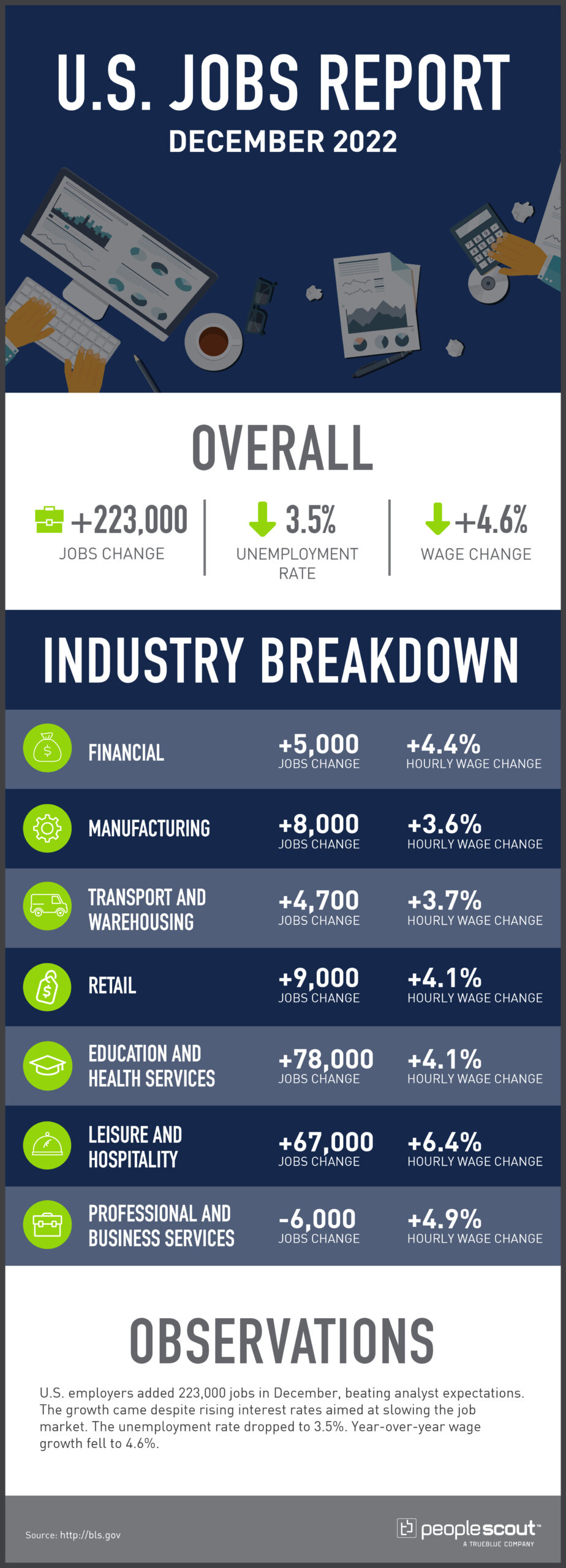
U.S. employers added 223,000 jobs in December, beating analyst expectations. The growth came despite rising interest rates aimed at slowing the job market. The unemployment rate dropped to 3.5%. Year-over-year wage growth fell to 4.6%.

jobs report infographic

The Numbers

223,000: U.S. employers added 223,000 jobs in December.

3.5%: The unemployment rate fell to 3.5 percent.

4.6%: Wages grew 4.6% over the past year.

The Good

December’s jobs report shows evidence the Federal Reserve’s strategy of increasing rates to provide a “soft landing” for the U.S. economy may be working. So, what would look like bad news in almost any other year is actually good news.  

The 223,000 jobs added to the economy is the smallest increase in the past years, as the Wall Street Journal reports, but it is still a healthy pace of job growth. Additionally, year-over-year wage growth slowed to 4.6%. Wage growth has remained stubbornly high over the past two years, and economists feared it could contribute to high inflation. December’s report helped allay some of those concerns.

The Bad

Though December’s job report was generally taken as good news, there are still some signs of unwanted weakness. As MarketWatch reports, layoffs in the technology sector are making an impact in the report. The business and professional services sector, which covers many tech roles, posted a decrease of 6,000 jobs. Additionally, while the labor force participation rate did increase in December, it still remains below prepandemic levels. This continues to contribute to the ongoing labor shortage.

The Unknown

Economists say that the slowing growth in December’s report will likely cause the Federal Reserve to slow the pace of interest rate increases aimed at slowing inflation. As the New York Times reports, the S&P 500 rose 2.3% with the release of the report. Investors have been eager for fewer and smaller interest rate increases. The Federal Reserve meets next on January 31.