COVID-19 Series: Hiring Solutions for Healthcare Providers

As organizations around the globe confront the challenges presented by the coronavirus (COVID-19) outbreak, even the most seasoned talent leaders find themselves in uncharted territory. We’re creating a series with our experts here at PeopleScout about the issues that are most pressing during this uncertain time.

We are focused on the safety of our employees and clients, friends, families and loved ones. However, it is important for many organizations to keep their talent acquisition functions moving – whether to provide essential services or to serve our communities by providing jobs. Many organizations are also now adapting to a newly virtual workforce.

In that spirit, this podcast shares insights from PeopleScout Global Leader of Solutions Design, Krista Sullivan de Torres about hiring solutions for healthcare providers.

Krista is a seasoned professional with more than a decade of human resources and talent acquisition experience. While Krista’s professional experience spans many industries, she has a passion for and deep expertise in healthcare. Her experience includes launching RPO programs for healthcare startup organizations, managing RPO operations for managed care, population health, behavioral health, and healthcare system clients. Krista’s specialties include global talent acquisition team design, talent acquisition operations, analytics and reporting, recruiting, sourcing and retention. Krista holds a bachelor’s degree in Mathematics from the University of California, Santa Cruz.

Talking Talent: Stretch Your HR Thinking

David Fairhurst is well known as an innovative HR leader and entertaining speaker. He was formerly Global Chief People Officer for McDonald’s, one of the largest employers in the world, with 2 million employees covering over 120 countries. He has held HR leadership positions at many of the top global organizations including Heinz, GSK and Tesco.  David is the founder of Orgshakers, helping businesses shape their organizations to achieve short-term performance as well as long-term organizational health.

In this podcast, David speaks with Robert Peasnell, Deputy Managing Director of PeopleScout UK about the future of HR and how you can stretch your thinking to create successful HR strategies.

Listen to find out:

  • How to navigate change and create organizational readiness.
  • The importance of being brave in employer brand and EVP innovation
  • Understanding the cultural context of HR in other countries
  • How HR messaging can change organizational behavior
  • The need to use tech to disrupt the market and win the best talent
  • How to make an impact in communities
  • The likely fundamental shifts after lockdown

Hiring Solutions for Essential Employers with Jessie McGowan

As organizations around the globe confront the challenges presented by the coronavirus (COVID-19) outbreak, even the most seasoned talent leaders find themselves in uncharted territory. We’re creating a mini-series with our experts here at PeopleScout about the issues that are most pressing during this uncertain time. 

This profile shares insights from PeopleScout Leader of Business Development in North America, Jessie McGowan. Jessie spends the majority of her time sharing our solution offerings with prospective clients, where she calls upon her years of experience leading a diverse portfolio of RPO client partners. 

Jessie shared her insights about hiring solutions for essential employers from her home in Charleston. 

A lot of people are feeling overwhelmed right now. What are you hearing from talent acquisition and HR leaders? In what ways and industries do those teams need support right now? 

There is a lot going on in all industries as we react to what’s happening in the world today with COVID-19. Mission critical industries like grocery, healthcare, logistics and other supply chain roles that hire drivers or selectors, manufacturing — specifically medical device — are seeing tremendous increases in their needs to find and hire qualified talent. And, unless they’re working with an RPO provider like PeopleScout that’s built to flex, they’re not going to have the adequate talent acquisition staff to meet the demands of the business.   

What are some easy ways essential employers can find that support? 

PeopleScout has a few offerings. One is Recruiter On-Demand (ROD) — where we provide a qualified recruiter to work as an extension of an organization’s team on an hourly basis. ROD can also be leveraged as a project approach, where an organization can have a provider support a certain function of their hiring process or a certain number of hires for a period of time. For instance, if you received 500,000 applications last week, how are you going to get through them? Unless you’ve already built a highly efficient automated process, a partner like PeopleScout can help improve that process for organizations. 

What do these solutions look like in practice? How are they implemented? 

Recruiter On-Demand can be deployed within about 24 hours. We have qualified recruiters with a wide range of domain experience like frontline or retail hiring, healthcare, manufacturing, drivers and IT. First, we assign the right fit recruiter and quote an hourly rate. Then, the organization provides our recruiter access to their applicant tracking system or system of record and an email address so that PeopleScout can become invisible to the candidate throughout the process.  

Our Recruiter On-Demand solution is simple and straight forward, and we work hard to keep it moving and efficient. Once we’ve landed on the business terms, we assign an engagement leader who will schedule what we call a “kickoff” with the client to document the process and discuss expectations. We’ve been doing this a long time, so we’ve built the process with the intention of keeping it really easy for talent acquisition leaders, and we’re able to launch it very quickly in a seamless manner. 

How do we use the solution in a way that keeps everyone, including employees and candidates, safe? 

That’s a great and timely question. Most of our recruiters worked from home even before the COVID-19 outbreak, so virtual work is part of the PeopleScout DNA. As a matter of fact, some of our most complex, high volume recruiting solutions are 98% virtual, where a very small subset of team members might sit together in a delivery center in Chicago, Charlotte or Toronto, for example.  

At PeopleScout, we have a lot of experience in building world-class virtual solutions that are designed to provide an exceptional candidate experience and deliver efficiency. We are able to advise talent leaders on utilization of digital interviewing tools such as texting or prerecorded voice or video. We also have our own proprietary tool, Affinix™ talent technology or we can advise a leader on what might be best for them and available in the market. We’re flexible and focused on getting talent acquisition leaders what they need to be able to deliver to their business and stakeholders, and we have a lot of experience, especially building a no-contact, virtual solution. We can source, qualify, schedule talent, offer positions, and even onboard new hires all virtually, over the phone or by utilizing technology. 

Can you talk a bit more about what a virtual solution looks like in practice? 

Our virtual interview management solution is designed to complement your existing hiring process and it can be set up in a matter of days. It would include process steps such as: 

  • Phone screening: includes on-demand and live options 
  • Video interviewing: includes on-demand and live options 
  • Scheduling tools: enables candidates to self-schedule available interview slots or be scheduled via recruiters’ assistance  
  • Results-based automated interview progression: allows you to define the criteria that determines whether to automatically advance candidates 
  • Feedback-driven advancement: creates settings based on recruiter rating and scoring criteria 

Interview notifications and updates can be pushed out to the candidate, so they understand at any given moment where they are in the interview process. And, hiring leaders can also see the progression of a candidate throughout the process. So, while at PeopleScout we’ve been supporting an essentially 100% virtual recruitment process for years now, we can appreciate that this is a new approach for many essential employers, and we can walk them through what to consider as they implement a virtual hiring solution. 

A lot of us are feeling a lot of stress and anxiety right now. What recommendations do you have for someone who is leading a talent acquisition team that feels like they’re in crisis? 

Sometimes it’s hard to see what the right plan might be when you’re dealing with the type of stress and anxiety that surrounds us these days. That’s where we can help. PeopleScout is highly consultative — by asking a few key questions, we can help a talent acquisition leader identify the right levers to pull to drive the result that they need. We’re happy to walk a potential partner through a quick diagnostic to see if we’re a fit and if we can be helpful. Sometimes, even if we’re not the right fit, just having the conversation can be helpful in getting down to the root of what talent leaders really need right now. And we’re happy to share our knowledge and be helpful, especially during these tough times. 

Are there any final thoughts you’d like to leave essential employers with today? 

The hope is that this is temporary. And that very quickly we’ll go back to solving more familiar talent acquisition challenges, like how to find more great people. But, at this time we’re poised to be flexible, and creative, to help solve the new problems we’re all dealing with today. 
PeopleScout U.S. Jobs Report Analysis — March 2020

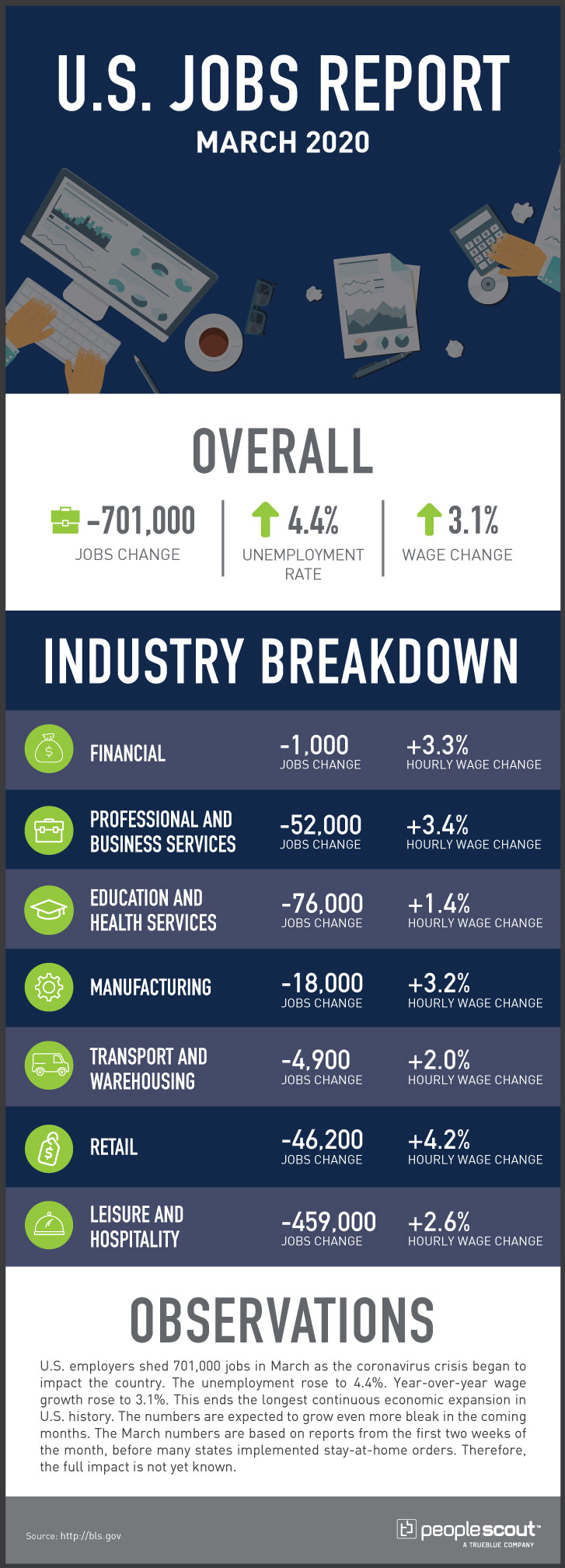
U.S. employers shed 701,000 jobs in March as the coronavirus crisis began to impact the country. The unemployment rate rose to 4.4%. Year-over-year wage growth rose to 3.1%. This ends the longest continuous economic expansion in U.S. history.

The numbers are expected to grow even more bleak in the coming months. The March numbers are based on reports from the first two weeks of the month, before many states implemented stay-at-home orders. Therefore, the full impact is not yet known.

U.S. jobs report infographic

The Numbers

701,000: The U.S. economy shed 701,000 jobs in March

4.4%: The unemployment rate rose to 4.4%

3.1%: Average hourly wages rose 3.1% over the last year.

The March Losses

The job losses are most significant in the leisure and hospitality sector, which shed 459,000 jobs as bars and restaurants closed and international and most domestic travel came to a halt. The March jobs report was the biggest monthly drop since the worst months of the Great Recession.

According to the New York Times, even industries that had initially continued running, like manufacturing, are starting to see major impacts as factories close. The job losses are also spread across industries considered essential, including healthcare, as dentists and other non-essential healthcare providers have closed their doors until the pandemic lifts.

There are very few bright spots in the report. Some employers in the transportation and warehousing sector and grocery stores have picked up hiring to meet increased demands.

What’s to Come

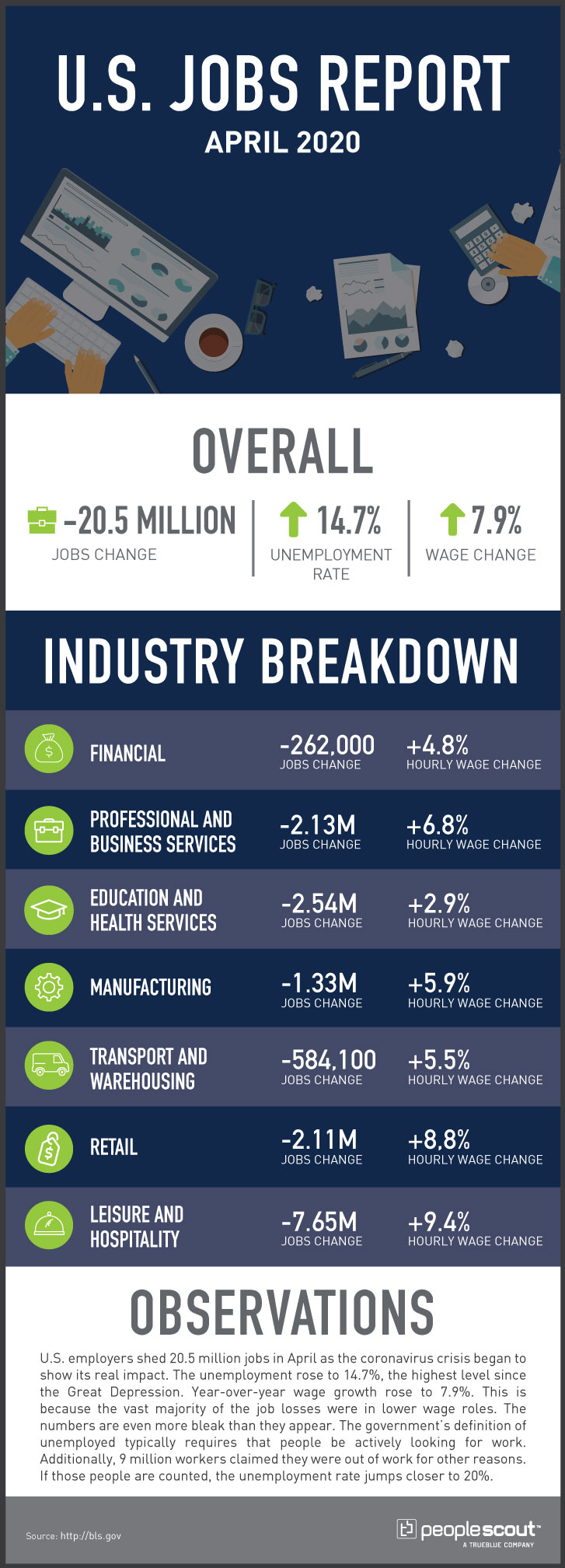
The numbers are likely to get far worse in the coming months. As MarketWatch reports, the March numbers don’t reflect the approximately 10 million people who filed for unemployment during the final two weeks of the month. 

The Wall Street Journal reports that the U.S. could lose 27.9 million jobs and have an unemployment rate as high as 16% by the end of May. The nonpartisan congressional budget office predicts that unemployment will pass 10% in the second quarter of the year. April’s job report could show the largest ever drop in employment.

COVID-19 Series: Hiring Solutions for Essential Employers

As organizations around the globe confront the challenges presented by the coronavirus (COVID-19) outbreak, even the most seasoned talent leaders find themselves in uncharted territory. We’re creating a series with our experts here at PeopleScout about the issues that are most pressing during this uncertain time.

We are focused on the safety of our employees and clients, friends, families and loved ones. However, it is important for many organizations to keep their talent acquisition functions moving – whether to provide essential services or to serve our communities by providing jobs. Many organizations are also now adapting to a newly virtual workforce.

In that spirit, this podcast shares insights from PeopleScout Leader of Business Development in North America, Jessie McGowan about hiring solutions for essential employers.

Jessie spends the majority of her time sharing our solution offerings with prospective clients where she calls upon her years of experience leading a diverse portfolio of RPO client partners.

COVID-19 Series: Keeping Candidates and Employees Safe with a Virtual Hiring Solution

As organizations around the globe confront the challenges presented by the coronavirus (COVID-19) outbreak, even the most seasoned talent leaders find themselves in uncharted territory. We’re creating a miniseries with our experts here at PeopleScout about the issues that are most pressing during this uncertain time.

We are focused on the safety of our employees and clients, friends, families and loved ones. However, it is important for many organizations to keep their talent acquisition functions moving – whether to provide essential services or to serve our communities by providing jobs. Many organizations are also now adapting to a newly virtual workforce.

In that spirit, in this podcast, we share insights from PeopleScout Global Leader of Affinix Client Success and Strategy Allison Brigden on transitioning to a virtual talent acquisition solution.

Allison has been with PeopleScout since 1995 and has served in roles related to implementing and managing complex RPO programs as well as operations and technology. In her current role, Allison focuses on leveraging technology to elevate the talent strategy and client success through Affinix, PeopleScout’s proprietary talent technology platform. Allison leads an Affinix Client Success Team and our strategic technology partnerships. The Affinix Client Success Team is focused on understanding our clients’ objectives with Affinix and creating positive outcomes. She also possesses a deep commitment to corporate social responsibility, with an emphasis on military veteran advocacy. Allison holds a bachelor’s degree from the University of Utah.

At PeopleScout, we’re all dealing with the same changes—working from home and recording these podcasts from a distance, so things may sound a bit different than you’re used to hearing.

PeopleScout U.S. Jobs Report Analysis — February 2020

The Labor Department released its February 2020 jobs report which shows that U.S. employers added 273,000 jobs in February, which beat analyst expectations. The unemployment rate fell to 3.5%. The labor force participation rate remained at 63.4%. Year-over-year wage growth fell to 3.0%. U.S. employers have now added to the payrolls for 113 straight months, extending the longest continuous jobs expansion on record.

U.S. Jobs Report February 2020

The Good

The headline numbers in the February jobs report are good news. According to MarketWatch, analysts had expected just 165,000 new jobs—far below the 273,000 added last month. The strongest gains came in healthcare, restaurants, construction and government jobs. Healthcare providers alone added 57,000 positions. This provides a strong baseline for the economy as concerns over the coronavirus grow.

The Bad

Despite the strong numbers, the New York Times reports that there are vulnerabilities in the economy. Business investment and wage growth have been sluggish for months. Hiring in manufacturing is also slowing. Analysts expect job creation as a whole to slow in 2020.

The Unknown

The biggest concern—the novel coronavirus—has yet to make an impact on the jobs report. The numbers in the February report come from the week of February 12—before the U.S. saw an uptick in coronavirus cases or deaths. Experts say the February report demonstrates a strong baseline against which they can monitor the impact of the virus in the U.S.

However, the Wall Street Journal reports that companies are starting to feel the effects. Airlines and hotels are reporting a decrease in business—with some airlines cutting back on the number of flights and announcing hiring freezes. Experts also expect the virus to have a large impact on restaurants, entertainment and retail. At the same time, there has already been increased growth in the healthcare and science sectors.

So far, the New York Times reports that the manufacturing sector is seeing mixed impacts from the virus. Those who depend on parts from China may be experiencing supply issues. However, some U.S. based manufacturers are seeing increased demand from companies that previously relied on overseas suppliers. Over the next few months, economists will be watching the impact closely.

Talking Talent Leadership Profile: Jon Porter

Jon Porter doesn’t have a typical recruiting background. He started out as an accountant with KPMG and made his way through the advertising sector before finally landing as the Managing Director of PeopleScout in the UK and Head of EMEA Operational Delivery. Along the way, he was lucky enough to work with many organizations with diverse recruiting challenges – from the British Army and the Metropolitan Police to Diageo. So, when Jon looks at talent challenges, he doesn’t just look at them as a recruiter; he views them through the wide-angle lens of the entire business, and he sees them as a storyteller.

Jon shared his story from PeopleScout’s London offices. He explained how the unique and ever-evolving challenges and opportunities in the UK and Europe will influence talent acquisition leaders around the globe.

What are some of the biggest challenges facing the UK and Europe in talent acquisition right now?

The biggest challenge has been the uncertainty around Brexit since the referendum in 2016. Organizations have not had certainty around the future, and this has influenced decision-making around how to potentially invest and grow a business. The focus of government around the normal investment programs has also been affected, as much of parliamentary time was focused on the many Brexit bills progressing through both Houses. It almost felt that the UK was on pause and we just needed to press the play button. After the election result of December 12, 2019, it now looks like some of that uncertainty has been removed. The newly formed government, now with a working majority, is pushing for a conclusion of the Brexit debate by the end of 2020.

What are the talent acquisition trends you’re seeing in the UK and Europe today?

There are some clear trends in the marketplace. The obvious one is technology. There is a fragmented and hugely diverse technology landscape in the UK and EMEA (Europe, Middle East and Africa), and leaders are looking at how to better navigate that landscape. How do they make the most of it – to drive efficiency, cost savings and better-quality candidates – and optimize the way they do things?

There is also a trend of organizations looking at multi-country programs, with a focus around EMEA. Organizations seem to be looking at talent more globally and around the concept that talent isn’t limited by traditional country boundaries or geography, or even technology. It’s fast-becoming a boundary-less environment.

How is the introduction of Affinix™ to Europe fitting into and changing the conversation about technology in the region?

I think that our timing couldn’t be better. We’ve had loads of great feedback on Affinix since our September launch at our Resourcing 2025 event at the London Science Museum, and I think it’s because it provides a flexible solution at a time when organizations are still a bit cautious about how they’re going to evolve their technology solutions. Because Affinix is a middleware, it affords our clients the opportunity to get the great technology of the now, but also it provides them with security for the future. It’s a manifestation of now to next.

How do you tell a cohesive and relevant story when recruiting across borders?

Finding “space” in a busy talent marketplace is hard; differentiating one company offer from another requires a deep understanding of brand and channel. Developing target personas, and understanding how they live their lives and how to create a one-to-one dialogue is essential. At PeopleScout, this approach and understanding is in our DNA. It’s how we think.    

When looking at cross-border campaigns, we first consider the message – the employer brand promise; the value exchange between the organization and the candidate – the deal. This message needs to be authentic across all borders. It needs to reflect the lived experience of employees within the organization. It can be aspirational; however, it can’t be an exaggeration of the truth. That can only lead to unfulfilled expectations, reduced engagement and increased attrition.

The art of the storyteller is to deliver a consistent, overarching message while accommodating the nuances of the countries in which it needs to be delivered. The language, tone, imagery and cultural touchpoints may change, but the essence of the promise remains consistent. Good recruiters understand how to bring the story to life in conversation with candidates and yet remain true to the organizational narrative.

What are some of the lessons from the UK and Europe that leaders in other regions should be paying attention to?

Many organizations have a structured view around their approach to talent and where they think hires might come from – whether it’s specific geographies, sectors or universities. I think one of the things that we’re doing in Europe – which does seem to be a message that’s landing elsewhere – is that we need to be more open-minded and a bit more conscious around things like social mobility and inclusivity.

Organizations are looking past the barriers of geography, society and technology. They’re seeing that talent is going to be pivotal to the evolution of business. That’s driving a mentality of embracing talent without any boundaries and taking a more progressive and equitable view of talent.

What are you most excited about for the future of talent acquisition?

The speed of change in talent acquisition is going to accelerate. Technology is absolutely going to fuel that acceleration. Clients are going to have greater and greater expectations, requiring more dynamic talent acquisition strategies. That will be driven by the fact that talent will be even more of a differentiator for organizations.

We’re also going to see employer brands and employer value propositions (EVPs) play an even greater role in the hiring process. The EVP is going to become the cornerstone of the people agenda – so, not just recruiting, but also learning and development, organizational design and more. How does the EVP play into the culture and behaviors of the organization?

Additionally, the vast majority of jobs that will be created five to 10 years from now probably don’t even exist today. So, there will be the evolution of new job roles, new technologies, new demands from organizations and new challenges in the world and political landscapes. This makes talent acquisition an exciting place to be.

Talking Talent: Transforming Talent Acquisition with Jeff Scott from BMO

In this episode of Talking Talent, we’re talking about how talent acquisition is transforming to become more strategic and drive business results.

Traditionally, talent acquisition has operated reactively and administratively, buried in the HR business function. But with a tight talent market and increasing competition for the best workers, recruiters at market-leading companies are starting to work as advisory partners and talent acquisition is driving change rather than simply responding to it.

Joining us to talk about the transformation is a guest who is leading it at his own organization — Jeff Scott, Managing Director of Talent Acquisition for North America at BMO Financial Group.

Throughout his nearly 25-year career at BMO, Jeff has been known as a fixer, a change agent who has led enterprise transformation and refined North American operations in diverse areas such as technology development, procurement, learning, and now Talent Acquisition.

In his role at BMO, Jeff is leading an aggressive growth agenda to attract the best talent, create the highest caliber recruiting experience in the marketplace and to position BMO to “be the best, attracting the best.” Jeff is passionate about disrupting the status quo and loves to ask the question “Why not?”, apply a little common sense and bring everyone along for the ride.

In this episode, Jeff looks back at what the role of the recruiter has traditionally looked like and looks forward to how a talent advisor needs to function to drive recruiting success. He shares some specific steps he’s put in place at BMO to drive the change at his organization. He also gives advice for leaders who want to make the shift at their own organizations and explains how technology and RPO partnerships fit into best-in-class talent programs.

3 Economic Trends That Will Affect Talent Acquisition in 2020

Every talent acquisition professional is kind of an economic expert. In the process of filling positions, you become aware of local unemployment levels, current rates of compensation, and the competitive landscape in the sectors and markets in which you work. And, while understanding these specific conditions may be essential aspects of successful talent strategies, there are always larger economic forces at work. In this article, we cover three of economic trends and their impact on Talent Acquisition in 2020.

Understanding these economic trends can help develop an effective workforce strategy. To illustrate this point, PeopleScout has identified three economic trends that will affect talent acquisition and workforce management in 2020 – and potential ways to respond to the challenges and opportunities they bring.

Trade Disruption & Uncertainty

Uncertainty over trade due to Brexit, ongoing trade disputes between the U.S. and key trading partners, and other global commerce issues dominated the headlines in 2019. How will these yet-to-be-resolved issues affect talent acquisition?

Flexible Workforce Planning

Imagine planning a budget without knowing the future costs of goods and services. Due to current uncertainty over trade, this is the dilemma that many enterprises are facing. The imposition of tariffs in the U.S.-China trade dispute has caused shifts in both the price and availability of products, according to The New York Times. Uncertainty over whether Brexit will happen – and, if it does, what the consequences will be on nearly every aspect of the UK economy and other nationsremains uncertain. One way to respond to uncertainty is to make flexibility a key component in workforce planning. Flexible workforce planning can include contingent staffing, sourcing strategies that promote rapid onboarding and employee cross-training in anticipation of potential downsizing.

Dig Deeper

PeopleScout Webinar: Using Data to Optimize Your Recruiting Process and Employer Brand

Sourcing Candidates from Alternative Talent Pools

While low unemployment still characterizes many of the world’s leading economies, trade disruption has also led to some job losses and displacement. For example, in Great Britain, a number of companies have closed, moved or are planning to, as reported by Metro in the UK. In both the U.S. and the UK, the manufacturing sector has seen job losses due to tariffs and trade uncertainty. Fortunately, many of those who work in manufacturing possess transferrable skills that can be used in other industries. Employers that can identify and attract this newly available source of talent will have a competitive advantage in tight labor markets.

The Migrant Workforce & Shifting Talent Landscape

The era of growing immigration to many advanced economies has been disrupted. The Guardian reports that thousands of European Union nationals have left the UK since the 2016 Brexit referendum, in large part due to the uncertainty over their legal status after an eventual exit from the EU. And, in the U.S., a tightening of available visas and selective immigration bans have caused the number of legal immigrants to plummet. On the other hand, 29% of Australia’s population is foreign-born, but the economic growth in many Asian countries – the source of much of Australia’s immigrant population – has contributed to its decline in net migration in recent years. 

Know the Affected Sectors

One important way for employers to respond to changing immigration patterns is to know which jobs are most affected and to plan accordingly. The reality is that immigrants comprise a significant portion of workers in a range of sectors. For example, nearly one-third of hotel workers in the U.S. are immigrants, and more than one in 10 healthcare workers in the UK are non-British nationals (half of these are from the EU), according to the Office for National Statistics. Understanding the sectors and markets that are affected by the falling rates of available talent from abroad may play an increasingly important role in developing effective talent acquisition strategies.

Talent Without Borders

The pool of available talent is exponentially expanded when work can be done outside of a fixed location. Advances in technology and communications have greatly reduced the need for many processes to take place in brick-and-mortar workplaces. For this reason, recruitment strategies may increasingly include a review of job descriptions to determine which positions can work from virtual locations, including those that are abroad. By doing so, employers can move beyond the constraints of limited talent pools and the wage pressures that tight labor markets generate.

OK, Boomer?

According to Glassdoor’s Chief Economist, Dr. Andrew Chamberlain, baby boomers, born between 1944 and 1964, are now the fastest-growing segment of the U.S. workforce. Dr. Chamberlain notes that “A ‘gray wave’ of senior citizens will be impacting the workforce in coming years, both in the United States and the United Kingdom.” In Canada, the percentage of workers aged 55 and older more than doubled in a little more than two decades; they are now more than one in five of all Canadian workers. Similarly, the number of Australians aged 65 and older who participated in the workforce in 2018 was 13%, compared to only 8% in 2006. And, in New Zealand, 22% of retirement-age people worked in 2016, an 87% increase in just 10 years.

Candidates with a Silver Lining

Given these striking statistics, an increasing number of applications from older candidates should be expected. In addition to the talent that these older candidates bring in their own right, they also help employers adopt a holistic approach to upskilling.

Take the case of a recent college graduate who has strong technical skills, but lacks industry knowledge and even critical soft skills, such as effective communication. These deficiencies can be offset by pairing this new hire with a seasoned industry veteran. The ensuing mentoring can go both ways; a tech-savvy new hire can help an older worker who may be challenged in this area, while the seasoned worker can guide and instruct the younger employee on important industry knowledge and work skills. This symbiotic pairing can also become an important element in an enterprise’s succession planning strategy.

Partnering for Success

Responding to economic trends can be daunting for those under constant pressure to fill positions and manage talent. However, tracking newly available workers due to shifting tariffs and treaties, knowing how to find candidates in unknown and far-flung locations, and navigating the process of recruiting from a broad range of age groups may seem overwhelming to even the best-equipped team of talent professionals. This is precisely why leveraging the expertise and resources of a talent acquisition partner can be the deciding factor for success in a complex and rapidly changing economic environment.