Bridging the Future: Sourcing an Ecologist to Drive Sustainability

Bridging the Future: Sourcing an Ecologist to Drive Sustainability

Amplifiers™

Bridging the Future: Sourcing an Ecologist to Drive Sustainability

PeopleScout helped an infrastructure company overcome market misperceptions to fill a niche ecologist role with Talent Sourcing, an Amplifiers™ solution.

700 + candidate profiles reviewed
2 shortlisted
1 offer accepted

Situation 

This infrastructure company operates, maintains and improves motorways and major roads in England. Their internal recruitment was struggling to fill a newly created ecologist role. However, the company is not well known in the market for environmental roles like this, making it difficult to reach professionals with a background in ecology. They advertised for the role using external media and LinkedIn, but this approach did not generate applications.  

They turned to their recruitment process outsourcing (RPO) partner, PeopleScout, for support.  

Because the client has a robust internal talent acquisition team who could handle interview scheduling, offer management and onboarding, we proposed our Talent Sourcing solution, part of our Amplifiers™ solution set. This shortlisting solution covers the front end of the process, sourcing and headhunting, screening and providing the hiring team with a shortlist of candidates that match the brief.  

Solution 

Our senior recruiters searched for candidates amongst industry governing bodies, environmental societies and networking groups, and employers with large ecology workforces. Ultimately, we reviewed over 700 profiles within the target talent pool. We reached out to candidates whose profiles appeared to have the required skillset. Due to the reputation of the transport sector amongst environmentally conscious talent, engagement and response rates were very low amongst this audience, but we were able to conduct in-depth screening calls to qualify candidates against the client’s brief.  

Results 

Despite the challenges, we presented a shortlist of two qualified candidates to the client’s hiring team which they were delighted with. This resulted in interviews being conducted and an offer being extended to one of the shortlisted candidates. The process from initial client briefing to offer extension was just under 11 weeks. 

At a Glance

  • COMPANY
    Infrastructure company responsible for building and maintaining motorways
  • INDUSTRY
    Building & Construction
  • PEOPLESCOUT SOLUTIONS
    Amplifiers
  • ABOUT THE CLIENT
    PeopleScout provides high-volume RPO and specialist talent sourcing to this infrastructure company, hiring over 400 hires annually within the transportation, building and construction sectors.

3 Strategies for Solving Hospitality Recruitment Challenges with Technology

Amongst travel and hospitality recruitment challenges is a clear and persistent issue: staffing shortages. Talent leaders are struggling to fill empty roles amid low unemployment rates.

According to a 2023 survey by Deloitte, more than half of hotel executives (53%) say their properties have between 25–74% of the workforce they had in 2019. The situation at airports is even tighter with 62% of executives saying their workforce is half its prepandemic size or smaller.

On top of this, the unemployment rate sits at 3.8% in the U.S., 4.3% in the UK and 3.7% in Australia. The travel industry also saw a massive exodus of workers. In 2022, the U.S. Bureau of Labor Statistics reported record quit rates during the Great Resignation, with the quit rate in leisure and hospitality jumping by a percentage point to 6.4%. So, how can talent leaders hire hospitality and travel workers when the available pool is smaller?

Luckily, the right technology solutions deployed at the right times during the recruitment process can help talent leaders source, attract and screen candidates to find the best talent more efficiently and effectively. In this article, we’ll cover three technology interventions that talent acquisition teams can put into place to tackle hospitality recruitment challenges.

Hospitality Recruitment Challenge No. 1: Our open positions receive few applicants, and many of those who do apply do not have the background or experience needed to succeed in the role.

Solution No. 1: Invest in artificial intelligence sourcing technology to fill the top of your funnel.

Amongst common hospitality recruitment challenges that we see is finding talent with a wide variety of specialized skills across diverse and distant geographies. There is no one-size-fits all approach to hiring travel and hospitality talent. Finding a chef for a luxury property in Lake Como, Italy will look very different from a search for housekeeping staff at a family resort in Orlando, Florida. Finding a flight attendant looks very different from filling a baggage handler role.

With such a tight talent market, employers must target passive talent. During the Great Rehire talent leaders focused on filling roles as quickly as possible, but now they need to focus on finding and hiring more experienced workers.

An AI-enabled candidate sourcing tool can identify passive candidates with the right experience for specific roles and can even identify which candidates would be most likely to leave their current employers. Within seconds, recruiters can build a list of these candidates and share the opportunity. PeopleScout’s total talent suite, Affinix®, includes the AI sourcing feature, Talent Finder, which can connect employers with millions of passive candidates.

Consider the following best practices for using an AI sourcing tool:

  • Before searching for candidates, make sure you have a thorough understanding of the technical and soft skills needed to be successful in the role.
  • Use features, like PeopleScout’s Diversity Boost, that can identify candidates from underrepresented backgrounds to help meet your DE&I goals.
  • Blend AI with the human touch. By having a recruiter reach out to a sourced candidate with a personalized message, employers can create a positive experience.
  • Make sure a human makes all final hiring decisions. AI can make the process more efficient, but hiring managers should make the final call.

Hospitality Recruitment Challenge No. 2: Candidates drop out of our process before reaching the offer stage, either by abandoning the application or ghosting the interview.

Solution No. 2: Improve the candidate experience by making the process quick and easy by embracing tools like SMS or virtual interviews.

Hospitality employers must ensure that their candidate experience sets them apart from other employers at every stage of the candidate journey. For candidates, how they’re treated during the hiring process is a preview of what their experience will be as an employee.

PeopleScout research shows that the hospitality industry has a lot of room for improvement in this area. In our analysis of the candidate experience of more than 215 different organizations, the hospitality sector came in last overall with the lowest average scores in every stage except Follow-Up (in which it was second to last). While hospitality organizations effectively showcased their diversity and inclusion efforts on their career sites, only half gave candidates the opportunity to register their interest.

Your candidate experience should be unique to your brand and help you distinguish yourself from other employers hiring for similar roles or skills. Many talent acquisition teams don’t appreciate that candidates don’t perceive the recruitment process as a funnel. They’re the main character in their own story, and they expect to be treated that way. Candidates want to engage in their job search on their own terms. So, anytime they encounter a roadblock to getting the information they want, especially if they don’t know what to expect in the next stage, they’re more likely to drop out of your process.

There are several ways to leverage  technology to make the process easier for candidates. First, start with a shortened application. According to PeopleScout research, nearly 40% of organizations asked candidates to duplicate information that was already contained in their resume or CV. Make sure your application only collects the information that is most critical for determining who moves along to the next step of the process.

From there, other technology solutions can be used to gather the additional information necessary to make a hiring decision. SMS can be used for an initial text screening, and virtual interviews, like those available in Affinix, allow candidates to answer additional questions at their own pace while feeling as though they’re driving the process.

Finally, automated communication can keep a candidate engaged in the process. The right technology platform can help by sending automated messages to candidates, via email or chatbot technology, updating them on their application status. You can even craft messages letting a candidate know if they did not get the job, so they aren’t left wondering if you ghosted them.

Consider the following best practices for using technology to improve your candidate experience:

  • Make sure your application is mobile-friendly and can be filled out in 10 minutes or less. Test your current application to see how long it takes to apply.
  • Provide candidates with the opportunity to opt-in to receive text messages or emails from your organization to remain in compliance with local spam laws.
  • Tailor the type of virtual interview to the type of role. While video interviews may be appropriate for customer-facing roles, others may prefer the opportunity to answer questions with recorded audio.
  • Make it simple for candidates to understand where they are in your process; this can be something as simple as a progress bar.

Hospitality Recruitment Challenge No. 3: Our assessment process isn’t effective at identifying the candidates most likely to succeed in the role, leading to increased turnover, reduced productivity and disengaged employees.

Solution No. 3: Assess candidates for passion, purpose and mindset.

The travel and hospitality industry is all about guest experience, and hotels, airlines, restaurants and theme parks differentiate themselves with the unique experience that they provide. So, talent leaders need to find candidates who not only have the right skills and experience but also a deep understanding of the brand and how it is reflected in the service provided.

For example, in a major city, you may find three hotels on the same street, one catering to a high-end luxury experience in a historic building, another geared toward young travelers with bold art and hit music playing in the lobby, and a third designed with business travelers in mind—with a large business center, meeting rooms and plenty of quiet spaces for someone to plug in their laptop. Many hotel brands even have this variety of styles within their own portfolios. The service provided in each hotel looks different, and a person who excels at a luxury property may not thrive in a trendy hotel.

By selecting the right assessment tool, employers can go beyond looking at just capability, behavior and results but also determine whether candidates align with their organization’s purpose, have passion for the work they would do and whether they have the mindset to adapt to new environments.

By building an assessment during pre-screening that accounts for passion, purpose and mindset in addition to the standard skills and experience, employers can use technology to shortlist candidates based on several different attributes at the same time. This way, employers can get a clear picture of the different strengths and weaknesses of candidates in order to make informed decisions about which candidates are best to bring forward to the interview stage.

By identifying candidates who match well with an employer’s brand of guest experience, talent leaders can reduce turnover and build a happier, more engaged team. In turn, that leads to better customer experience and a better bottom line.

Consider the following best practices for building an effective assessment for hospitality talent:

  • Identify the essential behaviors for the role to separate those who will actually be successful from those who simply present well during an interview.
  • Build assessment tools around your organization’s vision and values so applicants have a chance to form a connection to them from the start.
  • Self-evaluation tools can also be used to help applicants consider their own strengths and whether the role will offer sufficient opportunity to use and demonstrate them.
  • Distinguish between good candidates who meet the criteria and great candidates who will take an organization further.

Finding the Right Talent Technology for Hospitality

The travel and hospitality industry still faces an uphill climb in returning to or even exceeding their prepandemic staffing levels, but talent leaders have additional and improved tools available to help identify, attract and screen candidates. However, in a full marketplace, finding the right tools can be a challenge. Consider partnering with an RPO with expertise in technology that can help identify the most impactful ways new tools can solve your most pressing hospitality recruitment challenges.

Get more strategies for attracting and hiring hospitality, travel and tourism talent, with our Recruitment Handbook for Travel and Hospitality.

Checking In: Updating Your Hospitality Recruitment Strategies for the New World of Work

Travel is back, but hospitality employers are still playing catch up. Travelers around the world are booking flights, checking into hotel rooms, making reservations and buying tickets. Brands are attracting customers but struggling to attract employees with the right hospitality recruitment strategies.

In 2020, the size of the global tourism market fell by nearly a trillion dollars as travel came to a halt. The industry finally surpassed its prepandemic highs in 2023, reaching a market size of $2.3 trillion (USD). But employment in the industry lags behind. In the U.S. alone, nearly 2 million hospitality jobs remain unfilled, according to the Washington Post.

The old hospitality recruitment strategies aren’t working anymore. The world of work has changed.  Many sectors have expanded the availability of remote and hybrid work, and many front-line hospitality workers left the industry for more flexible roles.

Employers must update their employer branding and candidate attraction strategies to draw in top hospitality talent. In this article, we cover the hospitality brain drain and provide hospitality recruitment strategies that talent leaders can put into place now to get ahead of the competition.

The Hospitality Industry Brain Drain

One of the largest lasting impacts from the COVID-19 pandemic is the permanent loss of talent.  as workers fled the travel and hospitality industry for more stable, more flexible or less customer-facing positions. While employment in the hospitality sector still lags, professional and business services saw 1.4 million new jobs added during the pandemic.

Rather than returning to employment in hotels or with airlines, many laid off workers looked for behind-the-scenes office work where they were offered more flexibility, more traditional hours and often higher pay.

In 2022, the U.S. Bureau of Labor Statistics reported record quit rates during the Great Resignation, with the quit rate in leisure and hospitality jumping by a percentage point to 6.4%.

This phenomenon, sometimes called “brain drain,” has left hospitality employers with not just fewer workers but also those with less experience. This has led to increased competition for experienced hospitality workers and often increased time-to-fill rates for more specialized hospitality roles. Talent leaders must work to coax experienced workers back to the industry while also focusing on the next generation. Below, we outline three strategies to bring back and bring in hospitality talent.

Top 3 Hospitality Recruitment Strategies

1. It’s Time to Update Your Employer Brand

In today’s talent market, hospitality employers need to stand out in a crowded field of competition. Your employer value proposition and employer brand will be what convinces top talent to join your organization, rather than the hotel down the street or the customer service job that will allow them to take calls from their home offices.

However, after the past several years, few have had the resources to invest in and update their employer brands. If you haven’t refreshed your employer brand in a few years, now is the time. Each hospitality brand has its own distinctive personality and style that should be reflected in both consumer marketing and employer branding.

Your employer value proposition, or EVP, is the foundation of your employer brand. Your EVP describes the give and get between employer and employee. At PeopleScout, our EVP work has five phases:

  1. Define
  2. Discover
  3. Develop
  4. Design
  5. Deploy

In the define stage, we build a baseline understanding of you and your competition through competitor audits, social listening, candidate experience diagnostics and collaborative sessions. In the discover phase, we go deeper to understand what makes your organization unique through interviews with leaders and employees throughout the organization.

From there, we analyze the data and develop an EVP prototype that we validate through workshops and interviews with employees. In the design phase, we create the creative concepts to bring your EVP to life with an employer brand playbook and employer brand toolkit. These include deliverables like EVP positioning and messaging, social media posts and ads, and printed materials like posters and exhibition stands for job fairs.

Finally, we deploy, focusing on an employee ambassador program that helps your current employees share their stories with prospective candidates. From there, your EVP and brand can flex and evolve to adapt to changing candidate expectations.

By honing your employer value proposition and attraction messaging, you can zero in the characteristics you need for the variety of roles you need filled. By shifting your mindset from focusing on getting the most applications, or even those with certain experience, to getting applications with the right profile, you can reduce attrition by increasing the likelihood of your new hires being successful.

2. Are Your Offers and Benefits Competitive?

The leisure and hospitality sector has seen some of the highest wage increases across all employers in recent years. In the U.S., wages in hospitality have risen 23% over the past three years. Additionally, workers have more options for hybrid or flexible work in other industries where the pay is similar or even higher. This makes it more difficult for hospitality employers to compete. According to the Boston Hospitality Review, compensation was one of the most cited reasons that people left the hospitality industry during the pandemic.

To stand out in this market, you need offers that are not only competitive in terms of salary but also provide the types of flexibility and benefits that candidates are looking for and can likely find in other industries. Hospitality candidates are increasingly interested in remote work. Google searches for “remote hotel jobs” have increased about 400% since 2019.

Many hospitality jobs require being on site, making hybrid work only possible for a small percentage of roles; however, employers should evaluate and offer the option when possible. Additionally, consider flexible work arrangements or scheduling that would allow front-line workers time to do things like pick children up from school.

Other benefits can also help bring in or bring back hospitality workers. While 88% of employees say that health benefits are important to them, only 30% of restaurants offer medical insurance. Not every employer will have the budget for health insurance, so consider other benefits, like caregiver benefits, parental leave or a commuting allowance.

You can also consider different compensation models. Consider a salaried front-of-house staff. According to Monster, employers who pay their front of house staff a salary gain an advantage for attracting top talent, and those workers create a better customer experience because they aren’t focused on “turn-and-burn” tactics. You can also consider profit sharing or bonuses to help attract and retain employees.

3. Focus on Culture

Your company culture may not be listed as a line item on a paystub, but it can serve as a benefit for attracting top talent in a tough industry. In any customer-facing role, employees can be subject to stressful situations, but a supportive culture can increase employee retention.

One survey found that 91% of hospitality workers have dealt with customers who believed they inherently deserved privileges or special treatment. Of those workers, 70% wanted to leave the industry entirely after confronting a demanding consumer. Employers need to ensure that they not only meet traveler expectations but also keep workers happy and focus on retention.

Hospitality employers should focus on building a supportive culture. This should start from day one with structured training and can include things like mentorship programs to support new employees and help them feel like part of the team. Additionally, consider adding wellness programs that include things like counseling or employee assistance programs.

Finally, the travel and hospitality sector has a unique opportunity to build a fun culture by creating ways for employees to enjoy the services normally provided to guests. This can look like VIP perks for employees and their friends and families, discounted meals or free meals during shifts, yearly overnight stays at hotels to celebrate work anniversaries or discounted tickets to events.

Choosing the Right Hospitality Recruiting Strategies

Candidate expectations are always changing, so hospitality employers need to find the recruitment strategies that work best to attract the right candidates at the right time. An experienced RPO provider can help talent leaders narrow down the best solutions and help build an employer brand to bring in top talent with the right skills and mindset.

To get more strategies for attracting and hiring hospitality, travel and tourism talent, download our Recruitment Handbook for Travel and Hospitality.

The Recruitment Handbook for Travel and Hospitality

Hospitality & Travel Industry Recruitment is On the Road Again [Infographic]

When the pandemic struck in 2020, the travel and hospitality industry saw some of the biggest impacts worldwide, and the reverberations and recovery are still shaping the industry years later.  

Now, people are traveling again, but while many industries have recovered the jobs lost in 2020, hospitality lags behind. The industry faces a new set of talent challenges, but employers have the opportunity to reshape their talent programs for the world of travel.   

Check out this infographic for insights on this transforming industry.

Through the job market volatility that has defined the hiring market for the past three years, the travel and hospitality industry saw some of the biggest impacts worldwide, and the reverberations and recovery are still shaping the industry years later. Now, people are traveling again, but while many industries have regained the jobs lost in 2020, hospitality lags behind.  


Travelers are finally ready to hit the skies, seas and roads for both personal and business travel. 


After several years of staying close to home, pent up demand has the travel industry booming. Global travel revenue is expected to triple 2020 levels by 2027. Full recovery of business travel to 2019 spend volumes appears likely by late 2024 or early 2025.i 


Travel is more meaningful than it used to be, leading to increased traveler expectations and more challenges for hospitality staff. 


46% of people say travel is now more important to them than it was before the pandemic.ii  

43% of people are upping their travel budget in 2023.iii 

91% of hospitality workers said they have dealt with customers who believed they inherently deserved privileges or special treatment, and 70% have wanted to leave the industry as a result.iv 

 However, hospitality staffing has not caught up to the renewed demand.  


In the U.S. alone, nearly 2 million hospitality jobs remain unfilled, even as hiring slows in other industries.v 

In September 2022, 87% of hoteliers reported staffing shortages.vi 

In the UK, hospitality job openings are still 74% higher than they were in January and February of 2020.vii 


One big reason for that? Millions of hospitality workers fled the industry during the pandemic and recovery. 


15.6% of people left their hospitality jobs in March 2020.viii 

8.3% of hospitality staff left the sector between August and September 2022.ix 


Do you need help hiring hospitality workers? Learn about how you can attract the next generation of workers, build more diverse teams and plan for the future in The Recruitment Handbook for Hospitality and Travel. 


[Download your copy now!] 

For more hospitality insights, download our ebook, The Recruitment Handbook for Travel and Hospitality.

The Recruitment Handbook for Travel and Hospitality

The Recruitment Handbook for Travel and Hospitality

5 Strategies for Recruiting the Best Travel and Hospitality Talent Now and into the Future

Through the job market volatility that has defined the hiring market for the past three years, the travel and hospitality industry saw some of the biggest impacts worldwide, and the reverberations and recovery are still shaping the industry years later.

While many industries have recovered the jobs lost in 2020, hospitality lags behind. While people are traveling again, the industry faces a new set of talent challenges, from a talent exodus to shifting traveler expectations. Now, employers have the opportunity to reshape their talent programs for the world of travel.

In this handbook, you’ll learn:

  • Global trends driving the need for travel and hospitality talent
  • Strategies for overcoming challenges in your travel and hospitality hiring programs
  • How partnering with an RPO provider can help

Labor Market Trends Impacting Customer Service Hiring 

In today’s tumultuous labor market, where some industries are slowing down, customer service hiring is still challenging across financial services, utilities, hospitality and retail. Organizations in these sectors often find themselves competing on customer experience, which is being impacted by the lack of staff.  

A consumer survey from PwC shows that the four most important factors for an exceptional customer experience are speed, convenience, knowledgeable help and friendly service. The key to excelling in these factors is happy, engaged employees. Organizations with highly engaged workforces are 21% more productive, outperform competitors by 147% and have customer loyalty rates 233% higher than companies without engaged employees. 

How can companies achieve this kind of success when they are struggling to fill their customer-facing vacancies? Talent acquisition leaders are getting creative to recruit and retain customer service and call center talent. Here are three trends in how companies are adjusting their approach to hiring and engaging a customer-focused workforce.  

Trend 1: Hiring for Potential 

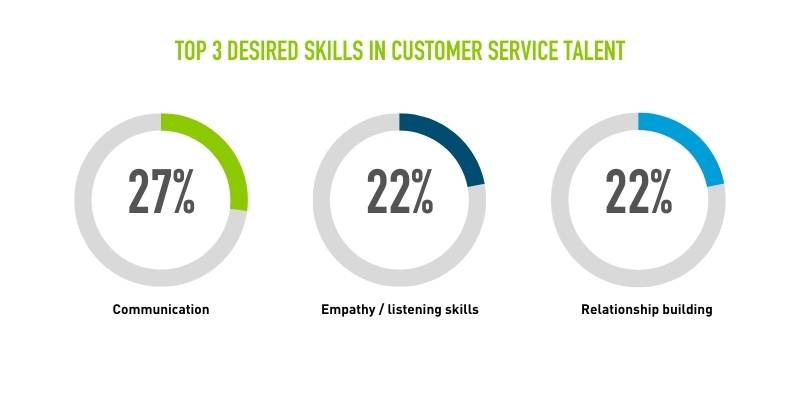
As customer expectations have changed, so have the skills needed for top customer service talent. We recently conducted a poll in which talent leaders indicated that soft skills related to emotional intelligence are highly sought after. 

The most desired skills for customer service recruiting are communication, empathy and relationship building.

We’ve worked with several of our clients to implement a culture-centric approach for attracting talent. Instead of assessing candidates based on previous work experience, we advise evaluating based on whether they possess the right skills, values and behaviors to be successful in the role. We’re reimagining interviews and assessments to be more focused on soft skills and purpose as we help talent leaders and hiring managers embrace candidates coming from outside of their industry.  

Trend 2: Expanding Talent Pools  

With job openings outnumbering job seekers, organizations across sectors find themselves getting creative as they try to expand their talent pool. For some, this means looking into new talent audiences, like underrepresented group or military veterans, and putting programs in place such as apprenticeships to future-proof their talent pipeline.  

For many companies, the growth of remote work means that they’re looking outside of their physical call center locations to candidates across the country and even expanding to new countries. This requires an adjustment to your talent acquisition strategy to ensure your employer brand and recruitment processes are ready to handle dispersed talent.  

Trend 3: Adapting to Remote Work 

Remote work is impacting more than just where talent comes from, it also affects how organizations onboard and engage their staff. As some countries are experiencing a cost-of-living crisis, customer service representatives are fielding queries from vulnerable customers which can be especially draining. Talent leaders are getting creative in how they connect with staff to ensure a sense of belonging and wellness—regardless of where the employee is working.  

Some contact centers have even adjusted their operational structure to work in “pods” which ensures agents—both in the office and remote—get the support they need to solve customer queries efficiently. Before, managers and team leads could walk around the call center floor and see when agents looked stressed. Remote working has made it harder to monitor employee wellbeing. Customer-focused leaders are investing in employee wellbeing, from training managers to catch the signs of burnout to offering wellbeing support programs.  

These are just a few of the labor market trends that are impacting how companies hire and engage talent. Clearly, organizations are finding creative and bold ways to invest in their employees to maintain a resilient and customer-focused workforce.  

9 STRATEGIES FOR SOLVING HIGH-VOLUME HIRING CHALLENGES

Strategies for Overcoming High-Volume Hiring Challenges

High-volume recruitment is one of the most demanding disciplines in talent acquisition. Whether you’re staffing a contact center, scaling a logistics network, preparing for a seasonal retail surge or maintaining a large healthcare workforce, the challenge is the same: hire large numbers of the right people, quickly, without letting quality slip or burning out your team. 

The organizations that do this well aren’t just working harder—they’re working differently. This guide explores the most common high-volume hiring challenges and the strategies that leading talent acquisition teams are using to overcome them. 

👉 Get our ebook: 9 Strategies for Solving High-Volume Hiring Challenges 

What is High-Volume Recruitment?

High-volume recruitment involves sourcing, screening, interviewing and hiring large numbers of candidates for similar openings or job types, often within compressed timeframes. It’s common across sectors including retail, hospitality, logistics, healthcare, contact centers, travel and government—and it requires a fundamentally different approach to talent acquisition than professional or specialist hiring.

The core tension in high-volume recruitment is speed versus quality. Move too slowly and candidates drop out or accept offers elsewhere. Move too fast without the right processes and you compromise on hire quality, driving up attrition and starting the cycle again. Getting this balance right—consistently, at scale—is what separates high-performing high-volume programs from those that are perpetually in firefighting mode.

The Biggest High-Volume Hiring Challenges—and How to Solve Them

Challenge 1: Candidate Drop-Off and Ghosting

Candidate drop-off—where applicants disengage partway through the process—and ghosting—where candidates simply stop responding or fail to show up—are among the most costly and frustrating problems in high-volume recruitment. When you’re processing hundreds or thousands of applications, even a modest drop-off rate translates into significant wasted effort and extended time-to-fill. 

The root cause is almost always the same: a process that moves too slowly, communicates too infrequently, or asks too much of candidates. Today’s high-volume candidates—many of whom are applying to multiple employers simultaneously—have limited tolerance for lengthy applications, long gaps between process stages or radio silence from recruiters. If a competitor makes an offer first, or the application simply feels like too much effort, they’ll move on. 

How to address it: 

Audit your application process ruthlessly. Every question that isn’t genuinely necessary to advance a candidate is a potential drop-off point. Streamline the process to capture only what’s needed at each stage, and reserve more detailed information gathering for later in the funnel when candidates are more committed. 

Look at where processes can be automated so that at every touchpoint—application confirmation, status updates, interview scheduling, offer—communication happens quickly and consistently. Candidates should never be left wondering where they stand. SMS and messaging tools are particularly effective in high-volume contexts, where candidates may not regularly check email. 

Reduce the time between process stages wherever possible. Speed is itself a candidate experience differentiator in high-volume markets. The organizations that move fastest tend to secure the best candidates. 

An RPO partner is particularly well-placed to address drop-off and ghosting. With dedicated volume recruiting expertise and access to the latest talent technology—AI-enabled CRM, automated scheduling, pipeline analytics—a high-volume RPO solution keeps candidates moving through your funnel efficiently while freeing your internal team from the administrative burden of managing large applicant volumes manually. 

Challenge 2: Maintaining Quality of Hire at Scale

Speed pressure in high-volume recruitment creates a persistent temptation to cut corners on assessment, like skipping interview stages, loosening criteria or defaulting to “warm body” hiring when vacancies feel urgent. The short-term relief this provides is almost always offset by higher attrition, lower performance and the cost of rehiring. 

The challenge is that traditional assessment approaches—often designed for professional or specialist hiring—don’t translate well to volume contexts. They’re too slow, too resource-intensive and often measure the wrong things. 

How to address it: 

Start by challenging the assumptions underpinning your current criteria. The skills and background that seem like obvious requirements for a role aren’t always the ones that predict success. At PeopleScout, when working with a high-volume RPO client struggling to hire for customer service roles, we interviewed their most successful customer-facing employees and found that prior customer service experience was not a predictor of performance, but problem-solving aptitude was. That insight expanded their talent pool significantly while improving quality of hire and reducing attrition. 

Redesign your candidate assessment to evaluate both hard and soft skills efficiently. For high-volume roles, soft skills, like attitude, adaptability, work ethic and communication style, are often the stronger predictors of success and retention. PeopleScout’s 1XP assessment model is built specifically for high-volume contexts, helping organizations evaluate what actually matters without adding time to the process. 

Structured, consistent assessments also reduce bias and support diversity hiring goals—an important consideration for high-volume programs that are often the largest source of diverse talent entry points into an organization. 

Challenge 3: Recruiter and Hiring Manager Burnout

High-volume hiring puts enormous pressure on internal teams. When recruitment processes are inefficient, hiring managers are pulled into administrative tasks they’re not equipped or resourced for—screening resumes and CVs, chasing candidates, coordinating interviews—on top of their day jobs. Recruiters managing large requisition loads without adequate technology quickly reach a point where quality suffers simply because there aren’t enough hours. 

This is a structural problem, not a motivation problem. Asking people to work harder within a broken process doesn’t fix it. 

How to address it: 

Identify which parts of your recruitment process are consuming the most recruiter and hiring manager time and ask whether they can be streamlined. Scheduling, application screening, reference verification and background checks are all areas where automation or RPO support can dramatically reduce the administrative burden on your team—without compromising candidate experience. 

Modular RPO solutions can also help you augment your internal team. By selectively outsourcing specific components of your hiring process, you allow an RPO partner to absorb the volume-intensive elements so your recruiters and hiring managers can focus on the decisions and interactions that genuinely require time and attention. This isn’t just about capacity—it’s about directing your internal resources toward the highest-value parts of the hiring process.

Challenge 4: Scaling Up and Down for Seasonal Demand

Many high-volume hiring programs aren’t steady-state—they spike. Retail ramps up for peak trading periods. Hospitality and travel scale dramatically for summer or holiday seasons. Tax and financial services see surges at predictable points in the year. Building and then dismantling a large internal recruitment team to match these peaks is expensive, inefficient and disruptive. 

How to address it: 

Build scalability into your recruitment model rather than treating it as an emergency response. This means establishing talent pipelines and candidate communities year-round—not just when the hiring surge hits—so you’re converting warm candidates rather than starting from scratch each season. 

RPO partnerships are particularly well-suited to seasonal high-volume programs because the engagement model is designed to flex. A high-volume RPO partner can scale delivery resources up or down in line with your hiring calendar, providing a consistent, experienced recruiting team without the overhead of permanent headcount. 

Why RPO is the Right Solution for High-Volume Hiring 

Most high-volume hiring challenges share a common root: a recruitment model built for normal hiring volumes, stretched beyond what it can reliably deliver. Bolt-on fixes—an extra job board, a temporary agency, an additional internal recruiter—rarely address the underlying process and technology gaps that are driving the problem. 

Recruitment process outsourcing is designed specifically to address this. A high-volume RPO partner brings: 

  • Purpose-built processes for high-volume contexts, designed around candidate behavior, dropout patterns and assessment approaches that work at scale 
  • Talent technology that organizations often can’t justify building or buying independently including AI-powered sourcing, automated candidate engagement, predictive analytics and pipeline reporting 
  • Dedicated recruiting expertise that your internal team can draw on without having to build and maintain the capability in-house 
  • Scalable delivery that flexes with your hiring calendar rather than forcing you to over- or under-resource for predictable peaks 
  • Talent advisory capabilities like employer branding, recruitment marketing and assessment design, that address the upstream factors affecting your ability to attract and convert candidates at scale 

PeopleScout’s high-volume RPO solution is purpose-built for organizations managing large-scale, fast-paced hiring programs across retail, hospitality, logistics, healthcare and beyond. 

👉 Explore PeopleScout’s high-volume RPO solution  

👉 Get our ebook: 9 Strategies for Solving High-Volume Hiring Challenges 

9 Strategies for Solving High-Volume Hiring Challenges

9 Strategies for Solving High-Volume Hiring Challenges

Competition for hourly talent is steep, with high demand from call centers, hospitality, retail, security, travel, logistics, healthcare and even government entities. In fact, 65% of companies have high-volume recruitment needs.

Talent acquisition leaders are facing the most tumultuous job market in recent memory with an impossible combination of soaring job openings and a labor shortage.

  • So, how do they compete for hourly talent when the competition is so fierce?
  • And how can they prepare for seasonal peaks?
  • More importantly, how can they increase speed without sacrificing on quality-of-hire?

Download our ebook to learn 9 Strategies for Solving High-Volume Hiring Challenges. It’s a must-read for any talent acquisition team focused on solving critical problems in their high-volume hiring programs.

Seasonal Hiring: How RPO can Help You Better Source and Hire Seasonal Workers 

Hiring seasonal workers is essential for employers in need of extra talent during the holiday season. If your organization depends on seasonal hiring to augment your workforce, it is vital to efficiently source, recruit, and onboard your seasonal hires to ensure you are staffed during the holidays.

Without a well-designed seasonal hiring program in place, employers risk going understaffed for the holidays, or for other times of the year when a business reaches a peak. In this article, we will walk through how an RPO provider can help you hire talent for the holidays and equip you with tips on building a seasonal hiring pipeline.

What is a Seasonal Worker?

hiring seasonal workers

A seasonal worker or employee is a worker who works for a short period to meet seasonal peaks in demand for an employer. This might coincide with weather seasons or with holiday seasons.

Employers that use seasonal hires typically need assistance at the same time each year, for example as lifeguards or lawn care workers in the summer or ski instructors or snowplow drivers in the winter. When hiring seasonal workers, you can hire them on a part-time or full-time basis depending on your needs.

ebook

9 Strategies for Solving High-Volume Hiring Challenges

What are the Benefits of Hiring Seasonal Workers?

If your organization experiences seasonal peaks in demand, hiring seasonal workers can be a good solution for staffing issues. Here are some of the benefits:

Extra Hands When You Need Them: When a business reaches its peak season, seasonal workers provide you that extra help fast when you need it, without the expense and time of hiring full-time staff.

Assist Full-Time Staff: Your seasonal employees can help alleviate the load carried by your full-time employees. This can improve morale for your permanent workforce because they have the support they need during peak times.

Low Risk: When you hire a permanent employee, you don’t always know if they’ll be a good fit for the job. Seasonal employees are only hired for a short period. If they aren’t a good fit, you have only made a minimal investment.

Potential full-time employee: On the other hand, if you hire a seasonal employee who works out well, you might be able to offer them a permanent position when one becomes available. It’s a trial run that works as a recruiting method for permanent positions.

Better Seasonal Hiring Begins with Crafting Better Job Descriptions

seasonal hiring

Writing job descriptions for seasonal positions is different from temporary, full- and part-time roles. It is important that your job descriptions accurately reflect the nature of your open positions, so candidates know ahead of time if they should apply.

For example, many seasonal roles are in a warehouse and logistics setting and may require candidates to work in a more physically demanding environment. Major retailers and logistics companies are in serious need of seasonal logistics workers with Walmart looking to fill 20,000 logistics roles while UPS, Kohl’s and Target are in need of 100,000 seasonal warehouse hires each.

To better understand the nature of the seasonal jobs for which you are writing job descriptions consider spending time shadowing workers in the relevant seasonal positions. What’s more, COVID-19 has made many employers became more familiar with video interviewing, however, the idea of leveraging videos to enhance your employment marketing and employer branding is sometimes overlooked.  

Job descriptions can be bolstered with video. A seasonal job posting could include a short video of a hiring manager describing the job and what they are looking for in a seasonal hire. Your video can even include examples of workers performing the most common tasks required to give candidates an accurate idea of the work involved.

How RPO Can Help

RPO providers can help employers conceive of and create a talent attraction strategy that considers both the needs of employers and seasonal hires through a data-driven approach to talent advisory and recruitment marketing making you a seasonal employer of choice.

Sourcing Seasonal Hires

Recruiting seasonal employees begins with mining a verdant source of seasonal workers. Employers should look for candidates such as students and other demographic looking for short-term employment opportunities. For example, recruiting recent graduates who are taking time to figure out what they want to do long-term is one way of sourcing seasonal talent. Often, these candidates prefer the temporary nature of seasonal work compared to a longer-term commitment.

Moreover, hiring candidates with a seasonal work mindset can help you keep them around for the full season or even retain them for next year.

When sourcing seasonal workers, look to hire people who want seasonal work including

  • Retired workers
  • Workers looking for extra work during the holidays
  • Stay-at-home parents who want to work while their kids are in school
  • Students who are on holiday break

How RPO Can Help

Many RPO providers have talent pools and networks they can tap into to source the right candidates for seasonal positions. RPOs also have experience building talent pipelines from the ground up and can assist employers in creating a sustainable seasonal hiring program that delivers year-in-year-out.

RPO partners also offer technology expertise to help you track, measure and optimize your seasonal hiring campaign by showing which channels and recruitment marketing messages are yielding the best candidates. They can help you with recruitment analytics so you can see your recruitment funnel at all your sites in a centralize dashboard.

Managing High-Volume While Hiring Seasonal Workers

seasonal hires

Many employers in need of seasonal hires require a large volume of talent to keep up with peak demand. High-volume hiring at its heart is a problem of scale which requires optimizing your time and recruiting spend. Recruitment automation can help you reduce the manual workload on your recruiting team and hiring managers while keeping your visibility on all of the candidates progressing through different stages of the interview process. Automating certain steps, such as screening and triggering assessments, allows recruiters to focus their time on higher-value, strategic work.

How RPO Can Help

An HR outsourcing solution such as RPO provides employers the ability to scale up seamlessly as seasonal hiring demands shift. With an internal talent acquisition team, it may be difficult to scale up hiring quickly enough to handle a higher number of hires and then scale back down when hiring volumes shrink.  What’s more, recruitment technology platforms such as PeopleScout’s Affinix® can help you automate your recruitment program and create great high-volume hiring efficiency.

Never Neglect Your End of-Season Plans

How you end a relationship with seasonal hires can help with next season’s hiring. Here are a few things to keep in mind at the end of the season:

  • Availability: Ask outgoing seasonal employees if they would be interested in returning next season. Some workers design their needs and lifestyle around managing seasonal and temporary jobs, and they may be looking for another opportunity next year.
  • Exit interviews: To learn from successes and drawbacks, hold exit interviews with seasonal employees, regardless of how long they worked with you. Having informative feedback can help streamline next year’s efforts.
  • Permanent talent: Tempting as it may be, you likely won’t have the means or the resources to bring every seasonal employee on full-time. However, keep an eye on exceptional workers whose mix of soft skills and talent would be excellent fit as vacancies come open during other parts of the year.

How RPO Can Help

An RPO provider can help organize your offboarding efforts at the end of the season by assisting in exit interviews, managing your seasonal worker database as well as hiring top performers to permanent positions. An RPO provider’s ability to scale down engagements quickly means the process can be seamlessly executed so that you can resume business as usual.

Are You in Need of a Seasonal Hiring Partner?

seasonal worker

When it comes to maintaining your seasonal operations and providing excellent customer service during your peak months, hiring seasonal employees can help keep your business moving.

Whether you are in need of seasonal recruiting or a permanent talent solution, employers in our new world of work face rising recruitment challenges. An outsourced recruitment solution like PeopleScout’s high-volume RPO and Total Workforce Solutions can help you stay connected with talent and provide hiring resources that will add immediate value to your talent programs.

Maersk: Making Waves with a Global Employer Brand

Maersk: Making Waves with a Global Employer Brand

Maersk: Making Waves with a Global Employer Brand

Maersk, a global shipping company, came to PeopleScout for a talent advisory solution that would deliver on a diverse and digital-forward new global employer brand.

Situation

Think Maersk and you think container ships. Steel giants criss-crossing the oceans. You probably think dependable and trustworthy, but slow moving. What you don’t think of is digital trailblazer. But, when they came to us, that was precisely their goal.

Already leaders in global shipping, the Maersk group was about to undertake a huge transformation to take them to the next level of their business strategy. Their vision was to become a global integrator of container logistics and digitalization of the business was at the core of this big move. Maersk no longer wanted to be seen as a shipping company; they wanted to be seen as a leader in technology.

The issue was that they didn’t have the world-class capabilities in the business to fuel this tech revolution.

The brief: create an employer brand that:

  • Made transportation and logistics attractive to global talent in a way it hadn’t been before – competing with the likes of Microsoft and Amazon.
  • Attract diverse candidates (especially STEM and digital) with the innovative mindset to bring radical change.
  • Change perceptions of the Maersk Group away from solid, slow and paternalistic to dynamic and pioneering.

Solution

RESEARCH

The insight phase was intensive.

Understanding the organization, the many and varied brands, the core business areas, its people and the nuances across the globe was highly complex. It was also the key to creating an employer value proposition (EVP) that would turn heads among non-traditional candidates.

We ran a very diverse, in-depth and international series of focus groups and one-on-one interviews across the group and externally.

This allowed us to:

  • Understand the views and vision of senior leaders within the business.
  • Gain deep insights into the lived experience of professionals at various managerial, technical and operation levels.
  • Map the competitor talent market to identify specific territories that Maersk could own with regards to its proposition and messaging.
  • Develop a set of core messaging pillars that we validated with senior stakeholders across the globe before developing our EVP and recruitment communications campaigns.

THE CORE MESSAGE

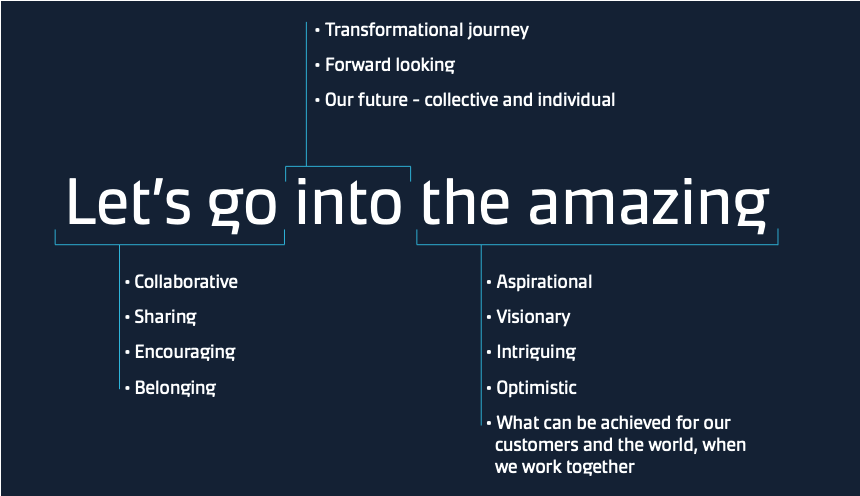
Our EVP message aimed to inspire, motivate and challenge employees and candidates to be part of a career-defi ning, once-in-a-generation transformation. The result is an invitation and a two-way commitment striking the kind of pioneering, adventurous and fast-moving note that you simply wouldn’t expect from a business like Maersk. It also gave us a platform to tell stories that capture hearts as well as minds.

EVP message: Let’s go into the amazing

INTERNATIONAL RESONANCE

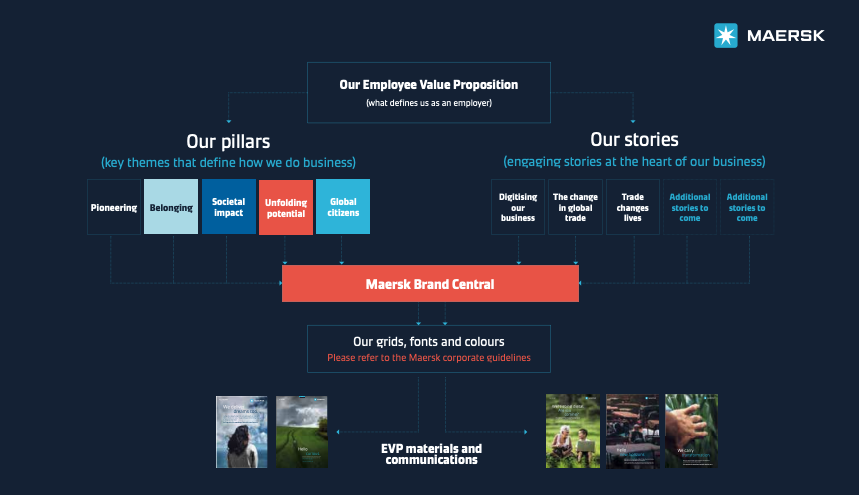
Because our audiences were very diverse and located all over the world, we created a series of five messaging pillars. Drawn from the key insights gained at the research stage, these pillars allowed our brand messaging to be flexed in order to speak to the motivations of individuals and talent groups all across the globe.

THE PILLARS

Pioneering
Candidate offer: Seize every new opportunity, pursue every experience and never be afraid to be the first.

Belonging
Candidate offer: Be open, be curious and bring your whole self to work.

Societal impact
Candidate offer: This isn’t just about the part you play in our business, it’s about the change you can make in our world.

Unfolding potential
Candidate offer: Jump in wholeheartedly and we’ll support and invest in you to be your very best.

Global citizens
Candidate offer: Broaden your horizons and make the world your workplace.

KEEPING IT ROBUST

Inspiring EVPs need strong foundations to stay inspiring. This is how the architecture of the Maersk employer brand all fits together.

MAKING IT REAL

This is how we took each of the pillars and turned it into a candidate-facing advertisement.

The Outcome

It’s still early days, but in the latest employer brand benchmarking, Maersk was delighted to see the impact the work was already having. A key measure is its ranking in The Most Attractive Employers List produced by Universum.

Maersk has seen its ranking improve. Our goal is to continue this momentum in each of the key markets and among each of the key talent segments.


At a Glance

  • COMPANY
    Maersk
  • INDUSTRY
    Transportation & Logistics
  • PEOPLESCOUT SOLUTIONS
    Talent Advisory
  • LOCATIONS
    Global with priority markets in India, the UK and Denmark
  • ABOUT MAERSK
    With locations in every port in the world, Maersk is one of the largest container shipping line and vessel operators in the world.