Global RPO

PeopleScout Global & Multi-Country RPO Solutions

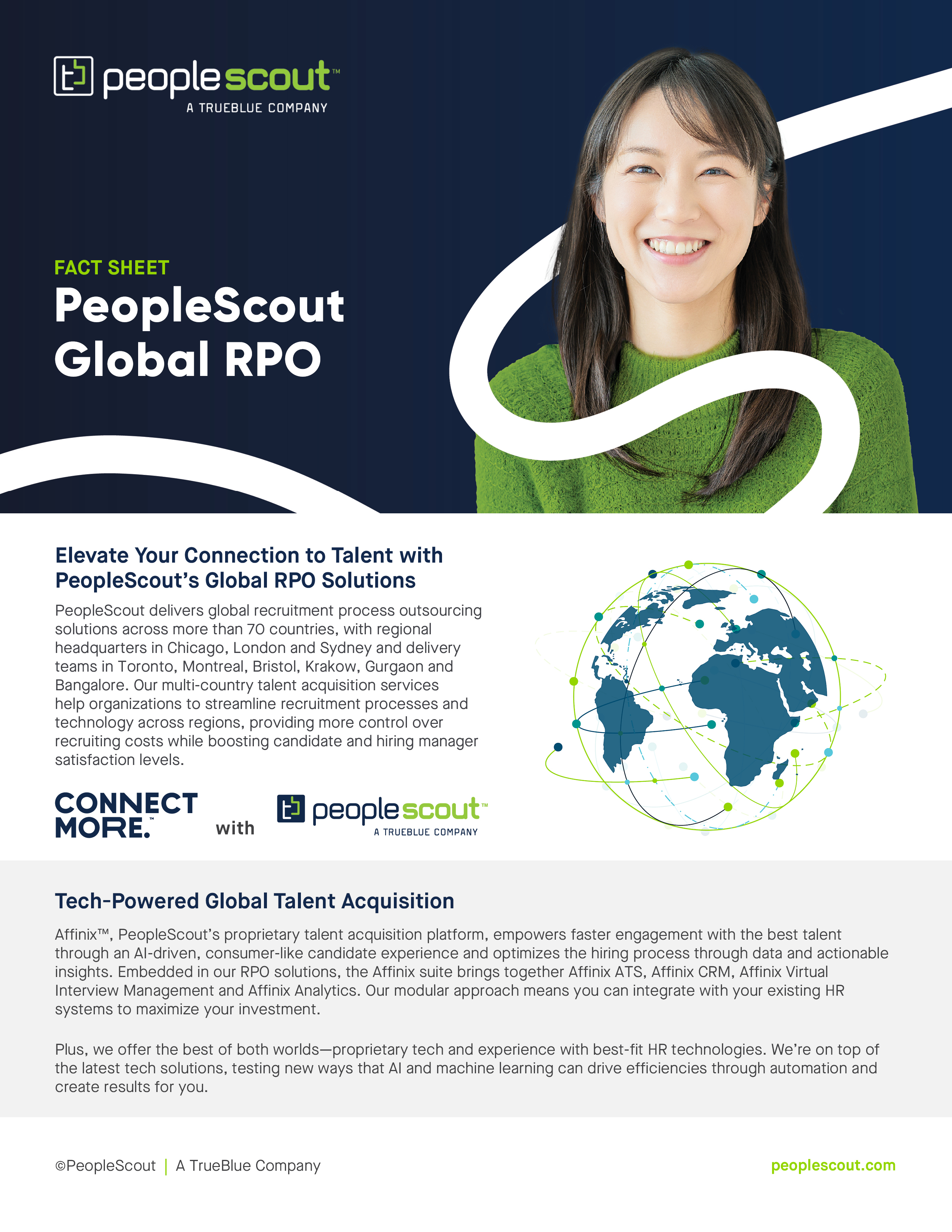
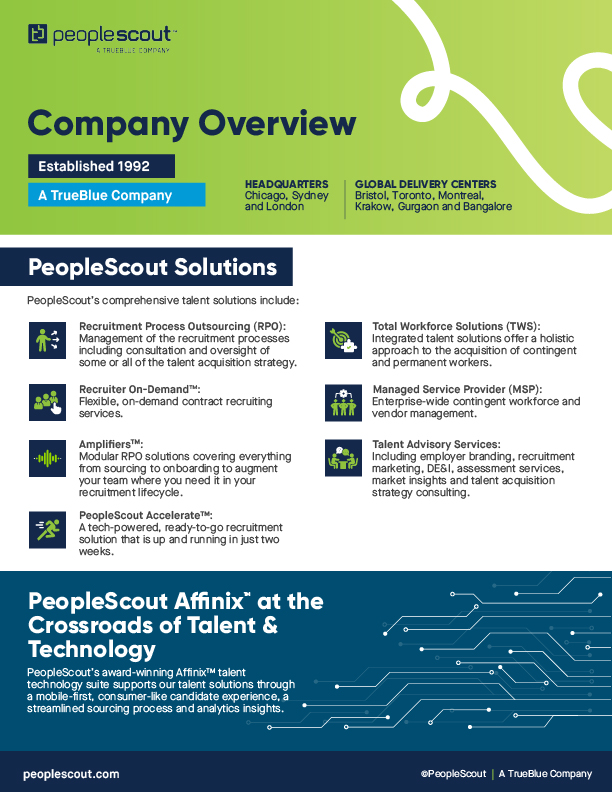
PeopleScout’s global RPO solutions help organizations to streamline recruitment processes and technology across regions, providing more control over global recruiting costs.

Download this fact sheet to learn more about our global RPO solutions.

Learn more about PeopleScout global RPO capabilities.

Dig into More Global Talent Insights

Ultimate Recruitment Process Outsourcing Toolkit
Toolkit

Ultimate Recruitment Process Outsourcing Toolkit

Our complete six-piece toolkit gives you the essential information on how RPO can boost your recruitment outcomes.

Recruitment Process Outsourcing (RPO) Buyer’s Guide
Buyer’s Guide

Recruitment Process Outsourcing (RPO) Buyer’s Guide

Check out this in-depth exploration of RPO and how it can help you achieve your recruitment goals.

Global Hiring and Labor Market Trends Affecting Recruitment in APAC 
Article

Global Hiring and Labor Market Trends Affecting Recruitment in APAC 

Check out these labor market trends in APAC and their effect on talent acquisition in the region.

High-Volume RPO

PeopleScout High-Volume RPO

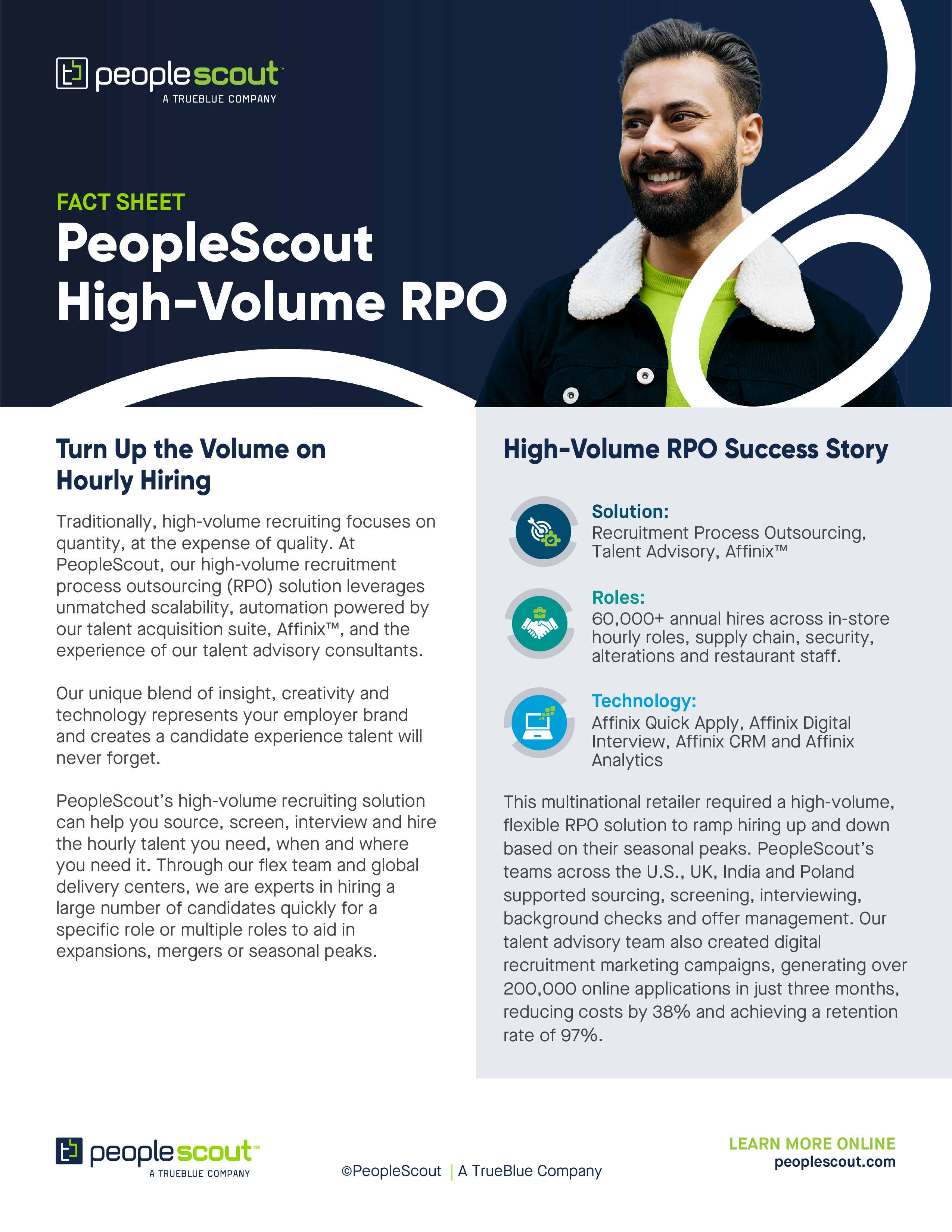
Traditionally, high-volume recruiting focuses on quantity, at the expense of quality. At PeopleScout, our high-volume recruitment process outsourcing (RPO) solution leverages unmatched scalability, the automation of our talent acquisition suite, Affinix®, and the experience of our talent advisory consultants.

Download this fact sheet to learn more about our high-volume RPO solutions.

Learn more about PeopleScout’s high-volume RPO capabilities.

Dig into More Talent Insights

Strategies for Overcoming High-Volume Hiring Challenges
Article

Strategies for Overcoming High-Volume Hiring Challenges

Explore the top challenges of high-volume recruitment and some ideas to address them.

9 Strategies for Solving High-Volume Hiring Challenges
Ebook

9 Strategies for Solving High-Volume Hiring Challenges

A must-read for any talent acquisition leader focused on solving critical problems in high-volume hiring programs.

High-Volume Hiring in the Contact Center: 3 Challenges and How to Tackle Them
Article

High-Volume Hiring in the Contact Center: 3 Challenges and How to Tackle Them

Here are three top high-volume recruitment challenges in the contact center and tips for overcoming them.

What is Recruitment Process Outsourcing?

So, what is recruitment process outsourcing (RPO), and why should companies use it? RPO can boost your talent acquisition by optimizing processes amid fierce competition. Whether you’re exploring RPO or want to learn more about maximizing it, this guide will provide valuable insights. Understand how partnering with an RPO can boost your talent acquisition outcomes.

This overview explains RPO, answering common questions, including:

  • How RPO works
  • Types of RPO
  • The benefits of outsourcing recruitment
  • What to look for when selecting an RPO partner

👉 Get our RPO buyer’s guide.

What is Recruitment Process Outsourcing?

Recruitment process outsourcing (RPO) is a type of business process outsourcing (BPO) in which an external organization (RPO provider) supports an employer’s talent acquisition function by assuming responsibility for some or all facets of the talent acquisition function to support some or all of an employer’s hiring needs.

For example, an RPO engagement may only cover sourcing and screening candidates (partial-cycle RPO) or it may cover the entire recruitment lifecycle from receiving hiring manager’s requisitions all the way to presenting and negotiating job offers to candidates (full-cycle RPO). An RPO provider works closely with an organization’s internal talent acquisition team, either remotely or on-site.

Why Do Companies Choose to Outsource Recruitment?

Below, we highlight a few high-level reasons why organizations seek RPO providers, and conversely, when RPO may not be a good fit:

REASONS TO ENGAGE AN RPO PROVIDER:

  • If your organization is looking for more speed, agility and flexibility in your recruiting processes
  • If you are looking to improve the quality of candidates applying to your positions or struggle to attract the right talent
  • If your organization is looking for a more cost-effective and standardized recruiting process
  • If your organization’s current use of recruitment technology isn’t up to par and you are seeking a variety of digital upgrades specific to your organization’s recruiting objectives
  • If your organization is looking to increase diversity hiring, RPO providers can help you uncover new diverse talent recruitment sources and strategies
talent recruitment

REASONS NOT TO ENGAGE AN RPO PROVIDER:

  • If your company culture is not ready for outsourcing talent recruitment
  • If you just need a vendor to fill a quick requisition or two as opposed to a partner to support your talent acquisition strategy
  • If your organization isn’t open to optimizing your recruiting processes and tech stack

Remember, these reasons are not set in stone. Only you and your organization can assess if you are in need of an RPO partner’s services. An RPO partner should customize their solution to match your needs and offer flexible options to support for peak hiring, hard-to-fill positions, compressed time frames and more—however it works best for you.

👉 Are you Ready for RPO? Ask Yourself These Three Questions.

How Does RPO Work?

During an RPO engagement, the RPO provider’s team works closely with their client’s talent acquisition team and hiring managers to learn the organization’s long-term talent acquisition strategy, hiring challenges and goals.

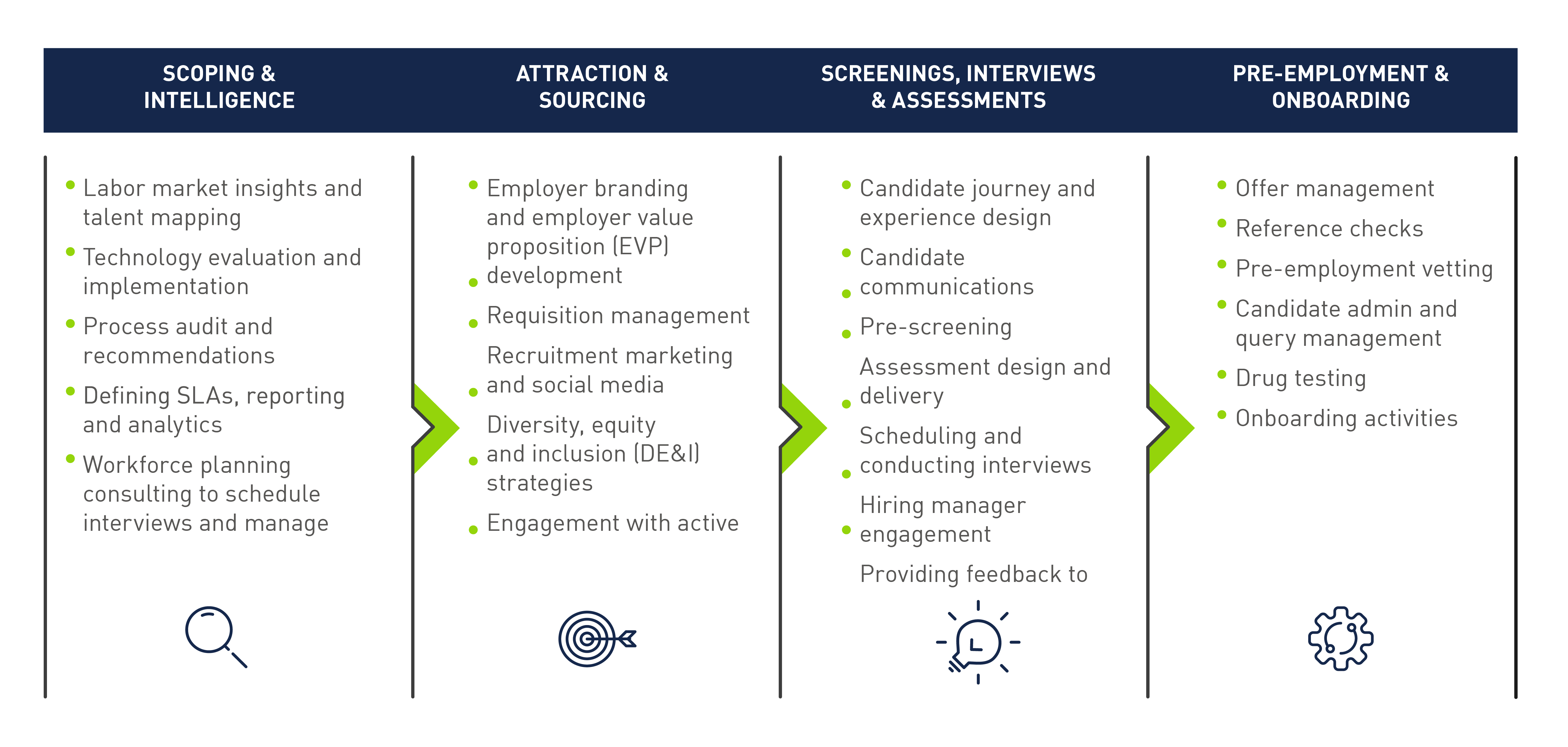
The RPO provider then designs a customized recruiting program tailored to support the client’s specific needs. RPO is not a one-size-fits-all solution. A leading RPO partner will customize its service to match your requirements, which could include any or all of the following talent acquisition activities:

RPO Process

👉 Learn more about what to expect in an RPO partnership.

What is the Difference Between an RPO Provider and a Staffing Agency?

An RPO provider is distinct from a staffing agency or headhunter. Staffing agencies identify candidates, obtain their résumés or CVs and submit them to the client.

An RPO partnership brings a higher level of engagement. Your RPO provider will do a deep dive into your talent acquisition goals and challenges and then create and execute a customized recruitment program—and report back on the results. An RPO partner is a trusted advisor who can help you gain agility and future-proof your business.

👉 Learn the top differences between an RPO and a staffing agency.

What are the Types of RPO Models?

Designed for flexibility, RPO can be customized to meet your needs. Fully outsourcing recruitment may not make sense for all organizations. But that doesn’t mean RPO won’t provide value if you’re not ready to go all in. RPO teams are often used alongside existing in-house recruitment teams. The RPO can complement your current recruitment program by handling recruiting for specific job groups, locations or business units.

Here are various types of RPO that are commonly available:

Full-Cycle RPO

The RPO partner owns the entire recruitment cycle from opening requisitions all the way to presenting and negotiating the job offer—and all activities in between. This solution offers the client the full benefit of the RPO partner’s expertise which most organizations don’t have in-house, including value-added services like market insights, recruitment technology and employer brand consulting.

Partial Cycle RPO

The RPO partner covers certain parts of the recruitment process to boost internal recruitment resources. For example, the RPO partner might source and screen candidates and then hand them over to the in-house recruitment team to schedule interviews and manage offers.

Recruiter On-Demand

Recruiter On-Demand engagements are typically fixed-term contracts meant to address specific recruitment challenges such as seasonal hiring peaks, hard-to-fill positions, compressed timeframes and more. The RPO is there to augment the in-house team, often due to rapid growth. These engagements kick off quickly, and the required positions are filled within a few months.

👉 Learn more about recruiter on-demand.

Modular RPO

Modular RPO, or variable RPO, is a strategic approach to managing the recruitment process in an ultra-focused manner. It involves outsourcing specific components of the recruitment process to an RPO provider, or as a supplement to an existing outsourced recruitment engagement, providing quick access to targeted and customized recruitment support. With a modular or à la carte approach, you choose from a range of services based on your requirements.

👉 Learn more about modular RPO.

High-Volume RPO

High-volume RPO involves sourcing, screening, interviewing and hiring large numbers of applicants for similar openings or job types. It requires a tricky balance of keeping substantial quantities of job applicants moving through the recruitment process at speed. Plus, throughout the year it requires talent acquisition teams to scale up quickly to meet seasonal demand, like for holiday shopping periods or during peak travel times.

👉 Learn how to overcome high-volume hiring challenges.

Recruitment Cost Per Hire

What are the Benefits of RPO?

Now that you can answer the question, “What is recruitment process outsourcing?”, you may be wondering why organizations engage an RPO provider. Partnering with an experienced RPO gives you access to extensive recruitment knowledge across industries, roles and regions. RPOs have managed every type of hiring campaign imaginable. Whether you need help with one function or end-to-end recruiting, RPO offers advantages including:

Minimize Costs

Every day a role goes unfilled, your organization loses productivity, which can lead to losses in revenue and profits. Plus, inefficiencies in your organization’s hiring processes can result in lost revenue and more hours spent recruiting. And, if your organization hires the wrong person, you’ll spend even more time and money recruiting and training a replacement for the bad hire. By streamlining and optimizing recruitment processes, improving the time-to-hire and retention rates, RPO providers can increase your recruiting return on investment and deliver real cost savings to your bottom line. In fact, Everest Group states that organizations can expect a 45% to 55% annual savings with RPO compared to in-house recruitment.

Access Higher Quality Talent Faster

As skills shortages and talent scarcity becomes more challenging, having an RPO team digging into passive sourcing to access niche skills sets will boost time to hire and improve quality-of-hire. RPO providers leverage their comprehensive talent networks and effective screening and assessment tools to produce stronger candidates and more diverse talent pools. This keeps hiring managers happy and helps your organization achieve its goals.

Agility & Scalability

A leading RPO provider should flex to meet your requirements. Your organization can scale the amount of work your RPO provider performs to better manage your recruitment cost-per-hire goals and recruiting budget. When you have an increased demand for talent, an RPO provider can promptly scale up your team of dedicated recruiters to keep on top of your increased demands. This works the other way around as well: when there is less demand, we can scale down, saving you recruitment spend, and you avoid layoffs in your talent acquisition team during low demand periods.

Enhanced Candidate Experience

You want your recruitment process to leave every applicant, regardless of whether they get the job, with a positive experience. Your RPO partner can advise on ways to improve the candidate experience including career site audits, job application recommendations and how to leverage technology to speed up the process and reduce friction.

👉 Get Inside the Candidate Experience with our exclusive research report.

Best-Fit Technology

RPO providers can help you implement technology solutions that balance human expertise with automation. RPO partners have expertise with platforms across the HR and talent acquisition tech ecosystem and can make recommendations to help you attract and engage talent more effectively. PeopleScout’s total talent suite, Affinix® proprietary total talent suite of AI-powered tools, connecting applicant tracking, candidate relationship management, recruitment marketing, digital interviewing and talent analytics.

Access More Expertise

Partnering with an RPO means you gain important talent acquisition expertise without having to invest in internal resources. RPO partners have developed a depth and breadth of experience from working across many clients, industries, job types and regions. While they offer recruitment sourcing best practices, they also offer value-added services that will optimize and streamline each phase of the recruiting process like employer branding, recruitment marketing, skills assessment, market insights, specialist sourcing solutions and more.

Improve Diversity

Through experience collected over many client engagements, RPO teams are knowledgeable about different talent attraction options and can help you expand to new job boards, social media groups, online forums and events to engage a more diverse workforce. Plus, RPOs understand the regional nuances of DE&I issues. For example, in some countries like Poland, it is not legal to ask candidates their ethnicity, gender, etc.

Workforce Planning Strategy

Leading RPO providers can provide labor market insights, talent intelligence and benchmarking data. With access to these insights, you have the data you need to support your workforce strategy as well as tactical business decisions. You can capitalize on the latest market analysis, thought leadership and competitive intelligence to inform your talent strategy. Your RPO partner can provide analytics to help you understand what’s working so you can maximize your ROI.

Global Reach

Leading organizations are taking a much more holistic view of the talent landscape and are looking for ways to standardize across regions. Working with a single partner for multi-country RPO eliminates the need for multiple relationships and saves time and money—while raising the quality of your hires. An RPO provider can be your most valuable partner in global expansion, because they bring a wealth of knowledge and experience gained through working with clients in different industries around the world.

Seamless Compliance

A significant aspect of recruiting is dealing with the multitude of compliance requirements that vary by jurisdiction. Your partner should help you navigate the labor laws and compliance issues that accompany any sourcing program. An RPO provider’s rigorous processes ensure a legally compliant hiring process and streamlined responses to audits. Additionally, a partner can help you anticipate any communication and training issues so that you can tackle them head-on.

The RPO Market: What Organizations Need to Know

Recruitment process outsourcing has grown from a cost-cutting measure into a strategic talent capability. As organizations face increasingly complex hiring challenges—growing skills gaps, rising pressure to door more with less and accelerate growth—demand for sophisticated RPO partnerships has grown alongside them. 

Today, the global RPO market is one of the fastest-growing segments of the human resources outsourcing industry, with analysts consistently projecting strong year-on-year expansion. Independent research firms including Everest Group and NelsonHall—who publish widely cited annual assessments of the RPO landscape—point to technology innovation, the rise of flexible engagement models, and expansion into new geographies as the primary drivers of that growth. 

What Separates Enterprise RPO Providers from the Rest 

Not all RPO providers operate at the same level. The market ranges from niche, single-market recruiting firms to large, globally integrated RPO organizations capable of managing complex, multi-country talent programs at scale. When evaluating the market, a few key differentiators tend to separate leading providers from the rest: 

  • Global delivery infrastructure: Enterprise-grade RPO providers maintain in-market teams and established sourcing networks across multiple regions—not just the ability to recruit internationally, but genuine expertise in various labor markets, compliance requirements and candidate behavior across geographies.
  • Proprietary technology: The strongest providers invest in their own talent acquisition technology rather than relying solely on third-party tools. Proprietary platforms—particularly those incorporating AI-powered sourcing, digital interview tools and analytics—give clients a meaningful competitive advantage in attracting and identifying talent. 
  • In-house talent advisory capability: Leading RPO providers go beyond filling roles. They offer integrated talent advisory services—employer branding, recruitment marketing, candidate assessment design, tech consulting and market intelligence—delivered by in-house specialists rather than outsourced to external agencies. 
  • Flexible engagement models: The shift away from rigid, full-cycle contracts toward modular and project-based RPO is one of the most significant market trends of recent years. Providers who offer genuine flexibility—allowing clients to outsource specific components of their hiring process rather than all of it—are better positioned to meet the varied and evolving needs of modern organizations. 
  • Sector depth: Hiring a nurse requires different sourcing strategies, compliance knowledge and candidate experience design than hiring a software engineer or a logistics operative. RPO providers with deep, demonstrable expertise across multiple industries and role types are better equipped to deliver quality outcomes across a complex hiring portfolio. 

👉 Think only large companies can benefit from RPO? Think again! Learn more about PeopleScout’s talent solutions for small- to mid-sized companies.  

How the Market Has Evolved 

The RPO model has changed significantly over the past decade. Early RPO engagements were largely transactional—a way to reduce cost-per-hire by outsourcing volume recruiting to a lower-cost delivery model. That framing has largely given way to something more strategic. 

The widespread adoption of AI and technology in recruitment has been a particular catalyst. Today’s leading RPO providers use AI not just to screen résumés and CVs faster, but to predict candidate quality, identify sourcing channels likely to yield diverse talent pools, personalize the candidate experience at scale and deliver analytics that inform talent strategy decisions well beyond the immediate hiring cycle. 

The growth of total workforce solutions—combining RPO for permanent hiring with managed service provider (MSP) programs for contingent workforce management—reflects a broader shift toward integrated talent partnerships. Organizations increasingly want a single, accountable partner who understands the full picture of their workforce, rather than separate vendors managing different pieces of it. 

👉 Learn how PeopleScout’s approach to RPO has evolved with the market. 

What Should I Look for in an RPO Company?

If you’ve decided that RPO will be a good fit for your organization, you may be wondering how you go about choosing the best provider. Here are just three things to consider in order to make RPO a truly transformational model for your business.

Partnership

The best RPO partners understand that each company has unique needs. Look for an RPO partner that is collaborative, that will listen to your ideas and take the time to truly understand your business and pain points. Avoid providers with a one-size-fits-all approach. The right partner balances consistency with customization.

At PeopleScout, for 30 years we’ve built our services on integrity. We won’t say one thing during the sales pitch only to reset expectations after the ink is dry. We won’t make you comply with a cookie-cutter recruitment process. If we mess up, we’ll make it right. That’s why we have some of the longest running client relationships in the RPO space. 

Talent Advisory Solutions

A strong employer brand is key to recruitment success. The right RPO partner offers talent advisory solutions to develop your employer brand, EVP, recruitment marketing approaches, candidate assessments and more.

Companies often use separate agencies for recruitment marketing and RPO. This siloed approach means less accountability. The agency is less likely to be held accountable for their campaigns leading to high quality candidates entering later candidate journey stages. On the other side, the RPO partner has limited means to provide feedback on the campaigns and the impact the ads have on recruitment outcomes.

Look for an RPO with in-house expertise (not one who outsources to an external agency) to consult on your entire talent program, not just filling roles. A holistic approach attracts and hires quality candidates.

At PeopleScout, our talent advisory team is one of the largest in-house teams in the industry—and we never outsource it. From organizational psychologists and creatives to strategists and technologists, our team consults on your full talent program: employer brand, EVP, recruitment marketing, candidate assessment design, DEI strategy and market intelligence. Because it’s all under one roof, your recruitment campaigns are directly connected to your hiring outcomes—with one accountable partner across the whole journey.

👉 Debunk common RPO myths.

Talent Acquisition Technology

HR tech is rapidly evolving, and RPO partners are well positioned to advise on tools like AI and analytics to improve recruiting. Your RPO partner should offer expertise on talent tech. Others have their own proprietary talent acquisition platforms. Look for an RPO partner who will support a modular approach, so you can continue to benefit from existing investments and grow your recruitment tech stack as your needs change.

PeopleScout’s proprietary Affinix® talent technology suite is built specifically for talent acquisition and powered by AI and machine learning. Affinix integrates with your existing ATS and HRIS, so you keep the investments you’ve already made while gaining access to capabilities—AI-driven sourcing, analytics, candidate experience tools—that most organizations couldn’t build in-house. And because we take a modular approach to technology just as we do to RPO itself, your tech stack can evolve as your needs change.

talent acquisition recruiter

What is Recruitment Process Outsourcing? The Keys to RPO Success

The most important key to successfully engaging an RPO provider for services is to have a clear understanding of what your organization is trying to achieve. Then, you can choose an RPO provider that best meets your needs.

One thing to keep in mind on your RPO journey: RPO engagements are not only about outsourcing your recruiting, they are also about finding the best partner to help manage the people, process, technology and strategy of your talent acquisition function.

There is no single best option, only the option that best aligns with your organizational needs. To determine if RPO is right for your organization, take an audit of what your organization’s specific recruitment and sourcing challenges are and if you have the internal capabilities to overcome your challenges.

Ready to Find Your RPO Partner?

Choosing the right RPO provider is one of the most consequential talent decisions your organization can make. This article is great a starting point, but the best way to evaluate fit is through direct conversation.

👉 Download our RPO buyer’s guide for a full evaluation framework, or get in touch to talk through your specific hiring challenges with a PeopleScout expert.
Recruiting Registered Nurses for Aged Care

Recruiting Registered Nurses for Aged Care

Aged Care Recruitment

Recruiting Registered Nurses for Aged Care

An Australian aged care provider needed to source critical healthcare roles in their most hard-to-fill locations. PeopleScout’s sourcing expertise and EVP insights helped them exceed their targets in one of the tightest candidate markets in memory.

600 + candidates screened
No drop outs occurred across the entire recruitment process
4 months to fill critical vacancies

Challenge

The client is one of Australia’s largest aged care operators, with 72 residential aged care homes in South Australia, Victoria, New South Wales and Queensland, Australia. The aged care sector in Australia is suffering from a major skills shortage as a result of the COVID-19 pandemic, international border closures and a large number of workers leaving the sector.

The aged care provider turned to PeopleScout for project recruitment process outsourcing (RPO) to support the recruitment of registered nurses and support staff across a number of critical locations where they were getting little to no response to their vacancies. 

Solution

Two senior recruitment business partners supported the client across five locations who drove passive and active recruitment for registered nurses and aged care workers. PeopleScout researched the client’s target market to understand what motivates workers in the healthcare sector to accept a role. Following this, our team provided recommendations on the lifestyle bonuses they could offer as incentives for workers to travel to their locations. We also coached the client on how to boost their employer brand to raise awareness of their opportunities, which has delivered a long-term impact within a challenging market.

Results

PeopleScout worked within the aged care provider’s existing ATS system and screened over 600 candidates. We were able to speed up the process for successful candidates and in a number of locations achieved zero dropouts throughout the screening and background check process.

Over a 4-month period, our team placed 14 permanent positions across:

  • Registered Nurses
  • Personal Care Workers
  • Hospitality Support

With a large worker exodus across the sector, recruitment in the aged care sector in Australia is still an ongoing challenge. However, PeopleScout has proven our ability to make a significant impact in a short period of time.

At a Glance

  • COMPANY
    Aged care provider
  • INDUSTRY
    Healthcare
  • PEOPLESCOUT SOLUTIONS
    Recruitment Process Outsourcing, Talent Advisory
  • ABOUT THE CLIENT
    This healthcare provider manages 72 residential aged care homes across Australia, supporting over 8,000 residents and their families at an important time in their lives.

Securing Software Engineers for a Healthcare Tech Pioneer

Securing Software Engineers for a Healthcare Tech Pioneer

Tech Recruiting in Healthcare

Securing Software Engineers for a Healthcare Tech Pioneer

A global healthcare technology company turned to PeopleScout to find much-needed tech talent to grow their healthcare data and analytics services.

97 % Offer Acceptance Rate
Implemented SMS Text Screening
20 % Exceeded Submittal-to-Interview Ratio Goal by 20%

Situation 

A healthcare technology company approached PeopleScout to help with their hard-to-fill software engineering and niche technology positions. With demand for tech and digital skills on the rise across all industries, the client was struggling to fuel their business growth.  

Solution 

PeopleScout implemented a partial-cycle recruitment process outsourcing (RPO) program for the client. Our dedicated delivery team consisted of tenured recruiters who had at least five years of software engineering recruitment experience. We established a multi-channel sourcing process, screening, scheduling interviews and completing the hiring process for the client.  

The PeopleScout RPO team partnered closely with hiring managers to brainstorm creative solutions to particularly hard-to-fill roles and to provide talent intelligence and detailed compensation information that they could take back to their leadership. 

We also implemented new technology that allowed us to screen candidates via two-way SMS texting to speed up screening time, improve candidate engagement and reduce fallout. Hiring manager surveys were also rolled out to gain more feedback, and reporting and analytics were set up to measure SLAs. 

Results 

PeopleScout effectively hired candidates for the organization’s niche technology roles, while exceeding time to fill expectations. Our recruiters thoroughly sourced against the role requirements, assuring candidates met the client’s standards. As a result, 77% of hires made were externally sourced candidates, and we increased the submittal to interview ratio to 54%, exceeding our target by over 20%. The offer-acceptance rate grew to 97%, well above the industry average of 70%.  

Following this success, the RPO program expanded from roles within the U.S. to also cover recruiting tech roles in the UK and Ireland. 

At a Glance

  • COMPANY
    Healthcare technology company
  • INDUSTRY
    Technology
  • PEOPLESCOUT SOLUTIONS
    Recruitment Process Outsourcing, Affinix
  • ANNUAL HIRES
    250
  • LOCATIONS
    U.S., expanding to UK and Ireland
  • ABOUT THE CLIENT
    This healthcare technology company provides data, analytics and software for healthcare and government social services. The organization works with healthcare providers, health plans, governments and life sciences companies to get more from their health data, using artificial intelligence, data analytics, cloud computing and other advanced information technology.

Healthcare Talent Shortage: Changing Demographics, Growing Demand & Shifting Skills

As the world of work transforms, the healthcare industry is at the epicenter of change. The industry is growing rapidly and facing a healthcare talent shortage and skills gaps. At the same time, the accelerating pace of medical and technological advancements means medical professionals must constantly adapt to new breakthroughs and changing expectations. Talent acquisition and HR professionals need to be ready to meet the growing challenge. To do so, they must understand the full picture of the healthcare talent landscape.

Is a Generational Change Creating a Healthcare Talent Shortage?

The industry is facing challenges in both supply and demand. Hospitals and Health Networks magazine calls the generational change “the most powerful force operating in our health system right now.”

On the supply side, the baby boomer generation is reaching retirement age, and according to Becker’s Hospital Review, one-third of practicing physicians are more than 55-years old and nearing retirement. Replacing doctors and surgeons who have decades of experience is challenging, as those earlier in their careers lack the years of training, education and on-the-job hours. The next generation in the workforce, Generation X, is relatively small. While the millennial generation is the largest generation in the workforce, the oldest millennials are nearly 40 years old, and some of Gen Z are too young even to start medical school. As baby boomers retire, these generations will have to fill that gap.

Dig Deeper

How RPO Can Solve The Top Challenges In Healthcare Talent Acquisition

On the other side of this equation, the overall population is aging, with 10,000 Americans turn 65-years-old every day. Caring for an aging population will require even more healthcare professionals.

As baby boomers age, the demand for healthcare is increasing, including home health services, long-term and aged care. Chronic conditions like heart disease, diabetes, cancer are becoming more common with nearly half of the American population suffering from a chronic illness. According to a study JAMA Internal Medicine, , baby boomers have a longer lifespan but higher rates of hypertension, high cholesterol, diabetes and obesity. This means the largest generation to reach retirement age will likely also need more healthcare than any previous generation

The Healthcare Talent Shortage

The aging baby boomer generation is fueling industry growth. The healthcare industry is predicted to be the largest driver of growth in the U.S. economy through most of the next decade. Yet, most healthcare organizations continue to experience strains as the healthcare talent shortage increases. This is a multi-pronged issue driven by increased demand, retirement, burnout and a lack of new healthcare professional entering the field complicating healthcare recruitment.

And experts predict the healthcare talent shortage will only get worse. The Bureau of Labor Statistics (BLS) projects that the country will face a shortage of 195,400 nurses by the year 2031. While doctors and nurses are the most visible employees in the healthcare industry, growth in the industry will impact positions throughout the sector. An increase in patients, hospital visits and appointments will call for more support staff, like clinic support, medical technicians, billing and coding professionals and even non-clinical hospital staff like janitorial and food service.

Laboratory technicians are facing many of the same labor challenges as physicians and nurses. Many are reaching retirement age, and retirements are expected to accelerate. Replacing them will tough, as the number of students graduating from laboratory technician programs is declining.

Plus, due to a shift towards home-based care, home health aide shortages are projected to grow significantly. The BLS predicts that the number of openings for home health and personal health roles will increase 37% by 2028.

Healthcare Talent Shortage

Less visible roles are also impacted by healthcare talent shortages. The medical coding profession has been plagued for years by a shortage of coders. Job growth for the position accelerated after the implementation of the Affordable Care Act, and experts expect that growth to continue along with the rest of the industry.

A Transforming Workplace

In addition to the healthcare staffing challenges, the healthcare industry is not immune to the changes impacting organizations across the country—like the digitization of services and the growing gig economy. The healthcare industry is always experiencing change due to technological advancement, medical research and new regulations. However, to adapt to these trends, organizations will need to seek out talent in different ways and find people with new skill sets.

Use of telemedicine and virtual care expanded during COVID-19 and are continuing to rise as a way to improve access. Jobs in these types of workplaces require different technology and communication skills than more traditional hospital and clinic jobs.

While many think of the gig economy as a place for creatives or rideshare drivers, the contingent workforce is taking on a greater role in healthcare. SIA reports that hospitals are turning to contract physicians and traveling nurses to deal with the talent shortage. Some practitioners are turning to this freelance work to boost their earning potential, and the system helps increase staffing at rural healthcare facilities that struggle with healthcare recruiting.

Large hospitals are also bringing in a greater share of doctors due to consolidation within the industry. Since 2019, over 100,000 private practice doctors have transitioned into employees of larger corporate healthcare organizations. Nearly three-quarters of physicians are part of larger healthcare systems in the U.S., a record high.

A Necessary Response

To remain competitive in this challenging talent landscape, healthcare organizations must take a proactive approach to planning their workforces, sourcing and recruiting talent, retaining workers and appealing to millennials and Generation Z workers who will fill the roles of retiring baby boomers.

Areas across the United States are already feeling the impact of the healthcare talent shortage, and experts say the pressure will only grow. Organizations need to respond now to prepare. Here are some steps companies in the healthcare industry should take to manage skills shortages and how technology can help.

Ultimate Recruitment Process Outsourcing Toolkit

Ultimate RPO Toolkit

Not sure recruitment process outsourcing (RPO) is for you? Think your organization is too small for RPO? Think outsourcing doesn’t fit your company culture?

Think again.

Our complete six-piece toolkit gives talent acquisition leaders the essential information on how RPO can boost their recruitment outcomes.

In this toolkit, you’ll get:

  • Our comprehensive buyer’s guide for RPO—everything you need to know
  • A guide for building a business case for RPO (including a free template!)
  • Conversation starters to help you create buy-in for RPO at your organization

Learn how RPO can unlock the full potential of your talent strategy. Download your kit now.

Navigating Security and Compliance Checks in Recruitment for Enhanced Efficiency and Candidate Experience

By James Chorley, EMEA Talent Solutions Director, RPO

In an era where security and compliance checks are taking center stage in corporate priorities, it is crucial to recognize their impact on strategic recruitment campaigns. The meticulous efforts of recruitment marketing and employer value proposition (EVP) teams can easily be compromized by a convoluted recruitment process, potentially driving away top-tier candidates.

In fact, recent surveys highlight that three-quarters of job seekers abandon lengthy recruitment processes. This underscores the urgency for organizations to optimize security and compliance checks to prevent potential top-tier candidates from losing interest.

Compliance Challenges for Lean Teams in High-Volume Recruitment

Devising a recruitment strategy requires careful consideration of security and compliance checks, documentation, and candidate data requirements. While experienced recruiters navigate vetting processes adeptly, lean teams face challenges in high-volume recruitment scenarios. Establishing clear guidelines becomes essential to ensure a seamless candidate journey, preventing dropouts and optimising the recruitment process.

Case Study: Transforming the Onboarding Process at International Airport

For this major international airport, entry-level security employees undergo a comprehensive onboarding process, necessitating the submission of detailed job and address histories spanning five years before the vetting commences. When airports resumed operations post-pandemic, as the airport’s recruitment process outsourcing (RPO) partner, PeopleScout’s focus shifted to streamlining this process, ensuring swift candidate progression and minimising post-offer dropouts.

Candidate Hub Development

At the core of our candidate-focused recruitment journey was the creation of a candidate hub, featuring a unique section for individuals who had passed the initial stages of the airport application. This hub aimed to guide candidates through every step of their journey while emphasising early preparation for the extensive onboarding requirements.

Streamlining Communication

To address the issue of candidates dropping out post-offer, we sought to reduce the volume of emails and attachments. Introducing a video-led section, we enhanced inclusivity by providing a clear understanding of the process. These videos, presented by actors and co-created with the airport’s resourcing team, humanized each stage, informing candidates about what to expect and what actions were required.

Improving Accessibility and Understanding

The video-led approach not only simplified the onboarding process but also contributed to a 36% increase in the weekly volume of offers. By focusing on documentation and key information required for onboarding, candidates were equipped with clear instructions, fostering a sense of inclusivity and understanding.

Enhancing Candidate Engagement

A key objective was to ensure a welcoming candidate journey. We achieved this by implementing regular check-ins over the phone, personalized messaging, and managing individual queries. Additionally, informative webinars were conducted to provide candidates with a seamless experience.

Exceptional Candidate Feedback

The impact of our efforts was reflected in exceptional candidate feedback, with a Net Promoter Score (NPS) of plus 70. This underscored the success of our strategy in creating a more efficient, engaging, and inclusive hiring process at one of Europe’s busiest airports.

Dos and Don’ts for Managing New Hire Security Vetting Processes

To help you understand best practices for creating a friction-free vetting process while ensuring compliance, we’ve included practical tips to set clear expectations, provide context, and offer guidance, while avoiding overwhelming candidates with information.

Do:

  1. Set Clear Expectations Early: Clearly outline vetting requirements in the job ad or as part of initial pre-screen questions.
  2. Provide Context: Explain why specific checks are necessary for the role, helping candidates understand their relevance.
  3. Be Transparent about Onboarding Timelines: Inform candidates of the expected duration for the vetting process, ensuring alignment with their commitment levels.
  4. Guide Candidates: Offer advice on where candidates can obtain the necessary data, simplifying the information-gathering process.

Don’t:

  1. Overwhelm with Information: Avoid bombarding candidates with numerous emails and attachments all at once during the vetting stage.
  2. Neglect Reinforcement: Don’t go silent on candidates at this stage. Continually reinforce the reasons they applied and accepted the offer, emphasizing the value of the opportunity.
  3. Assume Uniform Understanding: Recognize that individuals process instructions differently, and provide information in a variety of formats, like bulleted lists and videos, to accommodate diverse learning styles.

Onboarding, Compliance and RPO

Crafting a considerate approach to security and compliance checks in recruitment becomes instrumental in fostering an exceptional candidate experience. Through proactive management of vetting requirements, transparent communication, and clear guidance, organizations fortify their defenses against talent loss. Even in high-volume scenarios, this approach ensures that the recruitment process remains not only efficient but also centered around the candidate’s needs.

At PeopleScout, we seamlessly integrate your go-to-market strategy with tailor-made solutions, ensuring candidates navigate the vetting process successfully. Our award-winning candidate experience solutions, combined with our renowned marketing strategies, form an ideal synergy. This powerful combination not only streamlines your pipeline but significantly enhances the efficiency of your funnel metrics.

PeopleScout Jobs Report Analysis—January 2024

U.S. employers added 353,000 jobs in January, nearly doubling what economist had predicted and demonstrating employers’ willingness to keep hiring to meet steady consumer spending. The unemployment rate remained flat at 3.7% despite predictions of a slight increase. Year-over-year wage growth rose to 4.5%. 

The Numbers 

353,000: U.S. employers added 353,000 jobs in January.  

3.7%: The unemployment rate remained unchanged at 3.7%.  

4.5%: Wages rose 4.5% over the past year.  

The Good 

January’s jobs report defied expectations with job growth nearly doubling forecasts, the unemployment rate holding steady and wages outpacing predictions. Experts at The Wall Street Journal also point out that while the bulk of hiring in 2023 came from just three sectors: government, healthcare, and restaurants and hotels, job gains in January broadened, with nearly two-thirds of private sector industries adding to their payroll or keeping them steady. January’s report adds to months of data showing that economic growth is remaining stable, if not accelerating. And after being hit hard by inflation, Americans are finally starting to feel better about the economy, according to a University of Michigan survey which showed a 29% improvement in consumer sentiment compared to November 2023, the biggest two-month increase since 1991.  

The Bad 

With few signs of weakness, the January report was described by many as universally positive. Yet, some analysts have argued that after such a big rally, further gains will be more difficult to come by. Further, despite markets buoying, stock gains did not extend across the entire market, with shares of smaller companies falling in general. These businesses may continue to suffer if the Fed takes longer to cut rates, which as reported by the New York Times, they are now in no hurry to do.  

The Unknown 

January jobs reports have been somewhat hard to read since the onset of the pandemic. While job gains have consistently been above economist’s expectations for the past few years, some believe that may be the result of shifts in seasonal hiring patterns, according to The Wall Street Journal. Further, recent high-profile layoffs from companies like UPS signal for some that demand for workers may cool in the coming months, but for now as reported by Bloomberg, there’s still plenty of evidence that employers are still hiring.  

Conclusion 

For months, U.S. jobs data has pointed to a gradually cooling labor market, which along with receding inflation led experts to believe the Fed would start cutting interest rates in early 2024. However, this “blockbuster” January report has turned that narrative on its head, suggesting a reacceleration that is likely to delay any rate cuts, at least for the time being.  

What to Expect During RPO Implementation: A 120-Day Timeline

Some companies see their RPO provider as only a vendor, but taking a partnership mindset creates a more satisfying, successful working relationship. Working well together as a united front always makes for an easier, smoother rollout with a new RPO program.

The implementation and transition phases before and after a rollout are crucial, as this is when you set the tone and expectations for all involved. It’s also when certain issues need to be addressed and configured.

Recruitment process outsourcing (RPO) has evolved significantly over the past few years. Here are some key areas talent acquisition leaders should focus on when implementing a new RPO program:

Before Your RPO Implementation Starts

It’s no secret that people are hesitant when it comes to change—especially when that change is likely to affect their day-to-day routine. To address this hesitation, it’s important to get everyone on the same page, consider the effect on each stakeholder, and educate people on what they should plan for once the implementation begins.

Some stakeholders will be early adopters who are hungry for change; utilize them as ambassadors for the new process. Others will be resistant, and these are the people from whom you want to gain buy-in for RPO. Once you identify the more cautious stakeholders, try to help them see the benefits of change from their perspective. Then, they can serve as primary communicators to others who are hesitant and explain the value of the change in ways resistant team members will understand.

Establish Key Players Early in the Process

During the transition, one of the most important steps is to establish one key champion within your business. This person is your internal point of contact for RPO with the power to get things done. There’s often a lengthy checklist of tasks that need to be completed before a rollout. The appointed decision-maker must be able to use their influence with HR, legal, IT and other stakeholders, including hiring managers and vice presidents, to get things accomplished. Conversely, your RPO partner should also provide a primary point of contact who will work closely with you to navigate the implementation process. Effective communication with your RPO contact will keep things moving forward.

Be sure to let your RPO team know who your internal stakeholders are (especially any unofficial ones) and how they may influence the implementation and rollout process. Loop your RPO team into conference calls and meetings so they can get a feel for the issues at hand and start building trust with stakeholders.

Clarify Expectations and Goals for Your RPO Program

At the beginning of your rollout, have an open discussion with your RPO provider about what success looks like for your organization today and going into the future. It may be helpful to hold a workshop to specifically determine what stakeholders want out of the RPO program and how those goals can be measured.

Define clear, measurable goals aligned to business objectives like time-to-fill, candidate quality, requisition volume, diversity and more. Both you and your RPO team must work toward, and measure against, the same goals.

If historical data on key performance indicators (KPIs) is available, now is the time to provide it to your RPO contacts so they can use the data to set a baseline for future measurements. But if this isn’t available, your RPO partner should be able to help you benchmark against other organizations.

Address Key Questions Early On

The best way to get people on the same page is to address pain points and questions early on so people know exactly why a change is being implemented. Begin that process by answering these key questions:

  • What specifically is changing? Tell people what you’re going from and what you’re going to.
  • What does this change mean for what I do? Explain how daily operations will be affected.
  • Will this make a difference? Show people how the change will bring value.
  • How will success be measured? Set clear calendar goals and openly address when these goals are not met.
  • Where do I go to find more information? Designate point people to address all updates regarding the transition.

Continue to communicate these Q&As to your team throughout the RPO implementation to further drive buy-in for the new process.

👉 Debunk common RPO myths.

During the RPO Implementation

A typical implementation for an enterprise, full-cycle RPO engagement is 30-60 days, with a 90-day transition period afterward. Modular RPO engagements will have much shorter timelines. No matter what RPO solution you choose, map your timelines out before beginning implementation, and stick to the timetable and deliverables. However, realize that you get just one chance to roll the process out well. Thus, you should keep your rollout date flexible enough to get the process right.

It’s also useful to set within your organization the expectation that the first 90 days of a new RPO program are a learning curve for all involved. Proactively manage change by clearly communicating process changes, providing training if needed, and getting buy-in from hiring managers and other stakeholders.

The Four Phases of Implementation (First 120 Days)

Understanding these phases will help keep you on track during the implementation process.

Phase 1: Introduction & Learning — This is the time to educate people on what RPO is and what changes are going to take place. People are excited, energy is high, and everyone is working hard to be open-minded about the changes. Some people might feel an initial shock, as though changes are already starting, but this is the time to get everyone used to the idea of new processes and people before any big changes are made.

Phase 2: Optimization — In the second phase, you address lessons learned in phase one and can begin operating at the new normal day by day. Energy remains high as people become more proficient in using the new processes. Issues decrease, but small concerns begin to go unreported. While morale is still high, minor frustrations occur while not everyone is up to speed yet.

Phase 3: Measurement & Consistency — This is the phase your client delivery leader will warn you about; believe them when they say you’re going to get frustrated! Phase three is the toughest because it’s when people start becoming impatient with the way things are progressing. Everyone expects everyone else to be fully competent in the new processes and performing according to plan. Minor issues that went unreported in phase two often turn into bigger issues that come to light during this phase, leading to amendments to current processes and a review of the team structure.

For one client, during the first three months small changes were made to the process almost every day. At first, it felt frustrating, but it was the way the client was able to make progress quickly versus waiting for designated biweekly meetings for issues to be addressed. Through careful documentation, the client was empowered to successfully combat candidate fallout by continually adjusting the order of steps in the hiring process.

Phase 4: Scale & Grow — After adjustments are made to the team and process, things finally start to move more smoothly. People are now highly competent, wins are gained more consistently, and issues are reported and resolved as they occur. The team gets along and feels positive because it is at the correct size and structure. Phase four begins a state of steady growth, which leaves room to evolve.

While these phases are fixed, people in your organization will complete them at different rates. It’s okay that some people might still be getting adjusted in phase two while others are already becoming more competent in phase three. However, phase four means the entire team has mastered the changes and is ready for innovation and further growth.

Foster Open Communication and Trust

This cannot be overstated: communication is essential to establishing a strong working partnership with your RPO provider. The more you communicate, the better your RPO team can serve you. The RPO team should ask your stakeholders about their experience, what they want to achieve with the new engagement, and what potential obstacles the team might encounter.

It’s important to be open about what is happening in the company. If something is working against the RPO process, let the team know so they can work around it. Remember, RPO providers can only advise you on best practices; ultimately, they are there to serve your needs. Communicate openly, and your RPO team can make the decisions that will ensure you have a positive experience. The more collaborative the partnership is, the smoother the transition will be.

Because outsourcing your recruitment function means people from across the organization will be affected, be mindful not to overlook a specific group when communicating information about changes. As much as you need to be transparent with people about the goals and progress of the transition, they need to be open with you as well. As issues are addressed and people start performing in accordance with the changes, be sure to publicly recognize and reward their behavior to further reinforce the idea that each team member brings value to the success of the implementation.

Invest in Change Management and Technology

Proactively manage change by clearly communicating process changes and encouraging weekly or daily check-ins to get everyone on the same page.

Be prepared to work in an agile way, continuously optimizing processes and innovating together. You should work collaboratively with your RPO partner to take full advantage of the latest recruiting technologies like AI-enabled sourcing, virtual interviews, chatbots, and more. Remain flexible and adapt to changing business needs and market conditions quickly.

Technology and automation enable your RPO provider to scale talent acquisition strategically. Technology can create a better candidate experience, facilitate better collaboration between recruiters and hiring managers, and equip you with better analytics so you can measure ROI.

Identify Challenges Upfront

Don’t assume that your RPO provider knows what the potential hurdles to adoption will be at your organization. Talk about your concerns and what you see as risks. Together, make contingency plans to address how such situations will be handled, and categorize risks by the level of fallout that may occur. Be sure to discuss what kinds of issues are considered common mistakes and what kinds of things absolutely cannot be allowed.

rpo implementation timeline

After Your RPO Implementation

Beyond the initial 120-day implementation period, your RPO engagement enters a new phase focused on optimization, evolution, and sustained success.

An RPO implementation may feel like an uphill battle, but it’s important to remember that it’s a good thing. Through every growing pain along the way, you’re still moving forward, and that’s what an RPO transition should feel like. There’s always going to be some level of discomfort with any change, but remember, your RPO partner is there to help guide you throughout the implementation and beyond.

With any RPO engagement, you always want to be evolving and changing. As you’re working with your provider to fine-tune the changes, you’ll start to look at things with an innovative eye. As soon as you find yourself thinking about trying something new or adding in an extra piece to the program, that’s a good sign that you’re moving forward in the right direction.

This is when the benefits of your RPO partnership truly begin to materialize. You should feel excited by the idea of the value your RPO partnership will bring. If you ever stop feeling value, that’s when you know something needs to change.

How to Ensure a Successful Transition

Success in an RPO implementation isn’t achieved by chance—it requires intentional effort, clear communication, and a genuine partnership mindset throughout the entire process.

Build a True Partnership

RPO has evolved into a more strategic, technology-enabled partnership. Taking the time to communicate and build relationships with your RPO partner can make a huge difference in ensuring a smooth and successful rollout. Some companies see their RPO provider as only a vendor, but taking a partnership mindset creates a more satisfying, successful working relationship. Working well together as a united front always makes for an easier, smoother implementation.

Leverage Technology and Innovation

Work collaboratively with your RPO partner to take full advantage of the latest recruiting technologies like AI-enabled sourcing, virtual interviews, chatbots, and more. By focusing on these key areas, talent acquisition leaders can ensure their RPO engagement will deliver great talent and business impact in today’s world.

Maintain Continuous Communication

Communication is a two-way street, and it only works if both parties are actively communicating throughout the entire engagement. The more you communicate, the better your RPO team can serve you. Open, transparent dialogue helps identify issues early, allows for quick adjustments, and builds the trust necessary for a successful partnership.

Recognize Progress and Celebrate Wins

Throughout the implementation and beyond, acknowledge the efforts of your team. As issues are addressed and people start performing in accordance with the changes, publicly recognize and reward their behavior. These wins, no matter how small, build momentum and reinforce the positive impact of the RPO engagement.

Stay Flexible and Evolve

Remember that change brings both challenges and innumerable benefits. The best way to approach change during an RPO implementation is with the knowledge of what to expect and how to succeed in the face of obstacles that appear along the way. Stay flexible, adapt to changing business needs and market conditions quickly, and continuously look for opportunities to innovate and improve.

Your RPO partner is there to help guide you throughout the entire journey. By maintaining a collaborative mindset, investing in clear communication, and staying committed to continuous improvement, you’ll create the foundation for a successful, long-term RPO partnership that delivers real value to your organization.