PeopleScout Jobs Report Analysis—November 2022

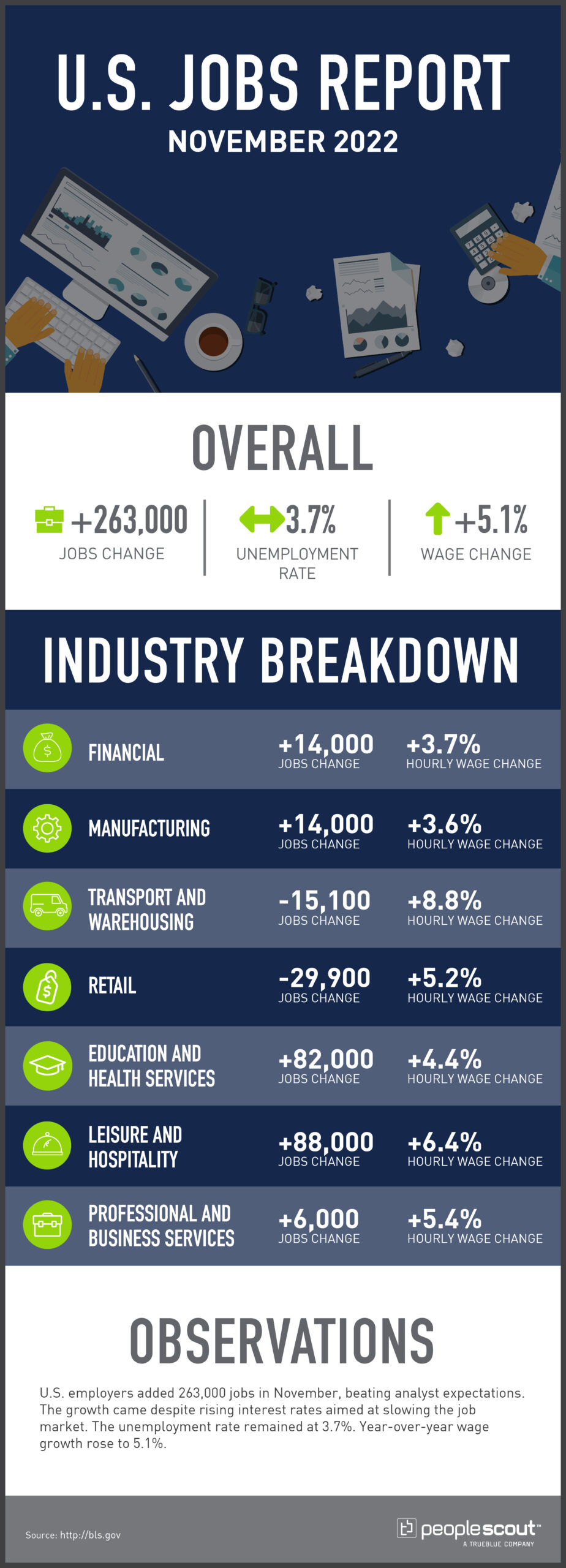
U.S. employers added 263,000 jobs in November, beating analyst expectations. The growth came despite rising interest rates aimed at slowing the job market. The unemployment rate remained at 3.7%. Year-over-year wage growth rose to 5.1%.

jobs report infographic

The Numbers

263,000: U.S. employers added 263,000 jobs in November.

3.7%: The unemployment rate remained at 3.7%.

5.1%: Wages grew 5.1% over the past year

The Good

While the overall jobs number remained higher than expected in November, the growth was not spread evenly across industries. Service-based industries like leisure and hospitality and education grew, while goods-based industries like retail and transportation and warehousing saw jobs losses. As the New York Times reports, these numbers show that while employers are being more cautious, they are still finding reason to expand.

While the U.S. job market has fully recovered the number of jobs lost at the start of COVID-19 pandemic, some industries lag behind their 2019 jobs numbers, like leisure and hospitality. Those industries largely drove November’s growth.

The Bad

As MarketWatch reports, November’s jobs data is not promising when it comes to reducing inflation. Year-over-year wage growth jumped back up to 5.1%—significantly higher than the Federal Reserve’s goal. November alone saw a 0.6% jump in wages, which is more than double what is expected.

The Unknown

The Federal Reserve is set to meet in two weeks, and as the Wall Street Journal reports, November’s jobs numbers make it likely that officials will raise interest rates about 0.5%. This comes after four straight .075% increases. Fed Chair Jerome Powell has said that some prices that rose significantly in the past year, like used cars and housing could fall in 2023 but that “despite some promising developments, we have a long way to go” when it comes to inflation. To decrease inflation, experts will watch carefully in the next year to see how high and for how long the Federal Reserve will raise rates.

Global Banking School: Increasing Offer Conversion to 87% for a Suite of Hard-to-Fill Roles

Global Banking School: Increasing Offer Conversion to 87% for a Suite of Hard-to-Fill Roles

Global Banking School: Increasing Offer Conversion to 87% for a Suite of Hard-to-Fill Roles

Global Banking School (GBS), a higher education provider offering a range of sector-relevant courses, turned to PeopleScout for project RPO to fill 35 professional and academic roles across eight campuses in London, Manchester, Birmingham, and Leeds.

87 % Offer acceptance rate across all roles
Increased diversity within roles filled through targeted messaging and sourcing
Enhanced candidate and hiring manager experience

Situation

GBS needed to fill 35 roles across a range of job families and levels, including professional and academic positions. They had a challenging timescale of just four weeks to go-live.

GBS was facing several challenges:

  • Some of the roles had been out to market several times, in some cases for up to a year, with little traction.
  • As an educational institution, face-to-face teaching is a vital part of the student experience, and therefore essential for the client. GBS needed this to apply to staff availability as well and wanted to avoid a two-tiered approach for academic and non-academic roles. This meant the client was unable to offer remote or hybrid working models. In a market where candidates have more choice around how and where they work, this resulted in a low interest from candidates.
  • Sourcing from other higher education institutions and universities meant the audience was hard to engage.
  • Hiring managers were disengaged due to high workloads. Plus, the previous recruitment processes were transactional and didn’t keep candidates engaged.
  • The hiring managers also had competing priorities, which meant the overwhelmed internal recruitment team were struggling to obtain the required information to fill the roles.

Solution

Our dedicated and skilled recruiters became an extension of the in-house team, optimizing and managing GBS’s recruitment process from attraction to offer for a four-month project RPO solution. PeopleScout managed each position in its entirety, from briefing through to verbal offer acceptance, including creating a sourcing and attraction plan for each role.

Our team seamlessly integrated into the organization’s culture, mapping the end-to-end candidate journey in collaboration with hiring managers. PeopleScout very quickly became trusted colleagues with the in-house recruitment team, and through our consultative approach we offered recommendations based on our labor market research and feedback.

A dedicated PeopleScout recruitment marketer was brought in to reimagine the organization’s messaging, job descriptions and attraction channels. GBS received a suite of copy, both bespoke to individual roles and templates which they could use into the future. Our recruitment marketing strategy included a social media attraction campaign featuring a one-click application.

On top of these attraction efforts, we directly sourced passive candidates to raise GBS’s profile in the market. Throughout the project, we gathered market feedback and tracked hiring metrics, presenting it through customized dashboards to guide hiring decisions. GBS received weekly analysis of market insights, salary benchmarks and candidate feedback.

Result

Our consultative approach to hiring and tailored strategies for each role resulted in:

  • An 87% offer acceptance rate.
  • An enhanced candidate and hiring manager experience.
  • Increased diversity within roles filled.

At a Glance

  • COMPANY
    Global Business School
  • INDUSTRY
    Higher Education
  • PEOPLESCOUT SOLUTIONS
    Recruitment Process Outsourcing, Talent Advisory
  • ABOUT GBS
    Global Banking School (GBS) is a higher education provider with campuses across the United Kingdom. GBS offers a range of courses in banking, management and healthcare designed to enhance students’ career prospects in the financial services industry.

Talent Consulting and Strategic Sourcing Support for Business Critical Roles

Talent Consulting and Strategic Sourcing Support for Business Critical Roles

Talent Consulting and Strategic Sourcing Support for Business Critical Roles

PeopleScout helped this waste disposal company source, attract and hire drivers, administrative roles and technicians with RPO, recruitment marketing campaigns and compliance support.

16,000 annual hires targeted
957 offers made over two career day events
38 % improvement in key SLAs in just 30 days

A leading waste disposal and environmental services company faced significant challenges sourcing, attracting and hiring talent for vital full-time frontline roles including CDL drivers, technicians and administrative roles.

Scope and Scale

As a result of continuing skills shortages in high-demand roles, the client found it increasingly difficult to source talent with the required skills, credentials and experience to fill business-critical roles. The client required a full-cycle RPO solution to support its internal team in making 16,000 annual hires across North America. What’s more, the client sought a consultative partnership with ongoing strategic guidance and best practice implementation across the client’s talent sourcing program.

Situation

PeopleScout has partnered with the client for nearly 14 years supporting full-cycle, end-to-end roles and recently, the client required additional support for partial-cycle hiring. PeopleScout deployed a flexible RPO solution to source and deliver a continuous slate of qualified candidates into the client’s talent pipeline. PeopleScout also provides the client with recruitment marketing support, detailed talent market insights and expertise on program compliance.

Solution

  • PeopleScout’s team executes talent sourcing strategies, provides guidance on how to tap into talent channels and helps the client develop grassroots recruitment marketing campaigns to reach the right candidates.
  • PeopleScout developed a custom SLA dashboard and performance reporting via Affinix® Analytics which highlights roles that aren’t getting as much traction and optimizes channel usage and ad spend accordingly.
  • With the additional scope, PeopleScout ramped up its team of 47 to 284, with specialized global support spanning India, Poland, UK and the U.S.
  • PeopleScout Talent Advisory team conducted a two-phased research project, including an exhaustive candidate persona framework based on interviews with the client’s current employees, for insight into their talent audience to develop highly targeted creative and messaging.
  • PeopleScout created a new employer branding and recruitment marketing strategy, and dedicated marketing experts from PeopleScout manage all the client’s social media accounts.

Results

  • PeopleScout’s team finds qualified candidates in niche skill sets despite challenges presented by the COVID-19 pandemic and resulting talent shortages.
  • PeopleScout’s full-cycle RPO solution targets an average of 16,000 annual hires for extremely difficult skill sets, improving business outcomes across the enterprise.
  • Implemented new channels including Indeed, Appcast, geofencing, social media and more which allow the team to instantly post jobs to multiple job boards at one time.
  • After just 30 days of launching the SLA dashboard, the client saw a 38% improvement in SLAs including the interview-to-offer ratio, candidate outreach timeframe and offer extension timeline.
  • PeopleScout helped with the planning and execution of two career day events with over 1,900 attendees and 957 offers made, resulting in two of the best career day events the client has ever had.

At a Glance

  • COMPANY
    Waste disposal and environmental services company
  • INDUSTRY
    Utilities, Environmental Services
  • PEOPLESCOUT SOLUTIONS
    Recruitment Process Outsourcing, Talent Advisory, Affinix
  • ANNUAL HIRES
    16,000
  • ABOUT THE CLIENT
    As a leading waste disposal company in North America, this organization has over 45,000 employees supporting over 20 million residences and businesses with their waste and recycling needs.

[On-Demand] Candidate Relationship Management: How to Get the Most out of Your CRM

[On-Demand] Candidate Relationship Management: How to Get the Most out of Your CRM

Candidate relationship management tools are a critical component of any recruitment process, but very few employers actually use the software to its full potential. Could your organization be doing more with your CRM?

When properly deployed, a CRM can help you attract and engage candidates from underrepresented backgrounds, source strong passive candidates and increase application rates. With so much power in one tool, talent acquisition teams that leverage the full suite of features will be more competitive in a difficult talent market.

So how can you tap into the power of your CRM? Join PeopleScout Senior Product Manager Brittany Taylor for the newest Talking Talent webinar, Candidate Relationship Management: How to Get the Most out of Your CRM, available now on demand.

In this webinar, Brittany covers:

  • The full range of CRM capabilities

  • How your CRM can supercharge your diversity initiatives

  • Proven strategies for decreasing candidate fall-out in the application process

  • Simple methods to fill the top of your recruitment funnel

  • Real-life examples of how implementing these changes helped employers reach their talent acquisition goals

  • And more!

PeopleScout Jobs Report Analysis—October 2022 

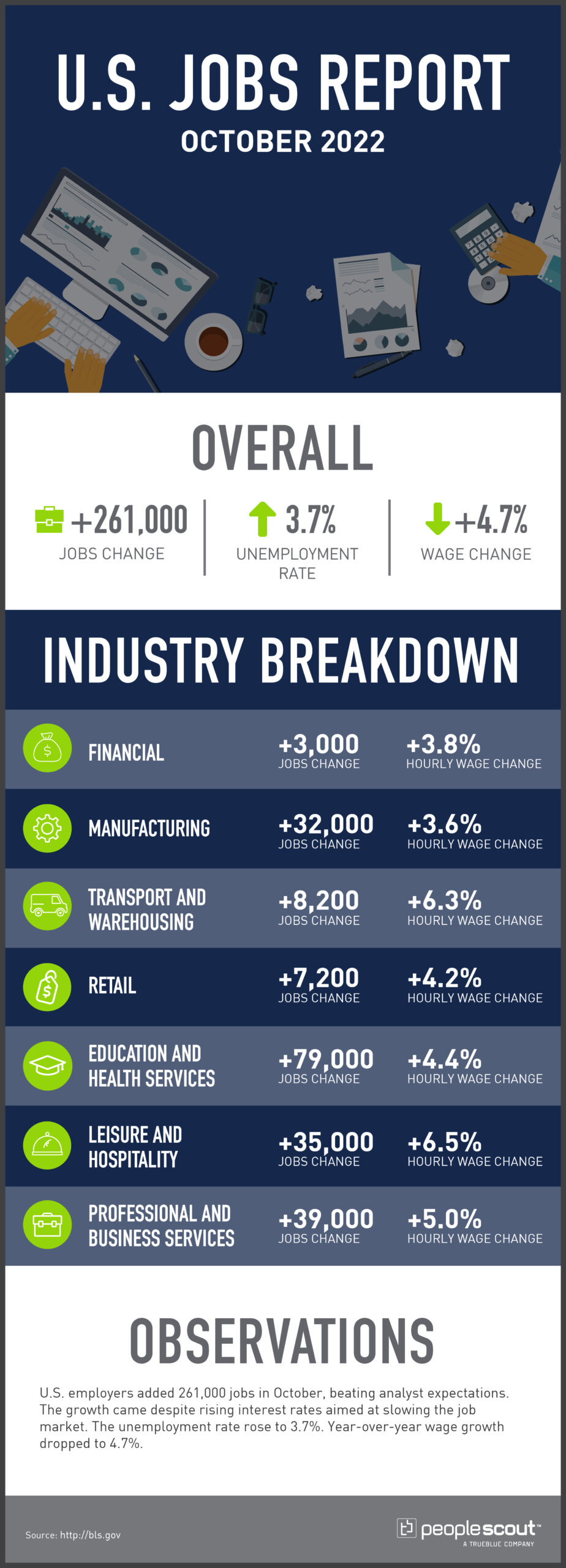
U.S. employers added 261,000 jobs in October, beating analyst expectations. The growth came despite rising interest rates aimed at slowing the job market. The unemployment rate rose to 3.7%. Year-over-year wage growth dropped to 4.7%. 

jobs report infographic

The Numbers  

261,000: Employers added 261,000 jobs to the U.S. economy in October.  

3.7%: The unemployment rate rose to 3.7%. 

4.7%: Wages grew 4.7% over the past year.  

The Good 

The 261,000 jobs added in October demonstrate continued resilience in the U.S. economy, according to the Wall Street Journal. Healthcare and education and business and professional services led the growth. While the leisure and hospitality sector has dropped back from the extremely high jobs numbers we saw during the Great Rehire, there is still sustained growth, led by hotels and other accommodations. 

The Bad  

Like last month, the bad news in October’s jobs report would look like good news at almost any other point. Job growth is strong, but as MarketWatch reports, the strong growth means the current labor shortages are not going anywhere. The Federal Reserve has been aggressively raising interest rates in the hopes of slowing the job market. The current labor shortages are driving higher wages, contributing to inflation. In fact, Fed Chairman Jerome Powell said the labor market is “out of balance” because there are too many job openings and not enough job seekers to fill them. 

The Unknown 

As the New York Times reports, the Federal Reserve is watching these jobs numbers closely, and October’s report suggests that they will be likely to raise rates again. Their next decision is scheduled for December 14. The fact that both hiring and wage growth have cooled slightly shows movement in the right direction, but experts say that it is still happening too slowly. Job postings actually rose again in September after falling in August, demonstrating the stubborn resilience of the job market. 

Destination 2030: 10 Predictions for What’s Next in the World of Work 

Destination 2030:

10 Predictions for What’s Next in the World of Work

The last few years have been tumultuous for talent acquisition leaders, and it doesn’t look as if the pace of change is going to let up. Are you looking for ways to future-proof your workforce and create a resilient talent strategy?

Buckle up and join us as we travel to the world of work in 2030! Our ebook, Destination 2030, explores the latest research and global workforce trends and how they might impact the way we work.

In this ebook, we explore:

  • Demographic changes in the workplace and how to engage each generation
  • The changing role of technology in candidate and employee engagement
  • Our top 10 predictions for what’s next in world of work

Talking Talent: RPO in a Shifting Economy

It has been more than two years since the start of the COVID-19 pandemic, and in that time, we’ve seen an economy and a job market that have changed in unprecedented ways. Talent leaders have dealt with lean teams, developed new, virtual processes for interviewing candidates and worked through the challenges of hiring through the Great Rehire and Great Resignation. Now, they’re staring down an entirely new economic reality.

In this episode of Talking Talent, Rick Betori shares his insights on the current economic landscape and how talent leaders can stay ahead. Rick also shares how RPO, recruitment process outsourcing, can create the biggest opportunities for talent leaders as they prepare for 2023.

The U.S. economy has officially regained all of the jobs lost at the start of the pandemic, putting an end to the Great Rehire. The pace of hiring has started to slow; however, current monthly job gains remain at historically high levels. The labor force participation rate has yet to return to pre-pandemic levels, and there are currently 4.8 million more open jobs than there are unemployed Americans. On top of that, inflation remains high, and the Federal Reserve continues to raise rates to keep the economy healthy.

It’s a complicated landscape. How should talent leaders respond? Many have leaned on RPO recruitment companies to get through hiring spikes and implement new technology. But what is the value of an RPO partnership during more steady state hiring? How can talent leaders pull in more workers who have yet to return to the job market? What is the role of talent technology in today’s market, and how can you ensure a strong employer brand?

Joining this episode to discuss these issues is Rick Betori, PeopleScout’s President.* Rick has been with TrueBlue since 2011 and has more than 25 years of proven experience driving organizational change and growth.

*At the time of this recording, Rick’s title was PeopleScout Managing Director, the Americas.

Candidate Experience Pitfalls That Impact Diversity Recruitment [Infographic]

Diversity, equity and inclusion (DE&I) is a top priority for global organizations, but only 5% say they’re succeeding with their DE&I initiatives. We decided to look into where talent acquisition programs fit in and how the recruitment process may be contributing to this disparity for companies.

In looking at the research, we uncovered some common pitfalls within the candidate experience in which organizations unintentionally sabotage their DE&I efforts.

CHECK OUT OUR INFOGRAPHIC TO EXPLORE SOME OF THE DATA WE UNCOVERED IN OUR DIVERSITY & THE CANDIDATE EXPERIENCE REPORT.

Diversity and candidate experience infographic

To learn even more about diversity recruitment, download, Diversity & the Candidate Experience: Identifying Recruitment Pitfalls to Improve DE&I Outcomes.

Strategies for Overcoming High-Volume Hiring Challenges

High-volume recruitment is one of the most demanding disciplines in talent acquisition. Whether you’re staffing a contact center, scaling a logistics network, preparing for a seasonal retail surge or maintaining a large healthcare workforce, the challenge is the same: hire large numbers of the right people, quickly, without letting quality slip or burning out your team. 

The organizations that do this well aren’t just working harder—they’re working differently. This guide explores the most common high-volume hiring challenges and the strategies that leading talent acquisition teams are using to overcome them. 

👉 Get our ebook: 9 Strategies for Solving High-Volume Hiring Challenges 

What is High-Volume Recruitment?

High-volume recruitment involves sourcing, screening, interviewing and hiring large numbers of candidates for similar openings or job types, often within compressed timeframes. It’s common across sectors including retail, hospitality, logistics, healthcare, contact centers, travel and government—and it requires a fundamentally different approach to talent acquisition than professional or specialist hiring.

The core tension in high-volume recruitment is speed versus quality. Move too slowly and candidates drop out or accept offers elsewhere. Move too fast without the right processes and you compromise on hire quality, driving up attrition and starting the cycle again. Getting this balance right—consistently, at scale—is what separates high-performing high-volume programs from those that are perpetually in firefighting mode.

The Biggest High-Volume Hiring Challenges—and How to Solve Them

Challenge 1: Candidate Drop-Off and Ghosting

Candidate drop-off—where applicants disengage partway through the process—and ghosting—where candidates simply stop responding or fail to show up—are among the most costly and frustrating problems in high-volume recruitment. When you’re processing hundreds or thousands of applications, even a modest drop-off rate translates into significant wasted effort and extended time-to-fill. 

The root cause is almost always the same: a process that moves too slowly, communicates too infrequently, or asks too much of candidates. Today’s high-volume candidates—many of whom are applying to multiple employers simultaneously—have limited tolerance for lengthy applications, long gaps between process stages or radio silence from recruiters. If a competitor makes an offer first, or the application simply feels like too much effort, they’ll move on. 

How to address it: 

Audit your application process ruthlessly. Every question that isn’t genuinely necessary to advance a candidate is a potential drop-off point. Streamline the process to capture only what’s needed at each stage, and reserve more detailed information gathering for later in the funnel when candidates are more committed. 

Look at where processes can be automated so that at every touchpoint—application confirmation, status updates, interview scheduling, offer—communication happens quickly and consistently. Candidates should never be left wondering where they stand. SMS and messaging tools are particularly effective in high-volume contexts, where candidates may not regularly check email. 

Reduce the time between process stages wherever possible. Speed is itself a candidate experience differentiator in high-volume markets. The organizations that move fastest tend to secure the best candidates. 

An RPO partner is particularly well-placed to address drop-off and ghosting. With dedicated volume recruiting expertise and access to the latest talent technology—AI-enabled CRM, automated scheduling, pipeline analytics—a high-volume RPO solution keeps candidates moving through your funnel efficiently while freeing your internal team from the administrative burden of managing large applicant volumes manually. 

Challenge 2: Maintaining Quality of Hire at Scale

Speed pressure in high-volume recruitment creates a persistent temptation to cut corners on assessment, like skipping interview stages, loosening criteria or defaulting to “warm body” hiring when vacancies feel urgent. The short-term relief this provides is almost always offset by higher attrition, lower performance and the cost of rehiring. 

The challenge is that traditional assessment approaches—often designed for professional or specialist hiring—don’t translate well to volume contexts. They’re too slow, too resource-intensive and often measure the wrong things. 

How to address it: 

Start by challenging the assumptions underpinning your current criteria. The skills and background that seem like obvious requirements for a role aren’t always the ones that predict success. At PeopleScout, when working with a high-volume RPO client struggling to hire for customer service roles, we interviewed their most successful customer-facing employees and found that prior customer service experience was not a predictor of performance, but problem-solving aptitude was. That insight expanded their talent pool significantly while improving quality of hire and reducing attrition. 

Redesign your candidate assessment to evaluate both hard and soft skills efficiently. For high-volume roles, soft skills, like attitude, adaptability, work ethic and communication style, are often the stronger predictors of success and retention. PeopleScout’s 1XP assessment model is built specifically for high-volume contexts, helping organizations evaluate what actually matters without adding time to the process. 

Structured, consistent assessments also reduce bias and support diversity hiring goals—an important consideration for high-volume programs that are often the largest source of diverse talent entry points into an organization. 

Challenge 3: Recruiter and Hiring Manager Burnout

High-volume hiring puts enormous pressure on internal teams. When recruitment processes are inefficient, hiring managers are pulled into administrative tasks they’re not equipped or resourced for—screening resumes and CVs, chasing candidates, coordinating interviews—on top of their day jobs. Recruiters managing large requisition loads without adequate technology quickly reach a point where quality suffers simply because there aren’t enough hours. 

This is a structural problem, not a motivation problem. Asking people to work harder within a broken process doesn’t fix it. 

How to address it: 

Identify which parts of your recruitment process are consuming the most recruiter and hiring manager time and ask whether they can be streamlined. Scheduling, application screening, reference verification and background checks are all areas where automation or RPO support can dramatically reduce the administrative burden on your team—without compromising candidate experience. 

Modular RPO solutions can also help you augment your internal team. By selectively outsourcing specific components of your hiring process, you allow an RPO partner to absorb the volume-intensive elements so your recruiters and hiring managers can focus on the decisions and interactions that genuinely require time and attention. This isn’t just about capacity—it’s about directing your internal resources toward the highest-value parts of the hiring process.

Challenge 4: Scaling Up and Down for Seasonal Demand

Many high-volume hiring programs aren’t steady-state—they spike. Retail ramps up for peak trading periods. Hospitality and travel scale dramatically for summer or holiday seasons. Tax and financial services see surges at predictable points in the year. Building and then dismantling a large internal recruitment team to match these peaks is expensive, inefficient and disruptive. 

How to address it: 

Build scalability into your recruitment model rather than treating it as an emergency response. This means establishing talent pipelines and candidate communities year-round—not just when the hiring surge hits—so you’re converting warm candidates rather than starting from scratch each season. 

RPO partnerships are particularly well-suited to seasonal high-volume programs because the engagement model is designed to flex. A high-volume RPO partner can scale delivery resources up or down in line with your hiring calendar, providing a consistent, experienced recruiting team without the overhead of permanent headcount. 

Why RPO is the Right Solution for High-Volume Hiring 

Most high-volume hiring challenges share a common root: a recruitment model built for normal hiring volumes, stretched beyond what it can reliably deliver. Bolt-on fixes—an extra job board, a temporary agency, an additional internal recruiter—rarely address the underlying process and technology gaps that are driving the problem. 

Recruitment process outsourcing is designed specifically to address this. A high-volume RPO partner brings: 

  • Purpose-built processes for high-volume contexts, designed around candidate behavior, dropout patterns and assessment approaches that work at scale 
  • Talent technology that organizations often can’t justify building or buying independently including AI-powered sourcing, automated candidate engagement, predictive analytics and pipeline reporting 
  • Dedicated recruiting expertise that your internal team can draw on without having to build and maintain the capability in-house 
  • Scalable delivery that flexes with your hiring calendar rather than forcing you to over- or under-resource for predictable peaks 
  • Talent advisory capabilities like employer branding, recruitment marketing and assessment design, that address the upstream factors affecting your ability to attract and convert candidates at scale 

PeopleScout’s high-volume RPO solution is purpose-built for organizations managing large-scale, fast-paced hiring programs across retail, hospitality, logistics, healthcare and beyond. 

👉 Explore PeopleScout’s high-volume RPO solution  

👉 Get our ebook: 9 Strategies for Solving High-Volume Hiring Challenges 

9 Strategies for Solving High-Volume Hiring Challenges

9 Strategies for Solving High-Volume Hiring Challenges

Competition for hourly talent is steep, with high demand from call centers, hospitality, retail, security, travel, logistics, healthcare and even government entities. In fact, 65% of companies have high-volume recruitment needs.

Talent acquisition leaders are facing the most tumultuous job market in recent memory with an impossible combination of soaring job openings and a labor shortage.

  • So, how do they compete for hourly talent when the competition is so fierce?
  • And how can they prepare for seasonal peaks?
  • More importantly, how can they increase speed without sacrificing on quality-of-hire?

Download our ebook to learn 9 Strategies for Solving High-Volume Hiring Challenges. It’s a must-read for any talent acquisition team focused on solving critical problems in their high-volume hiring programs.