The Multigenerational Workforce: Keeping Millennials Motivated

In this article, the third in our Multigenerational Workforce series, we’ll be focusing on millennials in the workplace, including what matters to them and how best to engage them.

By 2025, millennials will make up over half of the workforce, essentially replacing retiring Baby Boomers. They’ve already made a huge impact on the way we work, including leveraging technology to revolutionise productivity. As the older millennials enter their 40s, they’re moving into leadership roles and will have even more influence on how organizations operate into the future. So, how can employers harness the power of millennials to drive their businesses forward?

Who are Millennials?

Millennials, less commonly known as Generation Y, follow Gen X and precede Gen Z. Millennials were born between the early 1980s and the mid-1990s during the rise of personal computers and technology, making them tech-savvy. They’re the first generation to come of age in the new millennium, hence the name millennials. They are also known to be values-driven.

Workers from this generation are bound together through their shared experience of financial challenges, including the 2008 Great Recession, which caused a 19% unemployment rate and massive student loan debt among millennials. As a result, members of this generation are more likely to find themselves underemployed or self-employed.

Perceptions and Misperceptions

This generation have been characterized as lazy and narcissistic, labelled as “Generation Me.” Other common perceptions include being easily bored and hopping from job to job rather than staying with one employer. However, this could be due to the anxiety caused from the global financial crash.

Despite these stereotypes, millennials have been described as self-sufficient, solving their own issues and teaching themselves through the internet rather than relying on others for help. They are also known to be confident, curious and open-minded.

What Matters to Millennials in the Workplace?

Digital & Tech Skills

Having been the first generation to grow up in a digital world, millennials have widespread experience of the development of technology, being both the “pioneers and the guinea pigs”.

This has affected the way that they communicate, with 41% of millennials choosing to communicate electronically instead of face-to-face according to a study by PwC. However, they’re also the last generation to have grown up in a world without the internet in every household.

When considering a job, 59% of millennials claim that technology in the workplace is an important factor. Employers are responding to this by encouraging professional use of social media at work and introducing smartphones as an employee benefit.

Mission and Purpose

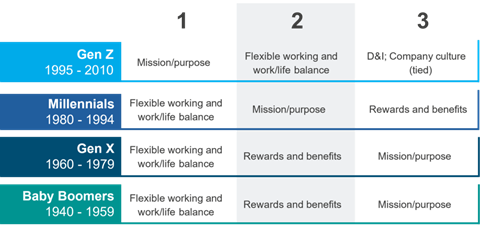
Millennials thrive in a workplace that is mission-driven, keeping them motivated and inspired. In our recent report, Inside the Candidate Experience, we found that mission and purpose were the second most important factor for millennials when considering a new job. Those who work for companies with this as a priority feel more accomplished. Millennials want to share their employer’s goals and values in order to feel they are contributing to the world.
Collaboration

The move to a more collaborative working environment has been driven by millennials through the use of technology as it’s become more sophisticated. A collaborative environment allows workers to speak their ideas freely and feel a sense of belonging as part of a team. One way that employers are emphasizing collaboration is through mentorship programs, which have been proven to increase the happiness of workers and their productivity.

How Do You Engage Millennials at Work?

As millennials slowly take over as the majority of the workforce, employers must learn strategies to keep them motivated and feeling valued.

1. Be Open and Transparent

Millennials want openness and transparency from their leaders, ensuring their confidence through factual information that can be validated.

Keep millennials productive by creating clear targets are regular opportunities for feedback and praise. In fact, according to the same PwC study, 51% of this demographic believe that frequent or continuous feedback is a must on the job, making up a huge part of what keeps them motivated and engaged in their work.

2. Embrace Teamwork

To manage a multigenerational workforce, leaders must recognize that each generation may need different methods of management. Among millennials, 74% expressed that they are as happy working alongside other generations as with their own. So, it’s unsurprising to find millennials now managing older workers.

However, 34% of millennials felt that their personal drive could be perceived as intimidating to other generations. Effective programs that encourage interactions between different generations are necessary to overcome these misperceptions. For example, millennials thrive in opportunities such as “reverse mentoring,” in which they are able to learn from and teach skills to older workers.

3. Invest in Employee Development

Millennials look at their work as a means to learn and develop, which may be the greatest differentiator between them and all other generations. Indeed, a whopping 87% of millennials say that growth and development opportunities are important to them in a job, compared to just 69% of non-millennials. Offering opportunities to develop technology skills and interpersonal skills will not only help you retain millennial employees, it will help you ensure this important segment of your workforce is ready to step into leadership roles.

4. Trust Them

While millennials want to be supported through feedback and praise, they also want the freedom to “be their own boss.” Flexibility is important to millennials in the workplace.They’ll happily put in the long hours if they believe their work has a purpose, but those hours may not be during the traditional 9-to-5.

Millennials believe that success should be evaluated through productivity, rather than the number of hours they are seen in an office. If they meet the deadlines you set, don’t be concerned about the hours they clock in and out. Focus on creating a flexible work culture to maximize millennial engagement, allowing employees to have more control over their working hours and location.

5. Lead with Your Values

Millennials are searching for more than “just a job” and want to achieve something worthwhile. Akin to Gen Z, millennials believe that companies and their leadership should be contributing positively to society. Strong corporate ethics will encourage loyalty among millennials.

A report from Deloitte found that 54% of millennials research a brand’s environmental impact and polices before accepting a job offer. To keep up with today’s candidates, it’s vital that organizations have updated employer value propositions (EVP) showcase the companies intentions to address social and environmental concerns.

In our multigenerational workplace, each generation will shape the world of work in their own way, and each will need different things from their working lives. Millennials bring commitment and collaboration to the workplace. In return, they want opportunities to grow and collaborate. Organizations that can effectively empower millennials to provide ethical leadership hold key to keeping them engaged.

Find out our top 10 predictions for what we think the working world will look like in 2030 and the best practices to prepare for the future in our Destination 2030 report.

Future of Work

Destination 2030: 10 Predictions for What’s NEXT in the World of Work

Shifting Perceptions of Tech & Digital Talent for a Leading Retailer

Shifting Perceptions of Tech & Digital Talent for a Leading Retailer

Retail Employer Brand

Shifting Perceptions of Tech & Digital Talent for a Leading Retailer

A renowned grocery retailer turned to PeopleScout for a new employer brand and recruitment process to help them change perceptions and become an employer of choice for tech, digital and data analyst talent.

13,000 views of digital, tech and data job postings per month on average
17,000 tech, digital and data pros have joined a new LinkedIn community led by the client
39 % increase in LinkedIn impressions

Situation 

With the rise of ecommerce and consumers seeking more digital experiences, this leading grocery retailer needed to shift their workforce to support web and mobile app development, data analytics, cloud computing and more. They anticipated that 50% of their new hires would go into digital, tech and data-focused roles, yet their legacy employer brand and recruitment journey was designed for volume in-store hiring. 

However, tech and digital talent couldn’t see past the shop floor. In a highly competitive and disruptive market, millennial and Gen Z digital natives simply didn’t think a retailer could match their needs or ambitions, despite the retailer’s vast capabilities and breadth of opportunities. 

The organization turned to PeopleScout to help them evolve their employer value proposition (EVP) and employer brand so that it would speak to candidates with tech and digital skills and experience. Because of the stiff competition, the new brand had to work hard. It needed to bring their culture to life, define what was unique about the retailer and do justice to their innovation and variety of roles.  

It also had to launch within 50 days to coincide with the conclusion of the launch of a new Digital, Tech and Data business unit. 

Solution 

In response, we created a dedicated brand platform for digital, tech and data roles. This brought all these roles under one umbrella, delivering integrated solutions across the company. With this bold new direction, the client could offer greater opportunities and take a new value proposition to market. 

Curate 

It was vital to understand the motivations of our audience. What was important to them, and what could the retailer offer that was a good fit? 

To make sure we really knew our target talent’s needs and wants, we had to gain key insights from tech-focused colleagues of all levels, plus external contacts who fit the “digital native” demographic. It was also crucial to ensure all our insight came from a truly diverse pool of respondents. 

We started by conducting interviews with leaders and visionaries to establish a clear view on the current situation and strategic direction for the future. We then held focus groups with team leads across data, tech and digital, as well as a series of workshops with their teams. This gave us a clear picture that helped us shape our prototype proposition. 

Our external research consisted of in-depth interviews with DevOps specialists, software engineers and data scientists working for competitors for talent in digital, tech and data. Additionally, we surveyed potential candidates on market perception of the retailer. Our proposition was tested on all external candidates before finalizing. 

Our key insights told us that external talent wanted: 

  • Challenging problems 
  • Collaborative cultures 
  • Freedom to experiment and learn 
  • A flexible work environment 
  • Training and development 
  • To see their work implemented 

We found that the client’s offering matched this head on. We needed to highlight these things in the new employer brand platform: 

  • Size, scale and complexity of challenge 
  • Values and culture 
  • Opportunities to develop 
  • Tangible impact 
  • Ability to work flexibly 

Create 

We combined our findings into employer value proposition (EVP) pillars that positioned the retailer as the perfect blend of nimble start-up with big business backing and future-facing retail giant. Using these pillars, we devised bold, exciting creative that brought our proposition to life. Steeped in the organization’s longevity and far-reaching impact from serving 71% of the public, the EVP focused on the journey to become a nimble tech-forward organization that creates incredible digital experiences. 

The new platform also included a fresh color palette, a new tone of voice and a suite of edgy, tech-inspired characters with a sense of fun to be used across all tech, digital and data branding. Derived from tech and data symbols, they served to disrupt notions of the client as a purely retail organization. 

These creative elements were then rolled out across a huge range of recruitment tools, including a brand book, presentation roadshow, social media video content, event materials, careers pages, lanyards, PowerPoint slides, a LinkedIn channel and external media. The tech teams are even dressing their offices using the new creative, applying images of the brand characters to walls and lockers and producing large 3D brand symbols situated across various spaces.  

Community 

The brand was well received internally and externally, driving engagement and inspiring teams. In order to build buzz, we built a communications and engagement strategy to drive awareness, which also resulted in existing employees becoming brand ambassadors. 

With the brand in place, we developed a more intuitive candidate experience with a simplified application process. We also designed an email nurture program to convert interest into applications. These communications harnessed the power of our new brand ambassadors and immersed candidates in personalized content. 

The new employer brand messaging now permeates all communications coming from the division, including the specially built LinkedIn community which acts as a digital talent pool for the retailer. 

As part of the new brand launch, we ran interactive workshops and sessions to generate brand awareness at the annual Women in Data conference. This gave the client an opportunity to build relationships with women in the tech space and speak about their available opportunities to prospective candidates. 

Results 

Across LinkedIn, strong results from the launch of the brand show we’ve cut through to successfully appeal to our audience. 

In the month after the launch, the LinkedIn content garnered: 

  • 216K impressions 
  • 4,100 engagements (a 39% increase from prior to the new brand launch) 

The LinkedIn community has grown to over 17,000 followers in the three years since the launch.  

On the client’s career site, there are an average of 5,000 proactive searches per month related to software engineering, showing that the brand has been successful in positioning the retailer as an employer of choice for software development professionals. The client experiences a monthly average of 13,000 views of digital, tech and data job postings.  

In addition, over the last three years, there’s been a 66% increase in visits to the company’s digital, tech and data careers landing page.

At a Glance

  • COMPANY
    Leading grocery retailer
  • INDUSTRY
    Retail
  • PEOPLESCOUT SOLUTIONS
    Talent Advisory
  • LOCATIONS
    600 supermarkets, 800 convenience stores and ecommerce platforms

Hospitality & Travel Industry Recruitment is On the Road Again [Infographic]

When the pandemic struck in 2020, the travel and hospitality industry saw some of the biggest impacts worldwide, and the reverberations and recovery are still shaping the industry years later.  

Now, people are traveling again, but while many industries have recovered the jobs lost in 2020, hospitality lags behind. The industry faces a new set of talent challenges, but employers have the opportunity to reshape their talent programs for the world of travel.   

Check out this infographic for insights on this transforming industry.

Through the job market volatility that has defined the hiring market for the past three years, the travel and hospitality industry saw some of the biggest impacts worldwide, and the reverberations and recovery are still shaping the industry years later. Now, people are traveling again, but while many industries have regained the jobs lost in 2020, hospitality lags behind.  


Travelers are finally ready to hit the skies, seas and roads for both personal and business travel. 


After several years of staying close to home, pent up demand has the travel industry booming. Global travel revenue is expected to triple 2020 levels by 2027. Full recovery of business travel to 2019 spend volumes appears likely by late 2024 or early 2025.i 


Travel is more meaningful than it used to be, leading to increased traveler expectations and more challenges for hospitality staff. 


46% of people say travel is now more important to them than it was before the pandemic.ii  

43% of people are upping their travel budget in 2023.iii 

91% of hospitality workers said they have dealt with customers who believed they inherently deserved privileges or special treatment, and 70% have wanted to leave the industry as a result.iv 

 However, hospitality staffing has not caught up to the renewed demand.  


In the U.S. alone, nearly 2 million hospitality jobs remain unfilled, even as hiring slows in other industries.v 

In September 2022, 87% of hoteliers reported staffing shortages.vi 

In the UK, hospitality job openings are still 74% higher than they were in January and February of 2020.vii 


One big reason for that? Millions of hospitality workers fled the industry during the pandemic and recovery. 


15.6% of people left their hospitality jobs in March 2020.viii 

8.3% of hospitality staff left the sector between August and September 2022.ix 


Do you need help hiring hospitality workers? Learn about how you can attract the next generation of workers, build more diverse teams and plan for the future in The Recruitment Handbook for Hospitality and Travel. 


[Download your copy now!] 

For more hospitality insights, download our ebook, The Recruitment Handbook for Travel and Hospitality.

[On-Demand] Harnessing Social Media & the Creator Economy to Amplify Your EVP

Harnessing Social Media & the Creator Economy to Amplify Your EVP

During RecFest 2023 Robert Peasnell and Ayo Ogunde delivered a session on the Resourcing Leaders stage titled: ‘Harnessing Social Media & The Creator Economy to Amplify your EVP’.

Many joined us for the live session in July, including four guest speakers – leading talent acquisition professionals from Selfridges, ERM, RPS Group and Direct Line Group.

Now influencers are key to telling a brand’s story – how are you telling yours?

Fill in the form to watch our session recording for all the insight around EVP & influencers.

[On-Demand] How to Attract and Engage Older Workers

[On-Demand] How to Attract and Engage Older Workers

As policymakers take a carrot-and-stick approach to increasing employment for the over-50s, what should businesses be doing to attract and retain older talent?

Official statistics suggest that around 27% of people aged 50-64 are currently economically inactive. That is more than 3.5 million people, and nearly a million of these have left work since the pandemic.

Changing demographics mean that almost a third of the UK workforce is now over 50. And 73% of the UK’s employment growth over the last 30 years has come from workers aged 50-plus.

This Personnel Today webinar, in association with PeopleScout, examines the needs of older workers, how to attract and recruit them and how to best utilise their skills and experience.

Watch now to find out:

  • what is keeping so many over-50s economically inactive.
  • how to create hiring strategies to attract and retain older workers.
  • the importance of providing flexible work schedules and compensation structures.
  • how recruiting for capability rather than direct experience can broaden talent pools.


The Recruitment Handbook for Energy & Utilities

The Recruitment Handbook for Energy & Utilities

The energy and utilities industry is undergoing a massive transition as providers move to green and renewable energy sources and adjust to changing energy use patterns across the globe.

This means the sector is facing a unique set of talent challenges. In many areas of the globe, energy job growth is outpacing the rest of the economy. At the same time, the workforce is aging, creating a massive talent gap. In fact, according to McKinsey, the massive growth in solar and wind projects expected by 2030 will make it almost impossible to staff these projects with qualified development and construction employees as well as operations and maintenance workers.

Now, talent leaders need to think big—not just to attract more and younger workers, but to reskill workers in the shrinking fossil fuels industry and plan for the future.

In this handbook, you’ll learn:

  • Global trends driving the need for energy and utilities talent
  • Strategies for overcoming challenges in your energy and utilities hiring programs
  • How partnering with an RPO provider can help

The Recruitment Handbook for Travel and Hospitality

The Recruitment Handbook for Travel and Hospitality

5 Strategies for Recruiting the Best Travel and Hospitality Talent Now and into the Future

Through the job market volatility that has defined the hiring market for the past three years, the travel and hospitality industry saw some of the biggest impacts worldwide, and the reverberations and recovery are still shaping the industry years later.

While many industries have recovered the jobs lost in 2020, hospitality lags behind. While people are traveling again, the industry faces a new set of talent challenges, from a talent exodus to shifting traveler expectations. Now, employers have the opportunity to reshape their talent programs for the world of travel.

In this handbook, you’ll learn:

  • Global trends driving the need for travel and hospitality talent
  • Strategies for overcoming challenges in your travel and hospitality hiring programs
  • How partnering with an RPO provider can help

ESG and Life Science Recruitment: Why ESG Initiatives Will Make Your Competition Green With Envy  

A plethora of social, economic and environmental impacts are contributing to the emerging global “polycrisis.” Beyond the pandemic, the future impacts of climate change, biodiversity loss, pollution and overexertion of natural resources will affect global health in the long term. This will impact the work of life science organizations as climate change is increasingly linked to diseases like cancer, diabetes and heart disease. Plus, the life science industry is among the largest carbon emitters, with biotech and pharma as the leading contributors. It’s no surprise that life science companies are focusing on Environmental, Social and Governance (ESG) initiatives. For talent acquisition leaders, this poses unique challenges and opportunities when it comes to life science recruitment. 

In this article, we review the industry’s impacts on the environment, how those impacts affect life science recruitment, and how a green EVP and employer brand can be leveraged as a critical differentiator in your ability to attract talent.  

Life Science’s Impacts on the Environment 

The average carbon footprint of one life scientist ranges from an estimate of four to 15 tons of CO2 per year. This doesn’t even include the use of consumables, chemicals, production resources, equipment, transportation, energy, and construction and building maintenance materials. There’s no denying that the entire industry’s workforce footprint is quite significant. 

Moreover, pharmaceutical production is highly water-intense, and waste is poorly managed with only nine out of 118 pharmaceuticals removing their waste sustainably during the treatment process. Approximately 4,000 active pharmaceutical ingredients (APIs) are administered worldwide in prescription and over-the-counter medication as well as therapeutic and veterinary drugs. Residues from these drugs are released into the environment, contaminating the soil, rivers and lakes. With drug waste polluting the environment, the Global Leaders Group has created a call to action for all countries to improve measures for the management and disposal of antimicrobial-containing waste, declaring it as a “major threat to public health.” 

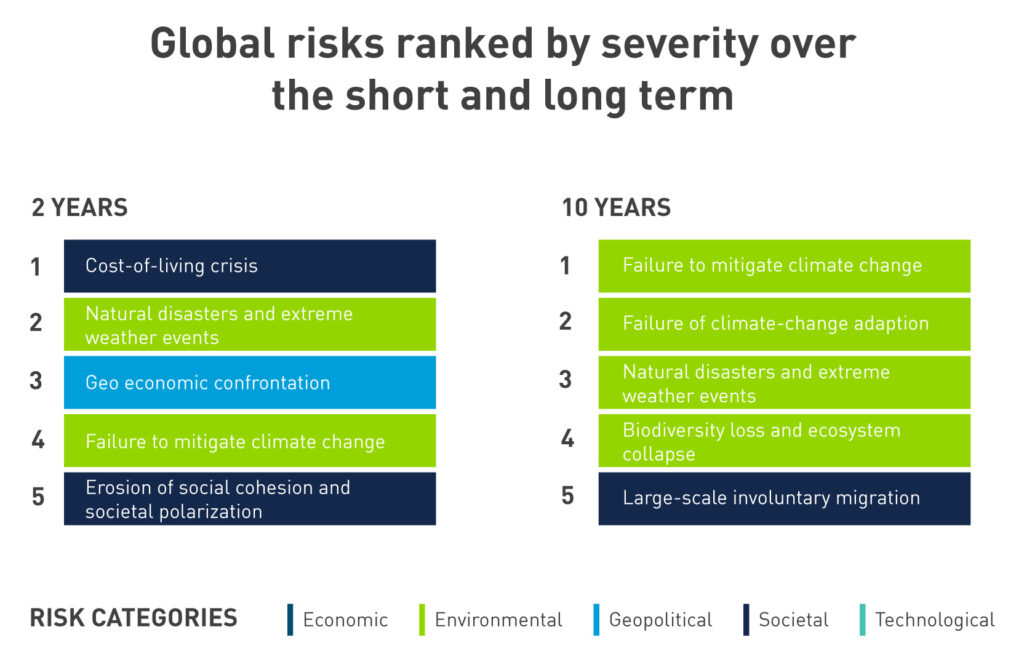
Four out of the top five (80%) global risks forecasted for the next decade are related to global health and climate change. The opportunities created by the industry to improve their environmental impact through ESG initiatives are huge.  

(Source: World Economic Forum, The Global Risks Report 2023) 

Gen Z and Millennials Care About ESG Initiatives

By 2029, Gen Z and millennials will account for 72% of the world’s workforce. This workforce has placed greater importance on ESG issues than previous generations. Considering the industry’s impact on the environment and the global force of this growing talent, millennials and Gen Z will keep the life science industry on its toes. To stay on top, it’s crucial that life science recruitment teams and hiring managers understand what this workforce wants, what they value and how these components contribute to their employment decisions. 

Around the world, young scientists and environmentalists are stressing the need for organizations to radically reduce their carbon emissions. They are tired of politics influencing scientific decisions, slow global engagement and action, and “poor public communication concerning the state of our understanding of climate change.” 

As this talent seeks purpose in their careers, they prefer to work for employers that have set actionable ESG initiatives towards improving their sustainability efforts. Organizations with ESG practices and policies show top talent that they are purpose-driven and progressive, which is a top consideration for this younger STEM-based workforce when applying and working for your company.  

According to a study by Swytch, nearly 70% of Gen Z and millennial respondents say that a strong sustainability plan would affect their decision to stay with a company long term. About 30% of respondents report that they have left a company due to its lack of a corporate sustainability agenda with over 11% doing so more than once. Additionally, a 2023 report by KPMG UK showed that ESG initiatives are influencing employment decisions for almost 50% of UK employees, with millennials and younger workers driving the growing trend of “climate quitting” in search of more environmentally friendly jobs. 

Employers must understand that candidate attraction is more than high salaries and fancy titles. This workforce wants leaders to fearlessly and publicly take a stance on their ESG initiatives and to make it a part of the workplace culture. Failure to do so will make it difficult to attain top talent, further adding to current life science recruitment challenges due to workforce shortages and widening skills gaps. 

Intertwining Your ESG Initiatives into Your EVP and Employer Brand Strategy

With no time to waste, life science organizations need to invest in a “green” employer value proposition (EVP) and employer brand strategy.  

“Today’s labor market wants to join companies that make a difference in a real way.”

Cynthia Burkhardt, Global Head of Talent Acquisition, Kimberly-Clark 

With Gen Z and millennials viewing social and environmental responsibilities as a key differentiator when considering where to work, it’s no surprise that an employer’s ESG initiatives have become a crucial component of the life science recruitment process. Whether your organization is already incorporating sustainable practices into your operations and mitigating risks to climate change or planning to do so, this is the opportunity to showcase that. Here are steps you can take that will appeal to your current and future workforce: 

1. Define Your ESG Voice 

Sustainability buzzwords are not enough, and top talent isn’t buying it. In fact, the European Commission’s National & Consumer Protection survey found that more than 42% of online corporate “green” claims were exaggerated, false or misleading. With “greenwashing” or “green-laundering” on the rise, employers need to establish ways to gain the trust of Gen Z and millennials. Your voice must showcase your purpose and intent. For example, using keywords like “zero discharge” and “risk mitigation,” rather than vague and misleading terminology such as “eco-friendly” or “sustainable,” will have candidates viewing you as more honest and authentic than the competition. 

“Sustainability plays a big role for me. An employer that is supposedly committed to it, but hardly knows what to do with the topic behind the scenes, has no future for me.”

Gen Z respondent from Austria 

2. Communicate Your Mission 

Build your internal and external employer brand messaging around the organization’s ESG initiatives such as corporate sustainability efforts and climate change initiatives. Keep in mind that the internal launch of an EVP and employer branding platform plays a critical part in laying the foundation for the success of the external launch. Bring your EVP to life through transparency and stakeholder alignment. Your employer brand message must be aspirational, future-focused and agile enough to sustain any changes that may come.  

3. Weave ESG Initiatives into Your Life Science Recruitment Marketing Materials 

Incorporate your ESG-centric mission and values into your career site and explain how those objectives are part of the organization’s DNA. On social media and other attraction channels, feature content that is relevant to topics like green training and development, environmental advocacy, waste minimization and corporate reduction of CO2 emissions to attract a wider variety of STEM-related talent. 

4. Showcase Your Investment and Metrics 

Remember that acting on your ESG initiatives is more than providing donations or partaking in “volunteer hours” that gain you a gold star. Let candidates know how much landfill waste you’ve reduced through your recycling program or that you’ve reduced your carbon footprint by 10%. Organizations that actively monitor their social and environmental impacts yield greater candidate attraction and positive impacts to their triple bottom line.  

5. Highlight Employee and Leadership Involvement 

Leverage your employees’ passions, concerns and ideas as a compelling way to address the organization’s initiatives. You can take the output from this to generate recruitment marketing materials, such as employee testimonials, quotes and even videos of leadership involvement or team building initiatives. For candidates, this effort exemplifies a company culture that genuinely wants to make an impact.  

6. Green Up the Candidate Experience 

Alignment of values is top priority for today’s candidates. However, it can be difficult for them to determine if a potential employer’s ethics align with theirs. To improve candidate experience, incorporate ESG initiatives into your job descriptions. For example, call attention to how the role will help achieve sustainability initiatives and feature any employee green benefits like locally sourced perks or green travel packages.  

Most importantly, make sure your recruiters and hiring team are aware of your green values. According to HRD Australia, often times the hiring team is not well-informed on what the company is doing in these areas. A life science recruitment team that is aligned with the organization’s ESG initiatives will ensure smooth communication and a good first impression with potential candidates. 

Can You Keep Up? 

With Gen Z and millennials shaping the future of work, employers cannot afford to trail behind the curve when it comes to ESG. Additionally, as early-career candidates and graduates are a top source for talent in the life science industry, organizations that do not have visible and measurable ESG metrics risk alienating this top talent. Focus on incorporating your ESG initiatives into your organization’s EVP, tweak your employer brand messaging to reflect what your workforce wants.

The Recruitment Handbook for Pharmaceuticals & Life Science

The Recruitment Handbook for Pharmaceuticals & Life Science

From increased adoption of technology in scientific research to the growing demand for innovation in pharmaceuticals and medical diagnostics, the global life science industry is changing rapidly, requiring recruitment teams to be agile to meet demand.  

With 87% of life science executives indicating that they’re experiencing skill gaps and expect to experience more within a few years, life science organizations must invest in better talent acquisition strategies to future-proof their workforce. 

In this ebook, we explore leading industry developments that are transforming the life science workforce: 

  • How demand for tech talent is reshaping the industry 
  • How innovation in medical research and patient care are creating skills gaps 
  • How the global push for sustainability and climate change initiatives is impacting the workforce 

Plus, learn how an RPO partner can help your life science organization rethink and remodel current recruitment strategies to overcome talent acquisition challenges.  

Digital Talent Demands: A Guide for Talent Leaders

The demand for skilled tech and digital talent is growing at an unprecedented rate in response to the emergence of new technologies, making the competition for talent as tight as ever, with both tech and non-tech companies vying for the same qualified candidates. For the tech sector, it’s a time of transformation. For non-tech organizations, it’s a golden opportunity to fill their technical skills gaps. But for any employer looking to attract top digital talent, it is essential to first understand what candidates are looking for in a new employer.  

In this article, we explore the opportunity for non-tech organizations and offer insights into what tech and digital professionals are looking for in a new employer.  

Plenty of Demand Despite Tech Sector Shifts 

The tumultuous labor market and recent economic landscape have been a rollercoaster for all HR leaders, but those in the tech sector have experienced particularly high highs and low lows. Recent layoffs at tech companies are being categorized as a “course correction” by many publications, and it seems the “growth-at-all-costs” attitude has finally caught up with tech organizations. Over 160,000 professionals were laid off in 2022 according to Layoffs.fyi, with additional cuts taking place in 2023.  

Yet, despite this, demand for tech talent remains high. Over 375,000 tech jobs remain unfilled in the U.S. according to the Dice Tech Job Report. In Australia, tech jobs grew more than twice as fast as the average employment rate in the last decade. In the UK, 41% of companies expect to hire for technical skills in 2023. 

The Tech & Digital Talent Diaspora 

This demand is being primarily driven by traditional companies, rather than software companies or other tech organizations. In fact, the majority of people in tech occupations (59%) don’t work in the tech sector

In our digital-first world, every company—from apparel brands to car insurance companies—has tech at the heart of their business as they develop mobile apps and ecommerce consumer experiences. In fact, the biggest and fastest-growing industries for tech professionals are finance, manufacturing and healthcare as these sectors increasingly digitize their operations. 

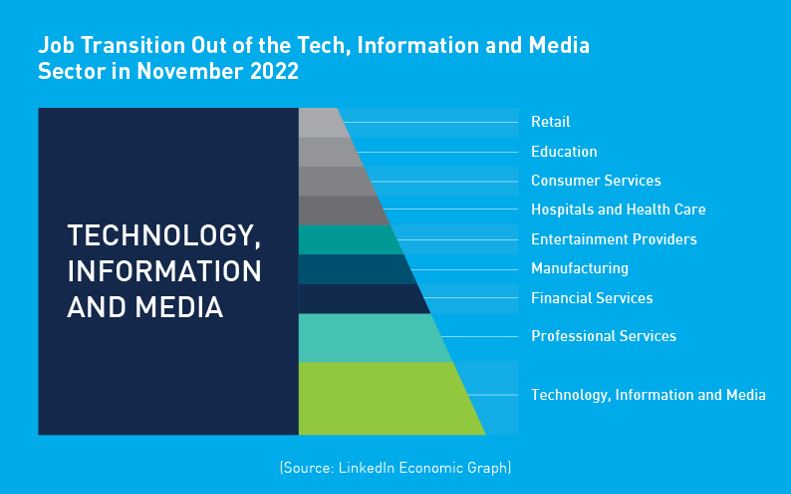
The ratio of tech and digital workers employed outside of the tech industry will continue to grow. Many workers recently laid off from Big Tech firms have highly sought-after skills, creating an opportunity for more traditional organizations to land tech and digital talent

Graph showing which industries tech and digital talent are moving into.

Will Former Tech Workers Re-Evaluate Their Options? 

Given the extent of the downsizing in the tech sector, many workers will think twice about going back to a tech company in the future. Traditional employers, that previously couldn’t compete against the high salaries and quirky perks that Big Tech could provide, now have more to offer tech workers—including stability. 

Tech workers are trading the excitement of startups for the steadiness of more traditional employers. The unpredictable nature and funding rollercoasters of tech firms have left many tech professionals seeking a saner pace. As traditional companies embrace AI, blockchain and cybersecurity, workers who have left the tech sector can still leverage their tech and digital skill sets, but with a greater sense of security.  

What Do Tech and Digital Talent Want? 

When they’re ready for growth again, Big Tech will have to rethink their approach to engaging tech talent and attracting them back to the industry. So, what do tech and digital workers want from their employer and their job? Here are three top considerations that organizations across sectors should focus on to attract and retain tech and digital talent.  

Flexibility & Work/Life Balance 

Many tech workers who experienced the fast pace and intense work culture of startups now find themselves burnt out and are prioritizing more work/life balance. Flexible contracts and remote working are important to tech workers, with 34% citing flexibility as a top priority when looking for a job. Yet, 48% of tech sector employees said that they were feeling pressure from their employer to come into the office more often. 

Recent Gallup analysis shows that employee engagement is lowest among on-site employees, with the biggest dip seen among employees who are capable of working remotely but are required to be on site. Flexibility is not just a perk to offer employees; it should be viewed as a critical way to increase productivity. Organizations can reap the benefits of flexibility in the workplace by continuously monitoring their flexible work program and addressing any challenges experienced by employees or hiring managers.  

What tech and digital talent want

Digital Skills Development  

No one is more aware of the speed of technological advancement than tech and digital workers. And this can lead to anxiety. In fact, 29% of digital employees globally believe their skill set is redundant now or will be in the next one to two years, and 38% believe their skills will be obsolete in the next four to five years. 

In terms of retaining digital talent, investing in training and upskilling programs is crucial for all organizations. Digital talent are more willing to change employers if they feel their skills are stagnating in their current role. Plus, 58% say they would gravitate to organizations that offer better tech and digital skills development. 

With an abundance of job opportunities available, these employees won’t hesitate to find an employer that will invest in their career development. So it’s concerning that 25% of employees said they have not been offered opportunities to learn new skills. Learning and development programs are not only an important part of retaining talent with tech and digital skill sets but can also be an effective way to attract talent.  

Start with a skills audit and compare the findings to your business roadmap. By uncovering the areas where your workforce needs the most training, you can then take steps to develop an upskilling program. For example, PeopleScout worked with a longstanding UK financial services RPO client to lead a reskilling program to help the client evaluate their customer service staff in bank branches and call centers to find candidates for their tech skilling program. We were able to identify over 1,000 employees who are now participating in a 12-month “bootcamp” to build digital and tech skills and move into new careers within the organization. 

Meaningful Work  

Organizations must find out how to communicate their employer value proposition (EVP) in a way that resonates with digital talent. Make sure your attraction content emphasizes the give and get for people in tech roles at your organization including learning and growth opportunities, your tech innovations and projects, well-being initiatives and more. Plus, more and more candidates are paying attention to organizational values and mission. If they can’t determine if their personal values are aligned with the company’s mission, they won’t apply.  

EVP is not all about attraction, but also about employee retention. From a retention perspective, it’s crucial that employers continue to showcase how you’re investing in your employees beyond compensation and benefits. This helps to boost feelings of engagement and to build loyalty. 

As the pace of digital transformation accelerates, it is difficult to envisage a company attaining its full potential without a strong foundation of tech and digital talent. Demand for this crucial part of the workforce won’t let up soon. It’s mission critical for organizations to understand what makes this group tick in order to attract, hire and retain tech talent. To get more strategies for attracting and hiring tech and digital professionals, download our Recruitment Handbook for Tech & Digital Talent.

Recruitment Handbook for Tech & Digital Talent