Co-Op: How We Significantly Reduced Time-To-Hire for a Leading UK Insurer
Co-op Insurance came to PeopleScout for a new assessment center and streamlined recruitment process, resulting in a reduced time-to-hire and quality new talent.
Reduction in Time-to-Hire
73%Assessment Center Pass Rate
up from 41%
Positive Candidate Feedback
Employing 70,000 people, the Co-op is known across the UK as a leader in socially conscious, community-led business. As well as being the country’s fifth largest food retailer, it is also a major general insurer. Co-op Insurance came to PeopleScout with a problem. They were having big issues recruiting the voices of the organisation: high-quality, productive, right-fit Claims Advisors who would stay. Also, the time-to-hire was very slow and a drag on the time of the resourcing team. Their recruitment process needed a complete overhaul.
SITUATION
The process we were presented started with a manual-intensive résumé screen. Because of the volumes that were coming through, the Co-op resourcing team was conducting daily résumé screens. This ate up immense amounts of time and resulted in the team screening candidates based on experience. That meant they were inconsistent in the way they were screening candidates (about 70% passed the screen). Those who passed this stage then had a qualifying call. This was not a formal telephone interview, but an introductory call to check the experience on their résumé, discuss any gaps and make sure they were eligible to work in the UK (85–95% passed this stage). Finally there was a face-to-face assessment centre—consisting of a computer-based assessment and interview. Following this, was the offer and induction.
SOLUTION
The right solution meant two considerations: what to assess and how.
WHAT – We conducted a period of job analysis to understand what good looked like in the role.
HOW – We needed to identify a solution which would support progressing candidates at speed through the process, providing a realistic job preview and automatically screening candidates so there was less manual intervention by the resourcing team.
We suggested removing the résumé screening step which meant there was less reliance on experience only. This allowed us to assess the whole person, progressing candidates who had no experience but great potential. We developed an online tool that incorporated a situational judgement test which tested for attention to detail and a video interview. Candidates completed this in one sitting, further reducing the time-to-hire. We also supported in the design of an assessment center.
RESULTS
The Co-op’s resourcing team was delighted with the new process. It’s easy to use and gives them back invaluable time to work on other projects. The assessment center significantly reduced time-to-hire, owing to the speed and efficiency of the new process. The pass rate at the assessment center stage is 73%—a big increase on the previous rate of 41%. This means that a much higher proportion of the best-fit candidates are going further in the process. In addition, new hires have been identified by the business as individuals who are motivated to succeed, with a propensity for learning and a growth mindset. Candidate feedback has been very positive, with many saying it gave them a proper understanding of the role.
At a Glance
COMPANY Co-op Insurance
INDUSTRY Financial Services
PEOPLESCOUT SOLUTIONS Recruitment Process Outsourcing, Talent Advisory
ABOUT CO-OP Co-op Insurance is part of Co-op Group, one of the world’s largest consumer co-operatives, owned by millions of members. As a leading UK insurer, the organization offers coverage for business, home, life, motor, travel and pets.
Rick Betori’s role as PeopleScout’s managing director of the Americas has a few similarities with a previous leadership position he held as coach of his children’s baseball teams.
“The ball is always going to roll in between someone’s legs,” he told me from his home in the Chicago suburbs. “And, it’s not about the fact that it went through their legs; it’s what they do after and how they respond when things don’t go according to plan. That’s one of the most important things I can do in my role as a leader.”
Rick thrives when there’s a challenge to tackle, when there’s a problem to solve and when there’s the opportunity to connect the right person with the right job in a difficult labor market. It’s an important quality as employers face a talent landscape that has been transformed by the pandemic.
Although Rick joined PeopleScout in 2021, he has been a part of the TrueBlue organization since 2011, most recently leading delivery operations at PeopleReady, where he helped spearhead the company’s digital transformation. As such, he understands how technology, combined with human expertise, can solve the toughest talent problems. We talked to him about the role of talent technology in 2022.
You’re not new to TrueBlue, but you are a relatively new face here at PeopleScout. What makes you really excited about talent acquisition right now?
I’m excited because I believe that we can truly help companies that are facing some of their largest hiring challenges in their histories. Talent acquisition teams need creative partners to help them succeed, and I’m thrilled to be a part of finding those solutions.
I’m also passionate about our talent technology platform, Affinix™, and what it does to help candidates seamlessly move through the application process. Candidates have so many choices today; when they’re searching for a new role, they expect a great experience, and they want it to be fast. I also think that now more than ever, data and analytics will be key in helping employers stay ahead of their competition in a difficult talent market.
And finally, I’ve been a part of the TrueBlue family since 2011, so I’ve been able to witness the passion and energy of the PeopleScout team working to put our clients first. It’s been great to dig in with the team in these last few months. They bring this infectious energy to do what’s right for our clients and their applicants. I’m proud to be a part of this organization moving forward.
Throughout the last couple of years, we’ve seen a lot of employers add technology to their recruitment process out of need. For talent acquisition leaders, where do you think their relationship with talent technology stands today?
I hate to start the answer to a question with “it depends,” but it really does vary. We have seen many employers add technology solutions to deal with increased workload, compliance concerns, and to eliminate or simplify administrative tasks.
More recently, employers feel the pressures of attracting top talent, so they’re taking the next step, focusing on easing and improving the process for candidates. More companies are starting to leverage technology to reduce friction for candidates in the application process and at the same time, building a stronger employer brand.
Finally, we’re seeing leaders stepping back and asking, “How can technology, data and analytics inform our decision-making from a talent standpoint?” These leaders want more information around changes in roles; how the market is responding in their specific area; and how factors like the rise of the gig economy and the COVID-19 pandemic have influenced their prospective talent pools.
The right technology can really make the recruitment process feel even more personal and enhance an organization’s employer brand. How can you make that happen?
It’s about more than the right technology; it’s about the right technology at the right time. Employers can make the greatest impact by targeting specific points in the candidate’s journey.
For example, we know that candidates want to feel a sense of control in the process, and they want to feel as though things are moving forward. That means employers need to keep candidates feeling engaged and empowered. So, the right technology intervention could be implementing a pre-screen that candidates can complete by text or adding an interview self-scheduling tool. These give candidates the ability to feel like they’re taking the next step in the process, rather than waiting to hear back from someone.
Employers should also evaluate specific tools to ensure they fit with their brand. For example, candidates applying to a technology company would expect the process to include more advanced technology, more automation and a more cutting-edge approach to the recruitment process. On the other hand, candidates for positions where the work is focused on manual tasks or face-to-face interactions may expect a different experience. It’s not one size fits all.
In the current market, talent acquisition teams need to move faster than ever to identify and secure talent. The days of long recruitment processes, multiple interviews and multiple steps are over.
Candidates have so many opportunities facing them today…and it’s not just different employers. Think about the impact of virtual work. It used to be that companies simply competed with other organizations in their area, but now, they compete for top talent with companies across the globe.
Add that to that the fact that many employers are reporting a record numbers of job openings and they can’t ramp up their internal teams fast enough to keep up with the number of requisitions they’ve got to fill. The right tools, and the right partner, can make the process easier and even provide them a competitive advantage.
Adding new technology to an established process can be scary. What advice do you have for talent leaders to help them gain buy-in in their organizations?
First off, I’d say, if there wasn’t any fear, I’d be surprised. It’s human nature. But that’s not a reason not to automate.
It starts with having a good, strong, proactive communication plan around the process—explaining what they’re doing and why they’re doing it. It should be transparent and easy to understand. The plan should clearly demonstrate the benefits for the team, and then, it’s important to gather feedback. There must be open lines of communication. It’s about letting people weigh in as you fine-tune the process. Finally, it’s great to recognize and celebrate the early adopters. We’ve seen a lot of success in highlighting the employees who engage and really embrace the change early on.
With internal buy-in, it’s tough, and you can’t underestimate the challenge. However, a good, solid plan executed by leadership goes a long way.
Are there any final thoughts you’d like to leave us with?
I want to put an exclamation point on something I said earlier about the importance of speed in the current talent market. I know the types of pressures that talent leaders are under right now. I don’t have a crystal ball to tell you how long it will last, but I can say that when you find the right partner, they can help you start this process in a way that feels manageable, and that can also help you prepare for whatever challenge lies ahead.
[On-Demand]: Recruiter On-Demand: How Project-Based RPO Can Solve Your Toughest Talent Challenges
Right now, employers across all industries are dealing with a difficult talent market as demand accelerated at a record pace. If your organization is struggling to meet a sudden need for talent or your internal recruiting resources are stretched thin, selecting a project-based RPO solution can drastically improve your talent acquisition outcomes.
Join PeopleScout’s Trish Koester, senior director of client delivery, and Karen Wendelberger, operations manager for our Talking Talent webinar, Recruiter On-Demand: How Project-Based RPO Can Solve Your Toughest Talent Challenges, available on-demand now.
Trish and Karen discuss the advantages of project-based RPO and how employers can best leverage an on-demand recruiting solution to source and hire top talent.
This webinar will cover:
Common challenges faced by employers and how project-based RPO can help solve them
The difference between working with an agency and a project-based RPO provider
How sourcing specialized talent through a project-based RPO reduces time-to-hire metrics
Real-world case studies from PeopleScout’s Recruiter On-Demand team
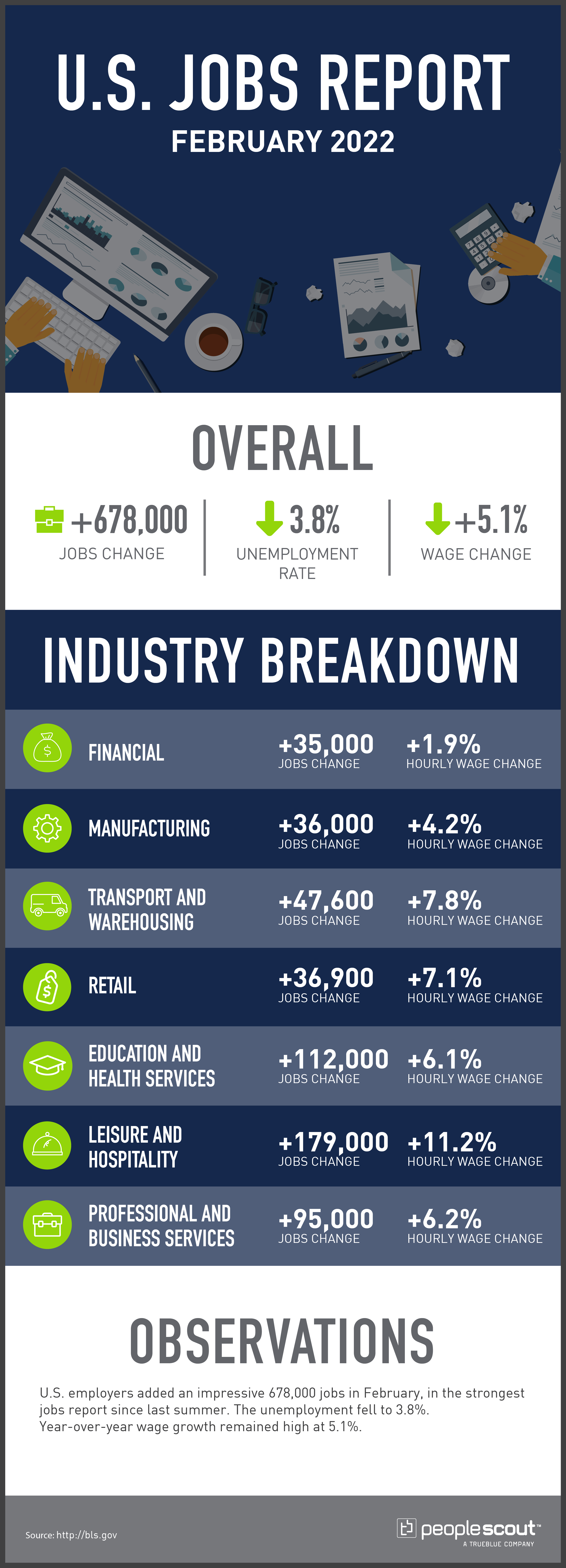
U.S. employers added an impressive 678,000 jobs in February, in the strongest jobs report since last summer. The unemployment rate fell to 3.8%. Year-over-year wage growth remained high at 5.1%.
The Numbers
678,000: Employers added 678,000 jobs to the U.S. economy in February.
3.8%: The unemployment rate fell to 3.8%.
5.1%: Wages rose 5.1% over the past year.
The Good
The headline number of 678,000 new jobs in February beat analyst expectations. Nearly a quarter of those jobs were in the leisure and hospitality sector, which includes the industries most impacted by coronavirus surges. Restaurants alone accounted for 124,000 new jobs, and no industries reported a decline in employment.
Additionally, labor force participation increased to 62.3%, though the number is still far below pre-pandemic numbers. However, the unemployment rate fell to 3.8%, only slightly higher than the 3.5% unemployment rate of February 2020. Though wage growth remains high, the Wall Street Journal reports that it has slowed enough to indicate that the nationwide labor shortage may be easing.
The Bad
There is very little bad news in February’s jobs report, though some challenges caused by the pandemic still remain. As the New York Times reports, the economy still has about 2 million fewer jobs it did before the pandemic, and the labor force is still about 3 million workers smaller.
The Unknown
February’s jobs numbers were collected before the Russian invasion of Ukraine, so they do not reflect any impact of the conflict. MarketWatch reports that the invasion is likely to worsen inflation. According to the New York Times, the U.S. will likely see less financial impact than Europe, but there will be repercussions that can be difficult to predict. Though experts do say that Americans are likely to see higher oil prices, which could curb household spending.
From the first African slaves brought to the shores of the American colonies in the 1600s to the present day, African Americans have an active and intricate role in the history of labor in the western hemisphere and beyond. African Americans have filled a wide range of roles vital in building and sustaining the nation’s economy, even in the face of racial discrimination and persistent challenges.
Yet African Americans have often found themselves availed with few economic and career resources of their own, historically restricted to lower-paying sectors of the economy. Moreover, despite improvements in workplace diversity, African Americans have faced a long history of workplace discrimination as employees and job seekers continue to face obstacles.
At PeopleScout, we are committed to providing you with information to help guide you on your DE&I journey. We aim to cover a wide range of DE&I topics, including issues regarding BIPOC, the LGBTQ+ community, gender gaps, people with disabilities and more. In this article, we cover the history and experiences of African American workers and offer advice and recommendations for employers looking to build more inclusive workplaces.
The Complex Legacy of Slavery and African American Labor
In the 17th century, to meet the expanded labor needs of the rapidly growing North American colonies, European colonists who depended primarily on indentured servants from Europe opted for a cheaper and more plentiful labor source, African slaves.
Historians estimate that up to 12 million African slaves made the middle passage during the trans-Atlantic slave trade. Following the Revolutionary War, the rural South’s demand for slave labor increased due to rising cotton production supplanting traditional cash crops like tobacco and sugar. The South’s demands for slave labor and growing calls for abolitionism in the Northern led to decades of political and social tension.
In 1861, the tensions between North and South erupted into civil war in America. On January 1, 1863, President Abraham Lincoln’s Emancipation Proclamation made it official that enslaved “shall be then, thenceforward, and forever free.” By freeing 4 million enslaved African Americans, the Emancipation Proclamation dealt a blow to the Confederate states’ labor force.
The Union’s victory in the Civil War granted 4 million African slaves’ freedom and in 1865, the 13th Amendment officially abolished slavery. Unfortunately, significant obstacles to full enfranchisement laid ahead during the Reconstruction era.
Racial Discrimination in the Workplace: The Emancipated Black Worker, Sharecropping and Black Codes
After the end of slavery, Southern legislators passed a series of laws also known “Black codes” intended to bar African Americans from skilled trades. While Northern states outlawed similar practices, white craftsmen resisted accepting Black workers into trade work. These restrictions on ex-slaves made them reliant on their former owners for work as landless sharecroppers.
Sharecroppers exchanged their labor for tools, seeds, fertilizer, and access to land to harvest their crops. While having more independence than during slavery, sharecroppers paid substantial rent, interest and also turned over a large portion of the crop to their landlord.
A History of Progress in The Face of Racial Discrimination:
1619 First African Slaves Brought to the New World: A Dutch ship brought 20 Africans ashore at the British colony of Jamestown. In the years to come, slavery spread quickly through the American colonies.
1865 The Thirteenth Amendment Abolishes Slavery: The end to official slavery was perhaps the greatest labor victory in U.S. history, yet the struggle for equal rights was far from over.
1866-1877 Reconstruction Era: During the Reconstruction era, the thirteenth and fourteenth amendments to the constitution ended slavery and granted citizenship to African Americans. Unfortunately, Reconstruction did not produce economic equality for millions of newly freed men and women.
1881 Tuskegee Institute Founded: Booker T. Washington became the first principal of Tuskegee Institute in Tuskegee, Alabama, on July 4. Tuskegee became the leading vocational training institution for African Americans.
1925 Pullman Company Porters form the Brotherhood of Sleeping Car Porters (BSCP): The first all-Black labor union in the U.S. formed in 1925 to address low wages, long hours and mistreatment from passengers. By 1935, the BSCP was the first African American union organization to be granted membership into the American Federation of Labor.
1961 Executive Order 10925 Establishes the EEOC: In 1961, President John F. Kennedy set forth Executive Order 10925, which established the President’s Committee on Equal Employment Opportunity, or EEOC. Kennedy’s order not only made it unlawful for government contractors to discriminate, but also gave the EEOC the right to impose sanctions on any organization which violated the spirit of civil rights laws.
1964 The Civil Rights Act of Outlaws Workplace Discrimination: Dr. Martin Luther King Jr. and other major figures of the civil rights movement successfully petitioned for the Civil Rights Act of 1964.
The view of African American labor as first enslaved, then free, changed when the modern civil rights movement helped expand the scope of American democracy and the rights of all.
African Americans continue to face both explicit racial discrimination and more subtle forms of discrimination in the workplace. According to a survey conducted by Gallup, 72% of Black professionals have experienced racial discrimination in the workplace—a higher percentage than all other ethnic group surveyed.
Although companies claim they want to overcome these explicit and implicit biases and hire and promote diverse candidates, they rarely do so in effective ways. In this section, we outline ways in which employers can address racial inequality as well as better support and promote inclusion for their African American employees.
African American or Black?
Racial identity can be very personal, and the language employers use to refer to a person’s race is a reflection of that. “Black” and “African American” are not always interchangeable. African American is typically used to refer to descendants of African who were enslaved. Some individuals prefer the term Black because they do not identify as African or because being Black about more than about race, it may also carry cultural meaning as well.
Moreover, some people identify as Black and African American and use the terms interchangeably for themselves, depending on the situation. Whether someone prefers “African American” or “Black” is very much up to the person, so it is always advisable to ask an individual which term they prefer.
Employee Resource Groups Can Help Support African American Employees
Being African American in the workplace can be emotionally taxing. Research by the University of Virginia shows that because Black employees feel a strong sense of difference between themselves and their mostly white peers, and as a result their ability to contribute is diminished. This sense of isolation can take a toll.
Creating employee resource groups (ERGs) is an approach you can use to build a more inclusive environment and addresses diversity and inclusion in a more holistic, community-based way.
The first employee resource groups were initially workplace affinity groups created in response to racial strife of the civil rights era. Joseph Wilson, the former CEO of Xerox, developed the concept following race riots in Rochester, NY in 1964.
ERGs can empower underrepresented groups by giving each group a voice to discuss issues with decision-makers and leadership. ERGs support learning and development by offering formal and informal leadership opportunities and creating visibility for employees who are active. ERG groups provide resources and guidance for cooperate leadership regarding diversity issues, community needs and policy.
Discrimination in the Workplace: Systemic Inequality and Corporate Culture
The problem? Many DE&I programs tend to focus on helping employees from marginalized and underrepresented groups fit into the status-quo company culture and do not take enough action to remove systemic barriers to equality within their organizations. Organizations can start by leveraging data analytics to assess whether employees feel included on their teams and are treated equitably within the organization at large.
To collect diversity information on their workforce, employers should refer to EEO data collected for compliance obligations. Once the diversity data is collected, it should be compared to the data available on the labor market. Employers should look for gaps in diversity and then draft a plan to hire and retain more members of underrepresented groups.
Support African American Employees in Being Themselves
Members of underrepresented groups often feel pressure to conform, suppressing personal values and feel uncomfortable bringing their whole selves to work. This can lead to a particular struggle with feeling inauthentic at work. Research by McGill University shows that the pressure to create “facades of conformity” to fit in with the culture of their employer.
African American employees might straighten their hair or “finetune” their résumés by deleting ethnic-sounding names or companies. They might suppress emotions related to racism in the workplace and in the world at large.
Employers should assess how much of themselves their Black employees feel comfortable bringing to work. Here we outline a few ways leaders can encourage employees to bring their true selves to work:
Leaders should listen to everyone and incorporate the views of their diverse workforce to improve the exchange of ideas, perspectives and values.
Encourage Black employees to speak up for racial and cultural authenticity and to be seen as individuals who are unique for reasons other than their ethnicity.
Create mentoring opportunities to empower Black employees to share their true selves at work rather than learning to conform to cultural expectations.
Another challenge African Americans face in the workplace are thepolitics of respectability. Respectability politics refers to attempts by marginalized groups to control the behavior of their own members to show the groups social values align with mainstream values instead of challenging the status qou for its failure to accept difference. Respectability politics narrow the parameters of the Black experience, and can denying employees the opportunity to be their truest selves.
Sourcing African Americans Candidates
Recruiters may come with their own set of unconscious biases that may manifest as racial discrimination when hiring, hurting an organization’s efforts to source diverse candidates. Implementing technology into the recruitment process can help decrease the unconscious bias that may take place during recruiting.
For instance, if you find that there’s a large drop in minority candidates moving between the onsite interview and skills assessment, unconscious bias training may be in order. Follow your data closely so you can make more informed decisions and continue making progress on your organization’s diversity, equity, and inclusion goals. What’s more, you should also build a team of recruiters who hail from a wide range of backgrounds.
There are also websites and job boards such as Jopwell that allow recruiters to advertise open roles to a talent pool that is full of diverse candidates so you can source from a variety of different places. Don’t rely on the same sources over and over again when seeking out new candidates. Focusing on only the sources that you know best can result in a talent pool of similar candidates and a lack of diversity.
Moreover, employers who are intentional about increasing African American diversity should look to Historically Black Colleges and Universities (HBCUs) who produce nearly 20% of all the African American college graduates.
Organizations can partner with these schools to find promising entry-level employees with not only the necessary skills and education, but also the drive to make an impact early in their career. With the rise and ease of virtual career fairs and other ways to engage job seekers, it’s easier than ever to access these highly desirable candidates.
What’s more, HBCUs provide to their students with career guidance and support to prepare them for the workforce, making these institutions an ideal place to recruit early talent. With an emphasis on mentorships, internships, and other ways to participate actively in the larger community, HBCUs prepare students for life outside the classroom while offering a safe, nurturing, and inspiring environment—a place to thrive.
How Employers Can Help Make Racial Discrimination in the Workplace a Thing of the Past
Despite increasing corporate investment in DE&I efforts, African Americans continue to face major barriers to advancement in the workplace. Now more than ever before, organizations and society should strive to benefit from the experiences, knowledge, and skills of all, not just a few. Organizations that understand racial discrimination, the reality and history of the African American experience will be better able to embrace and champion policies and programs that help to level the playing field. This will be hard but rewarding work that helps not only African Americans, but also the entire workforce and society at large.
Fuelled by an aging population and the growth of chronic conditions, jobs in healthcare are expected to grow 13% by 2031, much faster than the average for all occupations. In fact, nurse practitioners are predicted to grow by 46%. So, finding the right recruitment process outsourcing (RPO) provider is critical for healthcare organizations looking to hire top healthcare talent. Whether a healthcare organization is looking to improve its recruiting processes, improve healthcare staff retention or enhance its employer brand, developing a strong relationship with a trusted RPO provider begins with the selection process. In this post, we review the best practices when it comes to selecting the right RPO provider for your healthcare staffing needs.
What is Recruitment Process Outsourcing for Healthcare?
To understand RPO solutions, it’s important to understand what they are not. RPO providers are not healthcare staffing companies or headhunters. Rather, RPO providers implement solutions designed to streamline and improve the hiring process, and as a result, fulfill your healthcare hiring needs.
From employer branding to employee engagement, hiring, onboarding and much more, a well-executed RPO program can make a huge impact on a healthcare organization. RPO solutions are not one-size-fits-all plans. Each RPO solution must be tailored to meet an individual company’s needs and take industry specific concerns into consideration.
How Healthcare RPO Supports Staffing
Before contacting an RPO provider, a healthcare organization must first assess both its hiring and business needs. If you are looking to streamline your healthcare organization’s talent acquisition processes and procedures as a means to become more cost-effective, then engaging an RPO provider can help you reduce spend with healthcare employment agencies, yield lower turnover and create a higher quality pipeline of candidates for your open positions. The work of a good RPO provider will save your organization money throughout the new employee’s tenure at your organization, beyond when they’re hired.
RPO Providers Can Secure Specialized Healthcare Talent
The right healthcare RPO provider understands the unique challenges presented by the healthcare industry and has experience sourcing quality candidates for niche/technical healthcare positions.
RPO providers with expertise in the healthcare industry will quickly target and assess both passive and active candidates for hard-to-fill positions rather than placing an ad and waiting for job seekers to answer it. By understanding your healthcare hiring needs, an RPO provider reduces the need for training internal personnel or hiring those with healthcare-specific experience.
RPO Providers Can Provide Scalable Solutions to Accommodate Growth
As the U.S. population ages, the need for healthcare services is on the rise. As a result, many healthcare organizations are growing rapidly to meet the demand. If your organization is experiencing growth, an experienced RPO partner can source the right talent quickly to make sure your organization is staffed adequately to meet growth demands.
RPO providers can handle background checks, drug screens and other onboarding tasks as needed. They will make sure that all the applicants presented to you for interviews have the specific skills required for your open positions.
RPO Providers Can Improve Your Employer Brand to Attract Better Talent
Whether your healthcare organization is an established medical provider or a new player in the industry, building strong employer brand appeal can attract the best talent to your job postings. An RPO provider can help build your brand and your reputation as a good place to work. An RPO engagement can provide solutions to help you maintain healthy relationships with both prospective candidates—including ones that are not hired for open positions—former and current employees, which improves your employer brand in the healthcare industry.
Which RPO Provider is Right for Your Healthcare Staffing Needs?
Once you have considered your own needs, you need to research to see what your prospective RPO partner brings to the table. When consulting with a prospective RPO provider ask yourself the following questions:
Does the prospective RPO have expertise in fulfilling the specific staffing needs of healthcare organizations?
Do they have multiple healthcare organizations as current clients?
Where do they source healthcare professionals to build their talent pipeline?
Choosing the right RPO partner for your healthcare staffing needs is a carefully thought out process with many factors to take into consideration. You are not only selecting a company to help you with your recruiting processes, but you are also choosing a partner that will help you improve multiple business functions for your organization. Just like when choosing other products or services, you need to identify your specific business needs and what you want an RPO provider to handle or assist you with. This primarily means identifying your weaknesses/pain points and your organizational objectives, such as staffing cost reduction, organization expansion or reconfiguring your recruiting structure.
The Right RPO Provider Values Accountability & Transparency
Accountability and transparency are key factors in a successful RPO partnership. When you select the right healthcare RPO provider, they will deliver a high level of transparency and will encourage you to hold them accountable for how well the hires they make work out for your organization. A good RPO provider will also want to be judged on how quickly they can fill open positions and on how cost-efficient their service is for you. To ensure accountability, your RPO provider should work with you to establish mutually agreed upon Service Level Agreements (SLAs) to establish how you and your RPO provider will work together and can cover items like terms, liability, billing and payment, confidentiality, solicitation, insurance, warranties and employment relationships.
The Right RPO Provider Understands Healthcare Staffing
The right RPO provider knows healthcare staffing top to bottom. They have strong connections with healthcare professional organizations, they understand the technology used to source top healthcare talent, they know how to screen candidates effectively and they understand the compliance requirements for each healthcare position. An RPO provider who is knowledgeable about healthcare hiring can easily fill any position in your organization and will help you find the best candidate both in terms of cultural fit and fitness for the position.
The Right RPO Provider Understands Your Unique Needs
Each healthcare organization is unique, so a cookie-cutter approach to your healthcare staffing needs may not work to your advantage. The right RPO provider will take the time to form an in-depth understanding of your staffing needs and preferences, and will work to tailor a seamless RPO plan for you. No matter how many positions you need to fill, the right RPO provider will take that into consideration and make sure your new 10 or 1,000 employees all hit the ground running and seamlessly integrate into your organization.
The Right RPO Provider Understands Your Talent Market
Whether your healthcare organization has one location or multiple locations across many regions, the right RPO provider understands the laws, regulations, customs and structures in your regions of operation. Your RPO provider should possess the know-how and have experience in sourcing candidates in your talent market(s) to make sure you hire the best talent available. The right RPO provider will take as little time and money as possible sourcing your new workforce, and get them hired as quickly as possible.
Benefits of RPO for Healthcare Organizations
When you enter into an RPO partnership, you will find that a successful relationship is based on collaboration between your RPO provider and internal team, who need to work together to make the engagement a success. Here are six key things healthcare organizations should expect from an RPO partnership.
Seamless Integration Between Your Healthcare RPO & Internal Recruiting Teams
An ideal RPO partner should have a well-developed practice for integrating into a client’s organization and working with a client’s recruiters, hiring managers and leadership teams. During the implementation process, your healthcare RPO partner should conduct a needs assessment to understand your healthcare recruiting requirements. They will then develop a custom solution that meets the needs of your organization and business model.
Engaging an RPO partner is an opportunity to create change in the way you recruit talent across your organization. Changes in the recruiting process can include training hiring managers to be better interviewers, implementing new recruiting technology tools and establishing a unified message and employer brand. This is the time to take the recruiting process seriously and bring attention to it internally. Your RPO partner will work with you to be an agent of change in your organization in order to successfully implement new tools and processes.
Best-Fit Technology and AI-Powered Sourcing Methods
In a tight healthcare labor market, sourcing and attracting the best talent can be difficult. The right RPO provider understands this, and will employ cutting-edge recruiting technology and sourcing methods to meet a client’s healthcare staffing needs.
Your RPO partner should be deploying the most current and best-in-class recruiting technologies to access and leverage data, attract and source candidates, automate recruiting processes, and screen and shortlist candidates. Healthcare recruiting technology that utilizes AI and machine learning to source and screen candidates gives healthcare organizations a distinct advantage in finding the right candidates quickly. An RPO partner equipped with an experienced team of recruiters trained in using advanced tools and resources can use AI and predictive analytics to quickly find candidates with the skills and qualifications you’re looking for.
Recruiting technology can reduce the cost-per-hire and streamline the often disjointed healthcare staffing process by merging multiple recruiting functions into one easy-to-use interface. Healthcare RPO partners should also be able to help you quickly implement the best recruiting technologies into your talent acquisition program that can save both time and money.
Value-Added Recruiting Functions
As talent acquisition becomes more sophisticated, organizations are looking for additional services from an RPO partner such as employer branding capabilities, advanced analytics and new technology. When considering healthcare RPO partners, look for capabilities that will add value while improving your recruiting processes.
For instance, if your organization is anticipating a merger and requires a solution to swiftly ramp up your current healthcare workforce, talent acquisition services such as social media sourcing, video interviewing and recruitment marketing provide additional value by improving the candidate experience and your position in the talent market. To determine which value-added services would most benefit you, audit your current recruiting processes and performance to identify where your in-house teams excel and where outside expertise can make a positive impact.
In-Depth Program Analysis and Reporting
You should expect that your RPO partner will provide you with a complete analysis of your healthcare recruitment processes’ strengths, weaknesses and challenges. This assessment should include:
Detailed process mapping before, during, and after implementation
Understanding gaps and opportunities within your program
Visibility into real-time workforce data and analytics
From this deep-dive, your RPO partner should develop customized solutions for your immediate and long-term talent needs and consult with stakeholders on ways to improve your program. Recruiting metrics and analytics are powerful tools. When an RPO partner dives into the data, they can provide guidance on big and small recruitment changes that will lead to improved hiring metrics.
References from Other Clients
You would not hire a doctor or nurse without checking their references, and the same applies when partnering with an RPO provider. An RPO partner can always tell you about their solutions, skills and expertise. However, to get a real sense of an RPO partner’s true capabilities, you need to speak to their clients and hear success stories directly.
You should receive references from organizations that the RPO partner has worked with, ideally in the healthcare space, that have dealt with similar challenges as you, so you can really understand how the RPO has delivered effective solutions in the past. For example, if your organization is having a difficult time sourcing healthcare talent in a rural community, your RPO partner should provide you with a reference that illustrates their ability to source candidates in lean talent markets.
Conclusion
Healthcare staffing can be complicated, that’s why partnering with the right RPO provider is crucial for success. Once you have found the right RPO provider for your staffing needs, it can take time to build a strong relationship. Once the relationship is established, you will see all of the benefits the right RPO provider can bring to the table, and you will see how much easier the healthcare staffing process can be.
Selecting the right RPO partner is a big decision for any healthcare organization and outsourcing recruitment processes can have a tremendous business impact. Your healthcare RPO partner should possess the ability to understand the capabilities and reach of the latest emerging talent tools, provide both significant cost savings and a competitive advantage, and give you access to talent, quality of hires, process efficiencies and workforce management support.
U.S. employers added 467,000 jobs in January, beating analyst expectations despite the surge in COVID-19 cases. The unemployment rate rose slightly to 4%. Year-over-year wage growth remained high at 5.7%.
The Numbers
467,000: Employers added 467,000 jobs in January.
4%: The unemployment rate rose slightly to 4%.
5.7%: Wages rose 5.7% over the past year.
The Good
Despite record numbers of COVID-19 cases across the country, employers beat analyst expectations to add 467,000 jobs to the U.S. economy in the first month of 2022. Additionally, the jobs numbers for November and December were revised up 700,000 over what was initially reported. According to MarketWatch, some experts had predicted an increase of only 150,000, while others had even expected a decrease in employment. Even the slight increase in the unemployment rate is good news, as it indicates more workers sidelined during the pandemic have reentered the labor market.
The Bad
There weren’t many downsides to January’s report. However, there may have been some impact due to the Omicron variant. The Wall Street Journal reports that nearly 2 million workers were prevented from looking for a job in January because of the pandemic. Additionally, 7.8 million said they missed some work because of Omicron.
The Unknown
Looking ahead to the rest of 2022, economists will be watching some factors still holding back the economy, according to the New York Times. Supply chain bottlenecks, labor shortages and high inflation have left Americans frustrated despite the fact that the unemployment rate has fallen faster than many experts predicted. Additionally, the strong recovery makes it likely that the Federal Reserve will raise interests rates in March, with traders predicting a half-point increase. Finally, employers and workers will be closely watching wages. Over the past year, wages have increased an average of 5.7%. While increasing wages are drawing more workers back into the labor market, they pose a challenge for employers.
In January, the U.S. Supreme Court granted a temporary stay on the implementation of the Occupational Health and Safety Administration (OSHA) Emergency Temporary Standard (ETS) requiring employers with 100 or more employees to require proof of vaccination or weekly COVID-19 testing.
This means that the ETS is on hold for further review by the U.S. Court of Appeals for the Sixth Circuit and a potential return to the Supreme Court. For employers, this ruling is not a final decision on the issue, but it does give them more time to prepare if the ETS does ultimately take effect. However, it also indicates for employers that the current Supreme Court is unlikely to approve the requirement.
The ruling also does not apply to any state or local requirements. Littler maintains a chart of vaccine-related legislation by jurisdiction. In some states, lawmakers have taken steps to limit or prevent vaccine mandates, while other states, cities and counties already have vaccine mandates in place for certain workers. Employers should work with legal counsel to determine if they are impacted by any existing legislation.
Employers that are not impacted by any federal, state or local legislation, can choose policies and practices best suited to their business as long as those policies do not violate the law, according to law firm Jackson Lewis. According to U.S. Equal Employment Opportunity Commission (EEOC) guidance, employers are able to mandate vaccines in most cases, but they must provide reasonable accommodations for employees who cannot receive the vaccine because of certain medical conditions or sincerely held religious beliefs.
Employers who are asking about vaccination status should take care in their approach. Tracking employee vaccination status can help employers determine whether workers need to wear masks, how quickly they can return to the workplace after an exposure to COVID-19 or if they can increase capacity in offices, but employers should be cautious in asking follow-up questions about why a person has not gotten the vaccine. According to SHRM, questions about why an employee is not vaccinated could be subject to the Americans with Disabilities Act (ADA).
As for workers, surveys show they are split on vaccine mandates, with a small majority (53%) saying they want to see their workplace introduce the proper technology that could record proof of COVID-19 vaccination.
Talent attraction means grabbing a candidate’s attention and in this day and age that is not an easy task. Every day, we’re bombarded with between 4,000 and 10,000 ads. Naturally, we don’t give every one of them our full attention; our brains screen out the majority that they consider irrelevant so we don’t get overwhelmed. Recruitment messages—designed to grow awareness and excitement around job opportunities—are just one subset of ads fighting for our attention in this intense daily contest.
In such a ruthless environment, talent attraction techniques have evolved and adapted. Modern recruitment marketing now draws heavily on consumer marketing practices and technology to ensure that recruiting organizations create clear space between themselves and their competitors. This optimizes the likelihood that their messages will receive the attention of the right candidates and fuel growth in healthy pipelines for future vacancies.
This article will walk you through four strategic pillars to succeed in this hugely competitive space for top talent.
Talent Attraction Pillar One: Establishing Your Brand Narrative as a North Star
To attract top talent, you need to tell a vivid story about your unique employer value proposition, or EVP. This proposition should clearly communicate the compelling elements of your employment offer, as well as the behaviors and values you expect of candidates in return.
This narrative allows candidates to make an informed decision about whether your organization is somewhere they aspire to work and somewhere they can have an influence. But, it also ensures that the people who do go on to apply are in tune with your company values; are motivated to be a part of your team’s mission; and are ready to take on the particular challenges associated with their role.
Recruitment marketing is the task of telling that story—why talent should want to work for you. Specifically, it’s about telling it:
To the right people, at the right time
Consistently, with targeted content and experiences that develop a candidate’s understanding of—and trust in—your company
In exciting and unexpected ways to stand out from the competition
Changing jobs is a significant life event fueled by a complex and highly emotional decision-making process. More than ever, candidates are searching for an employer that exhibits a shared set of values and work that they find meaningful. This is even more apparent in the Millennial and Gen Z members of the workforce. As such, a well-articulated employee value proposition can provoke an emotive response from candidates; give them a first glimpse into your company culture; and differentiate you from your competitors for talent. Without a clearly defined employer brand story, the guiding North Star of your strategy is missing.
Talent Attraction Pillar Two: Build Authenticity & Trust with Your Employees’ Voice
When considering whether to apply for a role, candidates will evaluate the authenticity of your brand claims and develop perceptions of what it’s really like to work for you. Therefore, when it comes to the credibility of your messages, the sources that deliver them are all important. Appetite for glossy corporate advertising is low; candidates are looking for trusted spokespeople to reveal the real story.
According to Edelman’s brand trust report, nearly seven in 10 people globally use one or more advertising avoidance strategy.
Personal experience, earned media, and peer-to-peer conversations are far more influential than owned media and paid advertising in the battle for brand trust.
Industry experts and regular employees are seen as significantly more credible spokespeople for a brand than the company’s CEO.
Similarly, candidates are savvy to corporate clichés and empty promises. Alternatively, they will use resources like Glassdoor and Indeed to seek out the opinions of existing employees who have previously road-tested an employee experience.
Of course, you can’t control everything that’s written about your brand online, but you can empower your most engaged employees to be the voice of your brand by sharing their own experiences. Plus, personal stories will provide you with credible evidence to support your employer value proposition and build credibility among your external brand audiences. It can be easy to overcomplicate advocacy; the key is to make it a fun and celebratory process. For instance:
Make sharing simple. There are many content amplification tools that will allow employees to access your employer brand content and repost it to their own social channels in seconds.
Introduce a little competition. Award points to employees for sharing their own stories and reposting those of their colleagues.
Make advocacy rewarding. What do your advocates get in return for being active brand ambassadors? Social media training? Networking opportunities?
But, don’t just expect employees to go off and create great content; you’ll need to offer support. So, consider setting content creation challenges with detailed guidelines to keep them energized and engaged.
Talent Attraction Pillar Three: Connect to Talent with Data-Driven Insights
Top talent doesn’t need to actively look for new opportunities because, like in the consumer world, offers have already started coming to them. Nowadays, passive and active candidate status is no longer clear cut. While some people are actively looking for jobs, it would be incorrect to label everyone else passive and disinterested in new opportunities.
In fact, candidates expect to be approached with new opportunities. Take the highly competitive tech market, for example: More than half of all software engineers in North America are approached by recruiters at least once every quarter. In such a competitive market, you need to engage your future workforce before the demand to hire them exists.
So, instead of playing the numbers game and hoping that the right person is out there somewhere, wouldn’t it be better to have an existing relationship with the people we think would be perfect for the job? And, better still, to know exactly their level of interest in new opportunities so that, when we do approach them, we know it’s a welcome advance? Fortunately, this is all made possible if we build high-quality, data-driven talent pipelines that provide recruiters with live insights into candidate interest levels and improve their efficiency. Below are three steps you can take to start building talent pipelines.
Pillar Four: Differentiate Your Brand Through Human Experiences
Let’s reimagine the marketing funnel as the journey of a single candidate. Armed with your compelling employer value proposition, the task throughout this journey is to bring the promises of that proposition to life for candidates and reinforce your brand messages so that they build a preference for your organization.
In other words, rather than just telling candidates why you should be their preferred choice of employer, show them at every touchpoint.
Remember when we referred to your employer brand as your North Star? This is exactly what we meant by that: Use your employer brand and value proposition as a guiding force when crafting all of your recruitment communications and experiences. The more consistently and distinctively your value proposition is expressed throughout the candidate journey (and beyond into the employee lifecycle), the more your brand reputation will align to the identity that you want to portray.
As an example, if you claim to be an employer that cares about employee wellbeing, show candidates from the start by supporting them through the recruitment process with deep empathy. Likewise, if you claim to be an employer that fosters innovation, ensure that your communications are fresh and different.
The way that candidates experience your organization throughout the candidate journey will show them everything they need to know about how your company treats customers and colleagues. That perception, once created, is hard to shift. If you treat candidates with dignity and show them how their time is valued, most will walk away from the recruitment process feeling positive about the brand you represent—whether they were successful or not. This means that you’re more likely to be the beneficiary of positive word-of-mouth advertising from that individual, as well as ensure that they’re more likely to reengage with you in the future should another, more appropriate, opportunity arise. That could be next week, next month or next year. The long game matters. A human-centric approach is different and will certainly stand out among the numerous companies that still facilitate an impersonal hiring process.
Making The Right Match
When these four strategic pillars work cohesively together, they allow you to seek out top talent and start conversations with potential employees wherever they prefer to consume content. Then, you can convert candidates to the next stage of the recruitment process by delivering content that responds to behavioral triggers and underlying candidate motivations. Finally, you can differentiate your organization from your competitors with human experiences that bring your employer brand to life in unexpected and exciting ways.
To learn more about recruitment marketing and talent attraction and retention, including the important metrics you should focus on, read our ebook.
When people of different backgrounds with different experiences come together, they drive innovation—both in the workplace and in the world at large. In fact, there’s substantial research that DE&I initiatives bring many advantages to the workplace, including increased profitability and creativity; greater productivity; and better problem-solving, among others.
Employees with diverse backgrounds also bring their own perspectives, ideas and experiences, which help to create organizations that are resilient and effective and that outperform organizations that do not invest in diversity.
Yet, despite the obvious benefits of increased diversity and inclusion in the workplace, the reality still leaves much to be desired. For instance, research from Boston Consulting Group shows that diversity and inclusion efforts have yielded sparse results: Although nearly all companies have programs in effect, only 25% of employees from diverse backgrounds feel they have personally benefited from them.
Clearly, employers must do more, and the responsibility for diversity, equity and inclusion (DE&I) belongs to the entire organization—including talent acquisition and HR leaders. So, in this article, we’ll cover the different areas of the business that contribute to DE&I; how you can determine your DE&I program maturity; and areas where talent acquisition leaders can have the greatest influence.
So, Who’s Responsible for DE&I Initiatives?
For years, talent acquisition teams have led diversity efforts within organizations. In some cases, employers hire a chief diversity officer (CDO) and provide a budget for DE&I initiatives. However, the responsibility for DE&I initiatives is much broader, and everyone from senior leaders to entry-level employees in everything from marketing to IT has a role in creating an inclusive workplace. Here, we outline the roles that different areas of the business play in DE&I efforts.
Talent Acquisition & HR
More than any other group or individual, talent acquisition and the broader HR organization are responsible for diversity and inclusion in the workplace. According to a Society for Human Resource Management (SHRM) survey, in 59% of organizations, HR and talent acquisition oversee diversity efforts and, at 64%, they’re tasked with implementing diversity initiatives.
Leadership
An organization’s leadership team is responsible for diversity outcomes at 25% of organizations, according to a Deloitte report. But, leadership must play a role in the DE&I initiatives at all organizations. In fact, having a C-suite member as the diversity and inclusion program leader is one of the biggest differentiators between organizations in which diversity is not considered a barrier to progression versus ones where it is, according to PwC’s data.
However, to be successful champions of diversity, leadership needs to be fully engaged—because an inclusive and equitable culture must be present from the top down. Notably, if time and other responsibilities that accompany their jobs make it difficult for executives to be fully engaged, organizations may want to reconsider having their C-suite remain heavily involved in their diversity efforts. In this case, you might consider appointing another individual (or individuals) who is more able to focus on the work and, as a result, bring about more change.
Diversity Committees
Not every organization has the resources to support a full-time diversity role. In fact, the larger the employer, the more likely it is to have dedicated diversity staff, according to Xpert HR. However, as SHRM found, smaller organizations may be able to aid diversity and inclusion programs by taking a cue from the 17% of employers that have an advisory group/committee comprised of volunteer staff members. This can actually be quite an effective approach, as employee sponsorship corresponds with lower levels of reported bias within an organization, according to Center for Talent Innovation research.
Identifying Gaps in the Maturity of Your DE&I Initiatives and Programs
When it comes to really progressing your organization’s DE&I program, the best place to start is by asking yourself where your organization stands today. That way, you can best identify where to place your initial efforts in order to create the greatest influence. Below, we outline the different stages of DE&I program maturity. Note that your organization may be at different levels in different areas.
Beginner: Generally, employers at the beginner level of maturity tend to be more reactive rather than proactive; they may narrowly define workplace diversity, and leaders usually have limited involvement in driving DE&I forward within the organization.
Intermediate: Employers at the intermediate level typically focus on more purpose-driven DE&I initiatives, with leadership assuming a greater role in progressing DE&I in the workplace. At this level, the definition of diversity expands to include less-visible characteristics, like disability, religion, class, age, regionalism, sexual orientation and more. Additionally, at this stage, an employer may employ a dedicated staff and provide a budget for DE&I.
Advanced: Employers at the advanced stage focus on multi-dimensionality and intersectionality when thinking about diversity. In this situation, leaders practice inclusive leadership skills and are held accountable for creating a diverse and inclusive workplace. They also often have DE&I resources and budgets distributed throughout the organization to ensure organization-wide diversity.
Leading: Employers at this level take a sustainable approach to DE&I, in which leaders are expected to lead holistically and inclusively; be key DE&I initiatives change agents; and hold the organization accountable. In addition to their internal resources, they often have external DE&I advisory boards that guide them on leading practices.
Identifying your organization’s DE&I maturity level allows you to better measure your progress on key areas of workforce diversity, including communication, employee education, company culture, resource investment and the involvement of leadership. This will help guide your next steps toward creating a more diverse, equitable and inclusive workforce, as well as allow your organization to focus on interventions that are targeted and specific. Plus, in organizational environments facing a multiplicity of DE&I issues at once, the ability to pinpoint current state, plot out the desired state and craft the roadmap to get there is critical.
What is DE&I? The Role of Talent Acquisition
While the responsibility for DE&I is spread across an organization, talent acquisition still plays a major role. Recruiters, sourcers, hiring managers and HR leaders are powerhouse roles that must work together to find the right candidate for the job, while also demonstrating an organization’s commitment to DE&I from the company’s first interactions with employees.
As talent acquisition leaders, you also play a key role in bringing to life diversity and inclusion as values that are deeply embedded in an organization. More precisely, your team plays a particularly critical role by sourcing, engaging and eventually hiring candidates from underrepresented groups.
Does your organization have a talent pool of diverse candidates? Do your interviewing practices reduce unconscious bias? Do you have a strong reputation for being a diverse workplace? These are some of the critical questions that you and your teams should attempt to answer to deliver on the organization’s diversity agenda.
By understanding your role and performing it effectively, talent acquisition teams can work with leaders in other areas of the business to build a truly holistic DE&I program. Here, we discuss some of the tactics that talent acquisition can adopt to overcome diversity sourcing, selection and hiring challenges.
Championing Diversity
Once your talent acquisition team establishes awareness and accountability, members should become champions of diversity hiring; you have a tremendous opportunity to drive the diversity agenda by reinforcing the case for diversity hiring. For instance, engaged recruiters can champion diversity and make it an everyday dialogue with hiring managers. That’s because recruiters are responsible for ensuring that all candidates are treated fairly and equally in a process that removes bias. They’re also the first step in demonstrating how the organization appreciates and celebrates its diverse employees.
Diversity Sourcing
To ensure that your talent pool is representative of diverse candidates, source your candidates from a variety of talent channels. Clearly, you can’t rely on the same sources repeatedly when seeking out new candidates; focusing only on the sources that you know best can result in a talent pool of similar candidates and a lack of diversity.
Instead, seek out opportunities to source candidates from underrepresented backgrounds. For example, there are many online and offline groups dedicated to women in technology. This could be a great opportunity to meet and connect with high-caliber, female candidates directly—instead of waiting for them to find you through platforms like Indeed. And, the more initiative you take to find these channels, the more likely it is that your talent pools will be diverse.
What’s more, if you’re struggling to find diverse talent, reach out to employees from diverse backgrounds and encourage them to share your job ads with their networks; then, give them the tools they need to promote open roles within your organization. As a result, your employees and candidates will both feel that your company values their opinions and contributions, which is fantastic for team morale and engagement.
DE&I Initiatives: Building Inclusivity
Building an inclusive workplace is central to creating a workplace environment in which every employee feels valued. Granted, every organization is different, so the content and structure of an inclusion program needs to meet the conditions of your organization. To get you started, SHRM offers an inclusivity checklist for HR that provides a good place to start:
Make sure that company leaders understand that inclusion is about ensuring that everyone’s voice is heard, opinions are considered, and value to the team is evident.
Train managers to show that inclusivity is a core competency—and hold them accountable.
Form an inclusion council with genuine influence and power.
Value differences and create an environment in which people can feel comfortable bringing their authentic selves to work.
Identify the needs of underrepresented groups, and give them the necessary support and resources.
Provide workers with a safe space to voice their concerns.
Benchmark key aspects of your organization’s culture and understand the employee experience before making changes to promote inclusivity.
Remember that daily interactions are the most telling sign of whether your company has an inclusive culture.
Unconscious Bias & Candidate Selection
One of the key reasons companies lose out on diverse talent is unconscious bias, which can have detrimental effects on the diversity hiring process. The concept of unconscious bias or implicit bias was first introduced in 2006 as “the new science of unconscious mental processes that has a substantial bearing on discrimination law.”This challenged the longstanding idea that people are guided only by explicit beliefs and conscious intentions.
One example of unconscious bias is that a candidate’s last name—which implies their ethnic background—can adversely affect their chances of landing a job. Unfortunately, studies by Ghent University show that the last name appearing on a candidate’s résumé can reduce the possibility of receiving a call back by 25% in Germany; 29% in Sweden and the UK; and 50% in the U.S. Accordingly, to address unconscious biases, some companies mask candidate demographics while presenting them to the hiring team in order to shift the focus from ethnicity to experience and skills.
In another strategy highlighted by DiversityJobs, a large utility company in the U.S. moved away from the practice of long interviews with a few leaders and started exposing candidates to more interviewers in multiple, short interviews. This reduced the chance of a single, biased assessor significantly influencing a hiring decision. Additionally, the organization was also able to showcase a more diverse selection team to all new hires.
Diversity at Work: Converting Candidates From Underrepresented Groups Into Employees
However, winning over diverse candidates goes beyond just locating them and ensuring that they’re treated fairly during the hiring process. Rather, to win diverse talent, organizations should demonstrate the authenticity of their commitment to DE&I by leveraging their employer brand through career sites and social media channels, as well as by showing how diverse and inclusive they are through their employees and leadership.
Furthermore, talent acquisition can also play a role in reinforcing these messages by:
Adding a link to diversity and inclusion policies and practices in job advertisements and recruiters’ email signatures.
Minimizing adverse effects of recruitment discrimination by complementing recruiters with talent acquisition technologies like PeopleScout’s AffinixTM.
Ensuring job-related information is accessible to all groups. (For example, ensure your career site is accessible to those with visual impairments through design, alt text and screen readers; and ensure presentations and videos include subtitles or sign language.)
Scheduling interviews in locations that are accessible and convenient for all candidates, such as parking for people with disabilities; Braille script on elevators and signage; and female, male and gender-neutral restrooms.
Sharing relevant stories about a diverse set of employees in the organization and involving diverse employees and senior leaders in the interviewing process.
Respecting candidates’ gender identity. Because gender identity is internal, a person’s gender identity is not necessarily visible to others, so asking candidates what pronoun(s) they prefer to use in interviews and other communications can make a difference.
DE&I Initiatives: Talent Technology
The right talent acquisition technology can be a powerful tool for reaching your DE&I initiatives and goals. And, as you begin to recognize and fix disparities in hiring processes and work environments, data can be an important tool in determining the effectiveness of those efforts. No DE&I initiative can be successful unless it can be measured.
To that end, diversity dashboards—like those available in PeopleScout’s Affinix Analytics—can break down your hires by gender and ethnicity. Then, with that information, you can identify where the most diverse hires have been found. From there, you can focus on which recruitment strategies are most effective in bringing in candidates form underrepresented groups. And, once those initiatives are in place, you can track your success over time.
The goal of diversity, equity and inclusion in the workplace should be a central pillar in any organization’s journey. Embracing a multitude of viewpoints and cultures drives innovation; improves decision-making; increases employee productivity and retention; and leads to better-served employees—and, by extension, customers. While responsibility for diversity, equity and inclusion is shared across an organization, talent acquisition leaders have a significant influence.